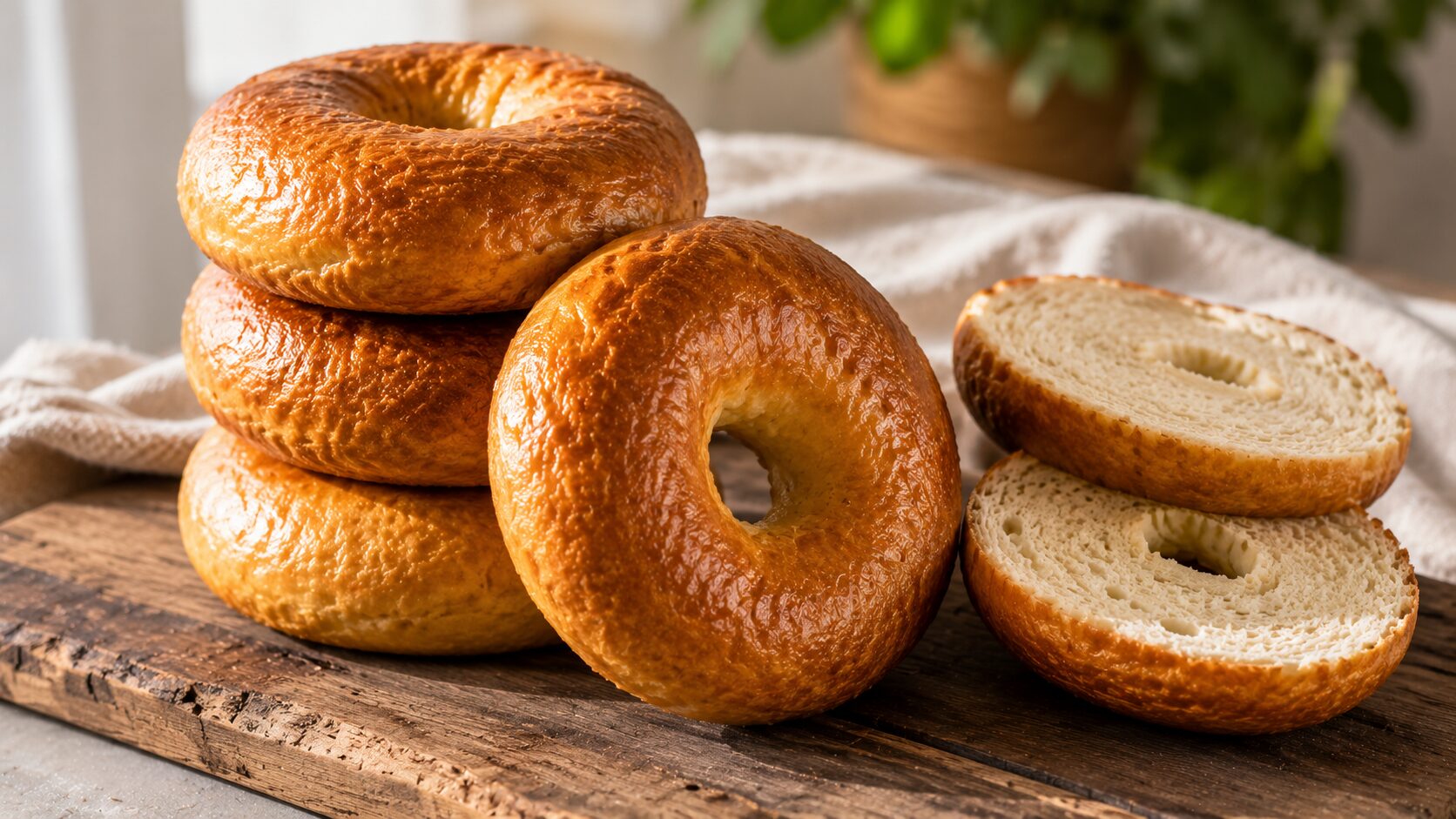
Carnivore bagels solve a problem most animal-based eaters run into fast: bread cravings that a plate of meat alone doesn’t fix. A real bagel — the kind you can slice, toast, and pile with eggs or smoked salmon — has always seemed off-limits without flour, yeast, or a proofing box.
Carnivore bagels get their chew and structure from melted cheese and eggs instead of flour and yeast — mozzarella provides the stretch, eggs provide the set, and a short, hot bake gives you a golden, sliceable ring with a real bagel bite. Get the cheese-to-egg ratio wrong, or bake at the wrong temperature, and you end up with something rubbery, flat, or hollow instead. This guide covers exactly why the method works, how to make decisions about ingredients and technique, and what to do when a batch doesn’t turn out the way you wanted.
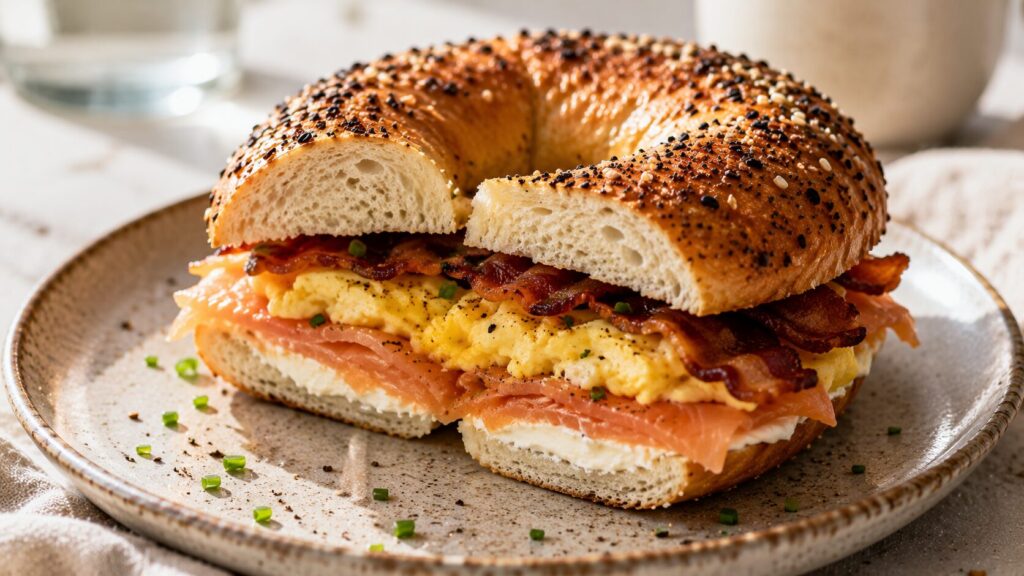
Table of Contents
Quick-View: Recipe Summary
| Metric | Full Batch (6 Bagels) | Per Bagel |
|---|---|---|
| Prep Time | 15 minutes | — |
| Cook Time | 18–22 minutes | — |
| Total Time | About 40 minutes | — |
| Yield | 6 bagels | 1 bagel |
| Calories | 1,740 kcal | 290 kcal |
| Protein | 132 g | 22 g |
| Fat | 126 g | 21 g |
| Carbs | 6 g | 1 g |
Macros are estimated from standard values for mozzarella, cream cheese, and eggs; your exact numbers will shift a little by brand.
Why Carnivore Bagels Behave Differently Than Traditional Bagels
The primary reason carnivore bagels feel different in the hand and in the mouth is that they’re built on melted cheese protein instead of gluten. That single swap changes almost everything about how the dough behaves, bakes, and holds together.
Traditional bagels get their dense chew from gluten — a stretchy protein network formed when flour is mixed with water and kneaded, then reinforced by boiling the shaped rings before baking. Carnivore bagels skip flour entirely, relying on melted mozzarella and eggs to form a pliable, workable dough that firms up as it bakes rather than through boiling. The texture lands in a similar place — chewy, dense, sliceable — but the mechanism getting you there has almost nothing in common with wheat baking.
| Traditional Bagels | Carnivore Bagels | |
|---|---|---|
| Structure source | Gluten network from wheat flour | Melted cheese protein and egg protein |
| Leavening | Yeast fermentation | None, or a small amount of baking powder |
| Pre-bake step | Boiled before baking | Baked directly, no boiling |
| Carbs per bagel | 40–50 g | Around 1 g |
| Chew source | Gluten elasticity | Melted cheese stretch |
Why They Don’t Need Yeast
Here’s what most people miss the first time they try this recipe: there’s no rise to wait for, and that’s not a shortcut — it’s simply how the structure works.
Yeast produces carbon dioxide through fermentation, and that gas needs a stretchy gluten network to get trapped inside, which is what gives wheat bread its rise over time. Carnivore bagels have no gluten network to trap gas in, so yeast would have nothing to push against even if you added it. Instead, this dough gets its shape almost entirely from how you form it by hand, and its slight lift in the oven comes from steam escaping the eggs and cheese as they heat, plus a small assist from baking powder if you choose to use it. That’s why shaping matters more here than in a yeasted dough — what you shape is close to what you get, since there’s no proofing stage to change the form afterward.
Protein Structure Explained: Why Egg Whites Create Structure
The real issue people run into with a first attempt is treating eggs like a binder alone, when they’re actually doing the majority of the structural work once the bagels hit the oven.
Egg proteins — most notably in the whites — unfold when heated, a reaction called protein denaturation, and then link together into a firm, connected network, known as protein coagulation. That network is what turns a soft, pliable dough into something with a real bite once it’s baked. Cheese contributes stretch while the dough is warm and workable, but it’s the egg protein setting around that structure that locks the final shape in place and keeps a baked bagel from collapsing back down once it cools.
In practical terms, this means the egg-to-cheese ratio is the single biggest lever you have over final texture. More egg relative to cheese gives you a firmer, more bread-like bite. More cheese relative to egg gives you a softer, stretchier bagel that’s closer to a baked cheese pull than a classic chew.
Why Cheese Changes Texture
Why this happens: not all cheeses melt and stretch the same way, and that difference shows up directly in your finished bagel.
Mozzarella has a naturally stretchy, elastic melt because of its moisture content and protein structure, which is exactly why it’s the standard base for this style of dough — it’s what gives a carnivore bagel its pull-apart chew. Cream cheese melts smoothly but without much stretch, contributing richness and a softer crumb rather than elasticity. Cottage cheese, once blended smooth, adds moisture and a milder flavor but very little of the stretch mozzarella provides, which makes it a supporting ingredient rather than a replacement for it.
| Cheese | Melt Behavior | Best Role in the Dough |
|---|---|---|
| Mozzarella | Stretchy, elastic, forms long strands when melted | Primary structural cheese — provides the chew |
| Cream cheese | Smooth, soft melt with little stretch | Adds richness and a softer crumb |
| Cottage cheese (blended) | Loose, moist, minimal stretch | Adds moisture; best used alongside mozzarella, not instead of it |
Choose mozzarella if you want a classic chewy bite. Choose a mozzarella-and-cream-cheese blend if you want a softer, richer bagel. Add blended cottage cheese if your dough feels dry and you want extra moisture without diluting the chew too much.
Which Mozzarella Works Best?
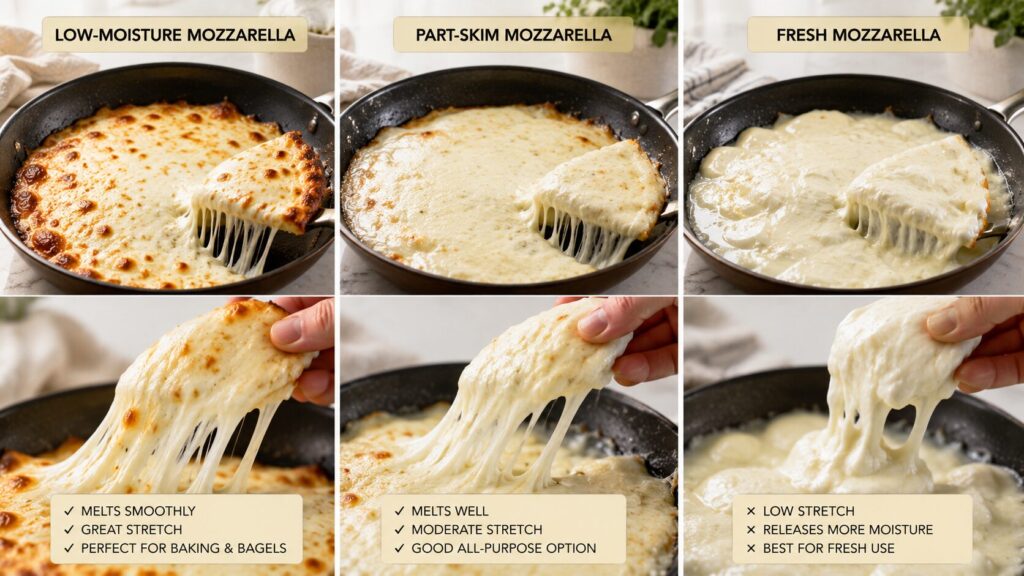
Not all mozzarella behaves the same once it melts. Low-moisture mozzarella creates the most stable dough because it contains less water and forms longer protein strands as it melts. Fresh mozzarella contains significantly more moisture, which can make the dough softer and more difficult to shape without adjusting the ingredient ratios.
| Mozzarella Type | Texture Result | Recommendation |
|---|---|---|
| Low-moisture Whole Milk | Chewy, stable | ⭐ Best Choice |
| Part-Skim | Slightly firmer | Very Good |
| Fresh Mozzarella | Softer, wetter dough | Use only with adjustments |
Best Fat Choices
The primary factor in choosing a fat here isn’t flavor — it’s how much moisture and richness your specific cheese blend already provides.
Full-fat cream cheese usually supplies enough fat on its own for a rich result, so most versions of this recipe don’t need an additional fat added. If you’re using a leaner cheese blend or want extra richness, a small amount of melted butter worked into the egg mixture adds moisture without affecting the cheese’s stretch. Avoid adding too much extra fat, though — an overly greasy dough is harder to shape by hand and can shed fat as it bakes, leaving an oily surface instead of a matte, bready crust.
Ingredients
- 2 cups (about 220 g) shredded mozzarella
- 3 oz full-fat cream cheese
- 2 large whole eggs, plus 1 egg for egg wash
- 1/2 tsp baking powder (optional — see the comparison below)
- 1/2 tsp fine sea salt
- Everything bagel seasoning or sesame seeds, for topping (optional)
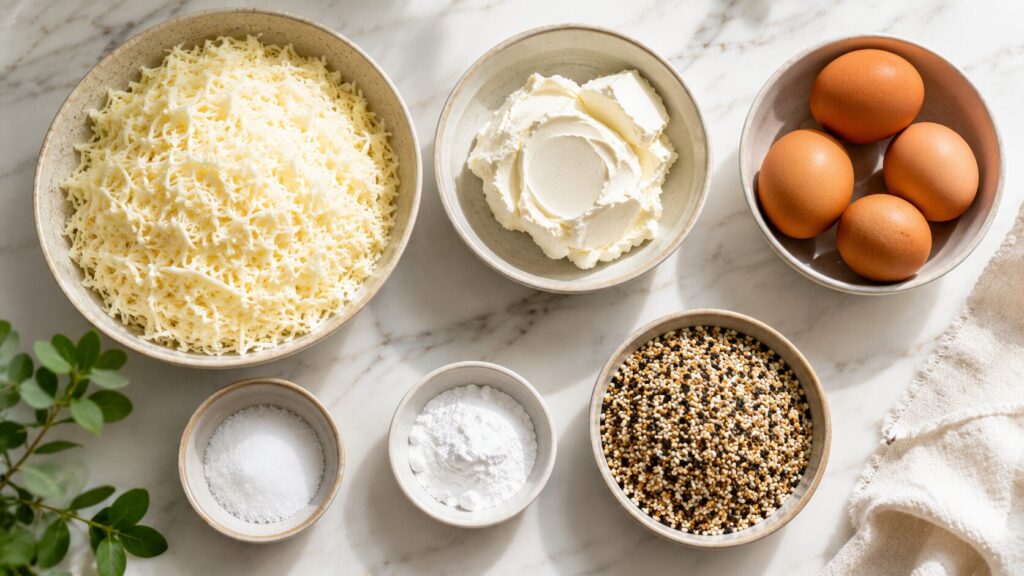
Whole eggs vs. egg whites is a genuine decision point here, not just a substitution. Whole eggs bring both structural protein and fat, giving you a richer flavor and a slightly softer crumb. Egg whites alone give you maximum structural protein with none of the added fat, producing a firmer, chewier, leaner bagel — closer in spirit to the structure you’d get from a high-protein egg white bread.
| Whole Eggs | Egg Whites Only | |
|---|---|---|
| Texture result | Softer, richer crumb | Firmer, chewier bite |
| Flavor | Fuller, more savory | Milder, cleaner |
| Fat content | Higher | Lower |
| Best for | Classic bagel texture | Leaner, higher-protein version |
Should You Shred Your Own Mozzarella?
Pre-shredded mozzarella is convenient, but it usually contains anti-caking agents that slightly reduce melt quality. Freshly shredded low-moisture mozzarella melts more smoothly and produces a more cohesive dough, making it the preferred option whenever possible.
Step-by-Step Instructions
- Preheat the oven to 400°F (204°C) and line a baking sheet with parchment paper.
- Melt the mozzarella and cream cheese together in a microwave-safe bowl in 30-second bursts, stirring between each, until fully smooth and stretchy.
- Whisk one whole egg, the salt, and the baking powder (if using) into the melted cheese quickly, while it’s still warm, until fully combined into a cohesive dough.
- Let the dough rest for 2–3 minutes until cool enough to handle, then divide it into 6 equal portions.
- Roll each portion into a ball, then poke a hole through the center with your finger and gently stretch it into a bagel shape, keeping the hole generously sized since it will shrink slightly during baking.
- Place the shaped bagels on the lined sheet, spaced apart, and brush each with beaten egg wash.
- Top with everything seasoning or sesame seeds if using, pressing gently so they adhere.
- Bake for 18–22 minutes, until deep golden brown on top and firm to the touch.
- Let the bagels cool on the sheet for at least 10 minutes before moving them to a wire rack to finish cooling completely.
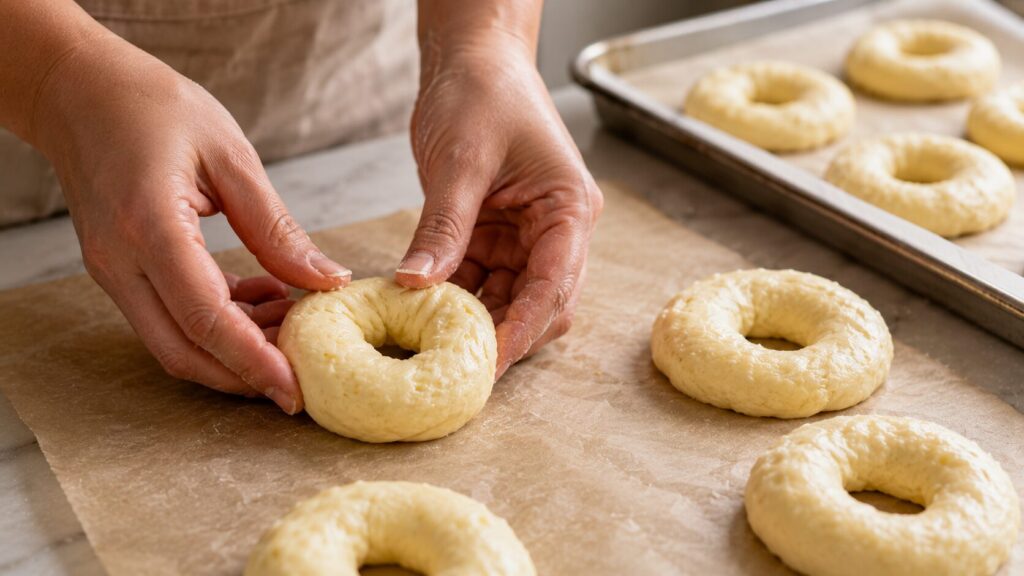
How to Know They’re Done Without Guessing
Instead of relying only on the timer, look for these visual signs:
- Deep golden brown surface
- Firm when gently pressed
- Bottom lightly browned
- Bagels lift easily from the parchment
- No soft or glossy spots remaining on top
If all five signs are present, your bagels are fully baked.
Baking Powder vs. No Leavening
The biggest mistake here is assuming baking powder does the same job it does in flour-based baking — in this dough, its effect is much smaller.
Baking powder gives a slight extra lift and a marginally lighter crumb, since it produces small gas bubbles as it bakes. Skipping it entirely still produces a fully functional bagel, since the majority of the structure comes from egg and cheese protein regardless — the difference is subtle, not dramatic. Use baking powder if you want a slightly lighter texture; skip it if you prefer the denser, more traditional bagel density some people associate with the “real” bite.
Silicone Mold vs. Baking Sheet
Here’s what most people miss: your shaping method affects more than convenience — it changes the final shape consistency.
A silicone bagel mold gives you uniform, evenly sized rings every time, which is useful if you’re making a large batch and want consistent bake times across every bagel. A parchment-lined baking sheet, shaped by hand, gives you more control over thickness and size but introduces more variation between bagels, which can mean slightly uneven bake times within the same batch. Hand-shaping on a sheet is the more forgiving option for a first attempt, since it’s easier to troubleshoot one bagel at a time; a mold is worth it once you’re baking larger, more consistent batches regularly.
Best Baking Temperature
The real issue with baking temperature here is the same one that shows up in most egg-and-cheese carnivore baking: too hot, and the outside sets before the inside catches up.
A 400°F (204°C) oven strikes the right balance for this recipe specifically — hot enough to brown the surface and firm the exterior in a reasonable time, but not so hot that the center stays underset by the time the crust is done. Going hotter to save a few minutes tends to produce a bagel that looks finished on the outside while staying soft and eggy in the middle.
Conventional Oven vs. Convection vs. Air Fryer
Different ovens transfer heat differently, which changes both texture and baking time.
| Method | Temperature | Notes |
|---|---|---|
| Conventional Oven | 400°F (204°C) | Best overall texture |
| Convection Oven | 375°F (190°C) | Reduce temperature slightly |
| Air Fryer | 375°F (190°C) | Check after 12–15 minutes |
Why Bagels Collapse, Turn Rubbery, or Go Hollow
The primary reason a batch fails almost always comes down to one of three specific mistakes, and each one has a distinct fix.
Collapse usually happens when the dough was overworked or handled while too warm, weakening the cheese’s stretch before it ever reached the oven — the fix is to let the dough cool briefly before shaping and to handle it gently rather than kneading it like bread dough. Rubberiness comes from overbaking, since egg protein tightens and pushes out moisture the longer it’s exposed to heat past the point it first sets — the fix is to pull the bagels as soon as they’re firm and golden, not after they’ve been in significantly longer “just to be sure.” Hollow centers happen when the dough was shaped with too thin a ring or when trapped air escaped unevenly during baking — the fix is to shape a slightly thicker ring than feels natural, since these bagels don’t rise the way yeasted dough does to fill in a too-thin shape.
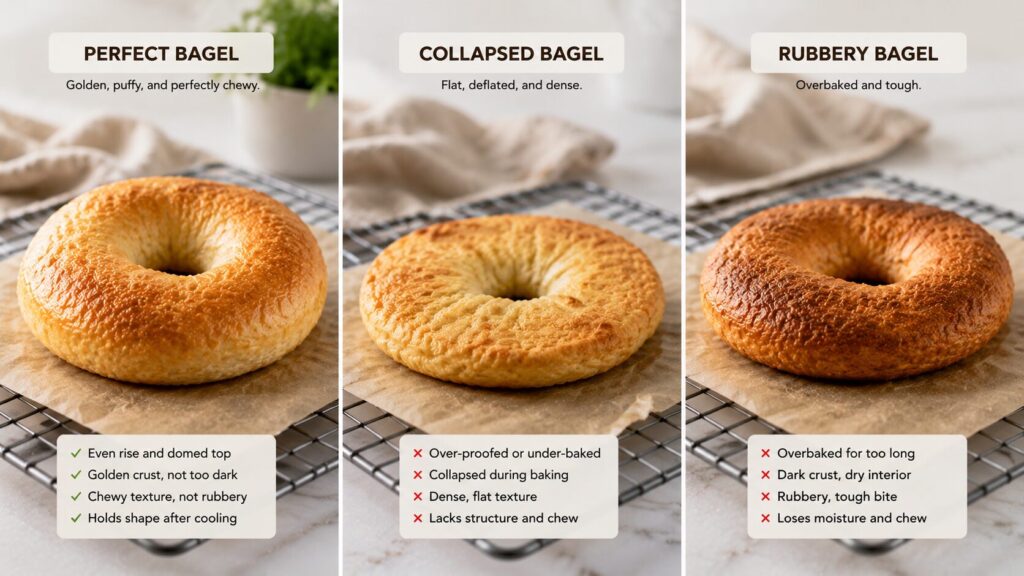
“A carnivore bagel gets its chew from cheese and its structure from eggs — lose either one, and the whole shape falls apart.”
Read Your Dough
| What You See | What It Means |
|---|---|
| Dough is stretchy and easy to shape | Correctly mixed while still warm — proceed |
| Dough is stiff and cracks when shaped | Cooled too much before shaping — rewarm briefly in the microwave for 10 seconds |
| Dough is greasy and hard to handle | Too much fat relative to protein — add a touch more cheese or egg next batch |
| Dough won’t hold a ring shape | Not enough egg mixed in, or dough too warm |
Read Your Finished Bagels
| What You See | What It Means |
|---|---|
| Deep golden top, firm to the touch | Properly baked — ready to cool |
| Pale top, soft center | Underbaked — return to the oven in 3-minute increments |
| Cracked, dark top | Oven too hot — lower temperature next batch |
| Sunken or collapsed shape | Dough was overworked, or bagels were moved before setting |
Read the Crust
The crust tells you almost everything about how the bake went.
| What You See | What It Usually Means |
|---|---|
| Thin golden crust | Perfect bake |
| Pale crust | Needs more baking |
| Very dark top | Oven too hot |
| Small surface cracks | Slight overbaking |
| Oily surface | Cheese released excess fat |
Best Cooling Method and Why Resting Matters
Why this happens: a bagel that looks finished the moment it leaves the oven hasn’t actually finished cooking.
Carryover cooking — the continued setting that happens from a bagel’s own retained heat — keeps firming up the interior for several minutes after baking ends. Cutting into a bagel immediately exposes a structure that’s still partly held together by heat rather than a fully set protein network, which is why a rushed slice can look gummier than the same bagel sliced ten minutes later. Resting the bagels on a wire rack, rather than leaving them on the hot baking sheet, also matters — a rack lets air circulate underneath, preventing trapped steam from softening the bottom crust.
Troubleshooting
| Problem | Cause | Fix |
|---|---|---|
| Bagels are flat | Dough was too warm and loose when shaped, or too little egg was used | Let dough cool slightly before shaping; don’t skimp on egg |
| Bagels are rubbery | Overbaked past the point of a firm, springy top | Pull bagels as soon as they’re golden and firm, not later |
| Bagels taste eggy | Egg-to-cheese ratio skewed too far toward egg | Use slightly less egg, or add a touch more cream cheese |
| Bagels are greasy on the surface | Too much fat in the mix, or oven too hot causing fat to separate | Reduce added fat; bake at 400°F (204°C), not higher |
| Bagels are hollow inside | Ring shaped too thin, or trapped air escaped unevenly | Shape a thicker ring than feels natural |
| Bottom crust is soggy | Cooled directly on the baking sheet instead of a rack | Always transfer to a wire rack to cool |
Ingredient → Function
| Ingredient | Function |
|---|---|
| Mozzarella | Provides stretch and chew through its melt behavior |
| Cream cheese | Adds richness and a softer crumb |
| Eggs | Provide the protein structure that sets the final shape |
| Baking powder | Adds a small amount of extra lift (optional) |
| Salt | Balances flavor across a protein-heavy dough |
Fresh vs. Frozen
Here’s what most people miss about freezing this style of bagel: the high fat and protein content actually holds up better in the freezer than a starch-based bagel does.
Fresh bagels, eaten within a day or two, have the best texture and the cleanest bite. Frozen bagels hold their shape and chew well for weeks, since there’s no starch structure to break down from ice crystal formation the way traditional bread suffers. Slice bagels before freezing so you can toast individual halves straight from frozen without thawing the whole batch first.
Room Temperature vs. Refrigerated
| Room Temperature | Refrigerated | |
|---|---|---|
| Best for | Same-day or next-day eating | Storage beyond 2 days |
| Texture effect | Stays closest to fresh-baked | Slightly firms the cheese structure |
| Recommended step before eating | None needed | Warm briefly or toast before serving |
Storage Guide
| Method | How Long It Stays Good |
|---|---|
| Airtight container, room temperature | 1–2 days |
| Airtight container, refrigerated | 5–6 days |
| Frozen, sliced | Up to 2–3 months for best quality |
Best Ways to Serve Carnivore Bagels
These bagels are versatile enough for much more than breakfast.
- Breakfast sandwiches with eggs and bacon
- Smoked salmon and cream cheese
- Garlic butter toasted bagels
- Mini carnivore pizzas
- Burger buns
- Meal-prep breakfast sandwiches
An Original Kitchen Observation
In my early batches, I kept losing the bagel-hole shape — it would shrink almost all the way closed by the time the bagels finished baking, leaving me with what looked more like a dense roll than a bagel. I assumed the dough was spreading too much, so I kept trying to shape a tighter, smaller hole to compensate, which only made the problem worse.
The actual fix had nothing to do with the hole size — it was that I was shaping the bagels while the dough was still too warm and loose, so the ring slowly slumped inward as it sat waiting for the oven to finish preheating. Letting the dough cool for a few extra minutes before shaping, so it held a firmer ring right from the start, solved it completely. If your bagels keep losing their hole shape, check your dough temperature before you touch your shaping technique.
Sandwich Ideas and Meal Prep
These bagels hold up well to real sandwich fillings, not just butter — toast a halved bagel and layer it with smoked salmon and cream cheese, scrambled eggs and bacon, or sliced roast beef for a genuinely filling, low-carb sandwich base. For meal prep, bake a full batch on a weekend, slice each bagel in half once cooled, and freeze the halves flat in a single layer before transferring to a bag — that way you can pull exactly the number of halves you need and toast them straight from frozen without waiting for a whole loaf to thaw.
Where This Fits in the Looksyumy Bread Hub
This same cheese-and-egg structural logic connects directly to a few other recipes worth knowing about if you’re building out a carnivore bread rotation. Our Carnivore Bread Rolls guide uses a different structural base — whipped egg foam instead of melted cheese — which is why that dough behaves so differently in the mixing bowl even though the final goal, a soft, sliceable bread, is similar. If you want the deeper reasoning behind egg-based structure specifically, without any cheese in the mix at all, our High Protein Egg White Bread guide breaks that mechanism down in detail. And if cheese-based structure is what interests you most, our Carnivore Cheesecake guide covers a related but distinct use of dairy protein — there, cream cheese sets through gentle heat into a custard rather than a chewy dough, which is a useful contrast if you want to understand how differently the same core ingredients can behave depending on technique.
Biggest Mistakes Beginners Make
Most first-time failures come from only a handful of mistakes.
- Using fresh mozzarella instead of low-moisture mozzarella
- Shaping the dough while it’s still too hot
- Making the center hole too small
- Baking longer instead of checking visual doneness
- Cutting the bagels before they finish cooling
Correcting just one of these mistakes often transforms the next batch completely.
FAQ
Can I freeze carnivore bagels?
Yes — they freeze especially well because there’s no starch to break down in the freezer. Slice them first and freeze the halves so you can toast individual portions straight from frozen.
Can I toast them?
Yes, and toasting is actually the best way to serve them once they’ve been refrigerated or frozen, since it re-crisps the exterior and warms the center back to a fresh-baked texture.
Can I make them dairy-free?
This specific recipe relies on mozzarella and cream cheese for its structure, so a fully dairy-free version isn’t a simple swap — you’d need to rebuild the dough around a different structural base, closer to an egg-white bread than a traditional bagel shape.
Can I make them without mozzarella?
Not easily. Mozzarella’s stretch is what gives this dough its bagel-like pull and chew; without it, you’d end up with something closer to a baked egg-and-cheese patty than a bagel.
Can I use cottage cheese?
You can add blended cottage cheese alongside mozzarella for extra moisture, but it can’t replace mozzarella entirely, since it doesn’t provide the same stretch.
Can I use egg white protein instead of whole eggs?
Yes — egg whites alone will give you a firmer, leaner, chewier bagel with less richness than the whole-egg version. It’s a reasonable swap if you’re optimizing for protein over flavor.
Why are my bagels flat?
This almost always comes down to shaping the dough while it was too warm, or under-measuring the egg. Let the dough firm up slightly before shaping, and don’t reduce the egg amount.
Why are they rubbery?
Overbaking is the most common cause. Pull them as soon as they’re golden and firm to the touch rather than baking “a little extra” out of caution.
Can I air fry them?
Yes — air fry shaped bagels at around 375°F (190°C) for roughly 12–15 minutes, checking a few minutes early since air fryers vary significantly in how they circulate heat.
Can I make mini bagels?
Yes — divide the dough into 10–12 smaller portions instead of 6, and reduce the bake time by about 5–7 minutes, checking for a firm, golden top as your doneness cue rather than relying on the original time.
Carnivore Bagels: The Complete Guide to Chewy, Sliceable, No-Carb Bagels
- Prep Time: 15 minutes
- Cook Time: 25 minutes
- Total Time: 40 minutes
- Yield: 6 bagels 1x
- Category: Bread
- Method: Baking
- Cuisine: Carnivore
- Diet: Carnivore Diet
Description
These Carnivore Bagels are chewy on the outside, soft on the inside, and made with simple animal-based ingredients. They’re perfect for breakfast sandwiches, burgers, or meal prep, offering a satisfying zero-carb alternative to traditional bagels without sacrificing texture or flavor.
Ingredients
– 2 cups (225 g) low-moisture mozzarella cheese, shredded
– 2 oz (56 g) full-fat cream cheese
– 2 large eggs, room temperature
– 1 tsp baking powder (optional, for a lighter texture)
– 1/4 tsp sea salt
– 1 tbsp everything bagel seasoning (optional, for topping)
– 1 egg, beaten (optional, for egg wash)
Instructions
1. Preheat the oven to 375°F (190°C) and line a baking tray with parchment paper.
2. Melt the mozzarella and cream cheese together in the microwave or over a double boiler until smooth.
3. Stir until fully combined, then let cool slightly.
4. Add the eggs, baking powder, and salt. Mix until a smooth dough forms.
5. Divide the dough into 6 equal portions.
6. Roll each portion into a rope and join the ends to create a bagel shape.
7. Place on the prepared baking tray.
8. Brush with egg wash and sprinkle with everything bagel seasoning if desired.
9. Bake for 20–25 minutes, or until golden brown and firm.
10. Allow the bagels to cool on a wire rack for at least 15 minutes before slicing.
Notes
– Use low-moisture mozzarella for the best chewy texture.
– Fresh mozzarella contains too much moisture and can create a soft, dense dough.
– Cooling completely helps the crumb finish setting.
– Store refrigerated for up to 5 days.
– Freeze for up to 3 months and toast directly from frozen.
Nutrition
- Serving Size: 1 bagel
- Calories: 255 kcal
- Sugar: 1 g
- Sodium: 420 mg
- Fat: 19 g
- Saturated Fat: 10 g
- Unsaturated Fat: 7 g
- Trans Fat: 0 g
- Carbohydrates: 2 g
- Fiber: 0 g
- Protein: 19 g
- Cholesterol: 105 mg
Final Thoughts
Two habits separate a consistently good batch of carnivore bagels from an inconsistent one: shaping the dough while it’s cool enough to hold its ring, and pulling the bagels the moment they’re golden and firm rather than baking past that point out of caution. Get those two details right, and everything else in this guide — the ratios, the cheese choice, the baking temperature — has already set you up to succeed. Once you’ve made a batch or two, you’ll be able to read your dough and your finished bagels well enough to adjust on the fly, no recipe required.