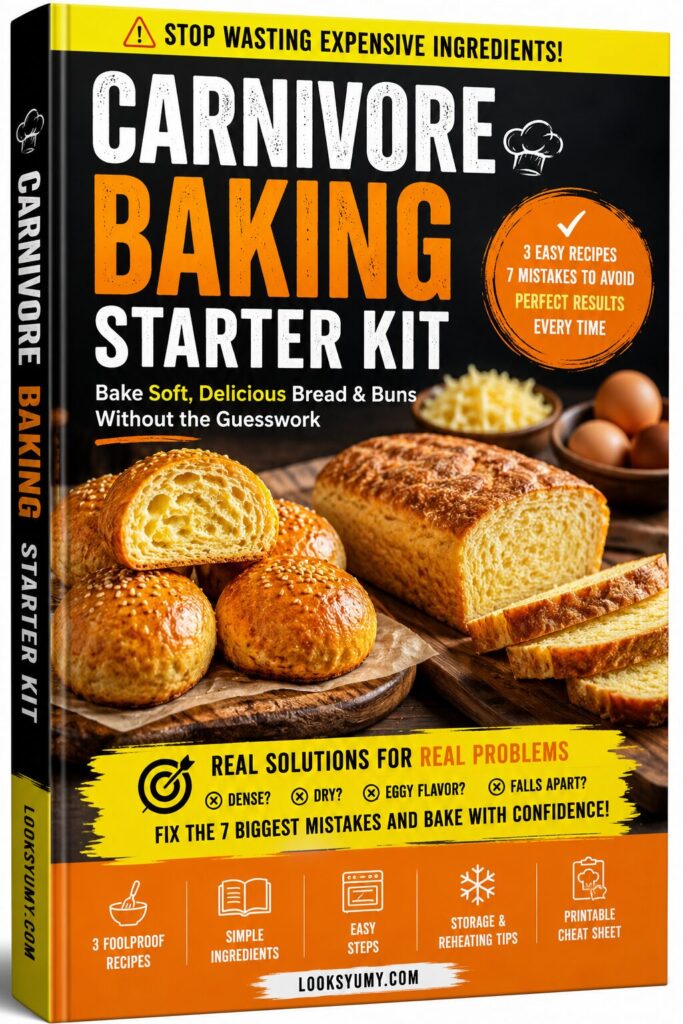
The Carnivore Baking Guide
Why your carnivore bread failsand what to change next
Dense. Gummy. Rubbery. Collapsed.
Stop guessing which ingredient to change. This 232-page guide helps you identify what went wrong and choose what to test next.
When bread looks right outside but fails inside, the answer isn’t always more baking time or another ingredient. Learn to read the signs, understand ingredient functions, and test one meaningful change at a time.
232 pages · Digital guide · Instant access
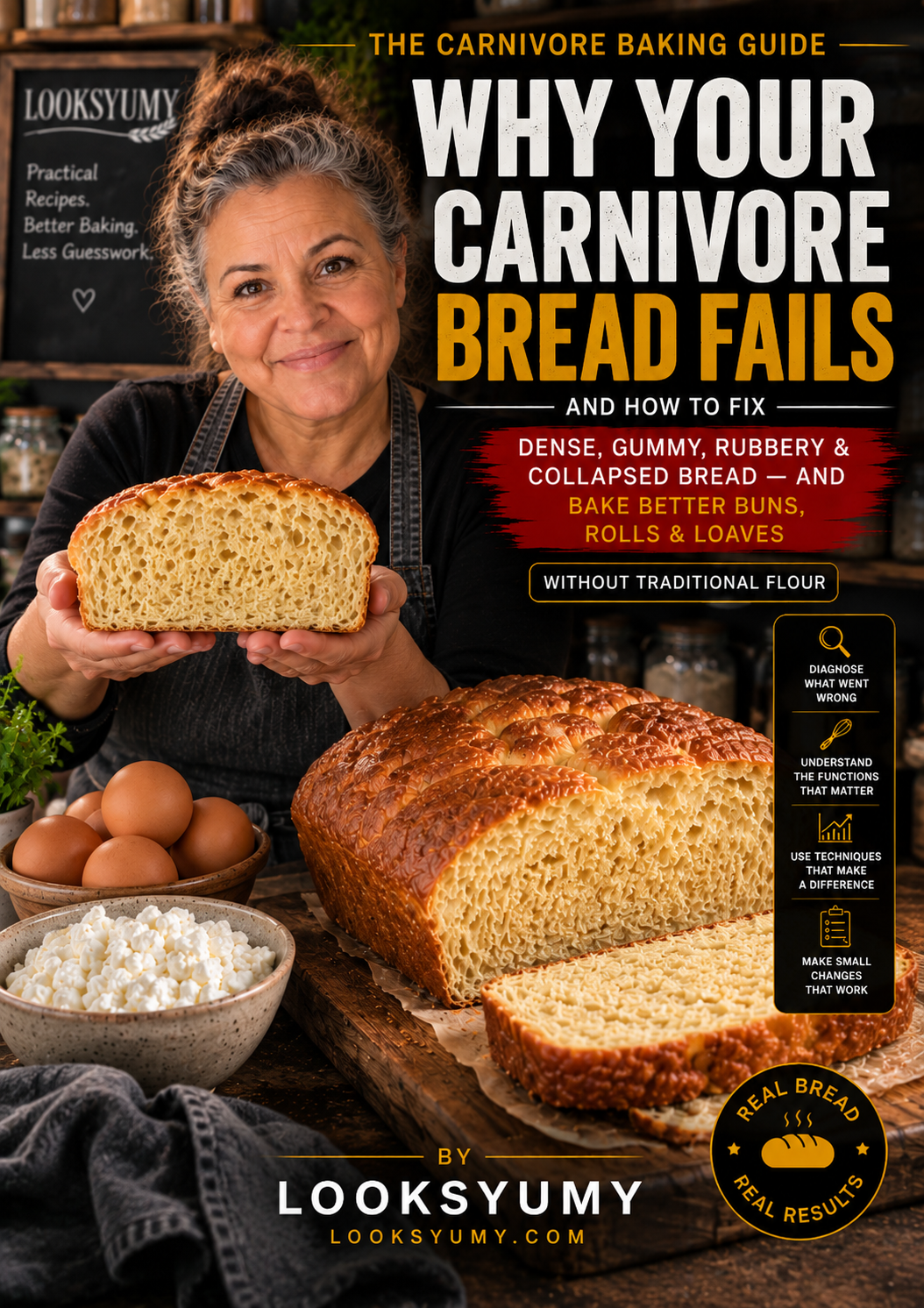
The Carnivore Baking Guide232-page digital guide · Instant access
Your bread can look perfect.
And still fail.
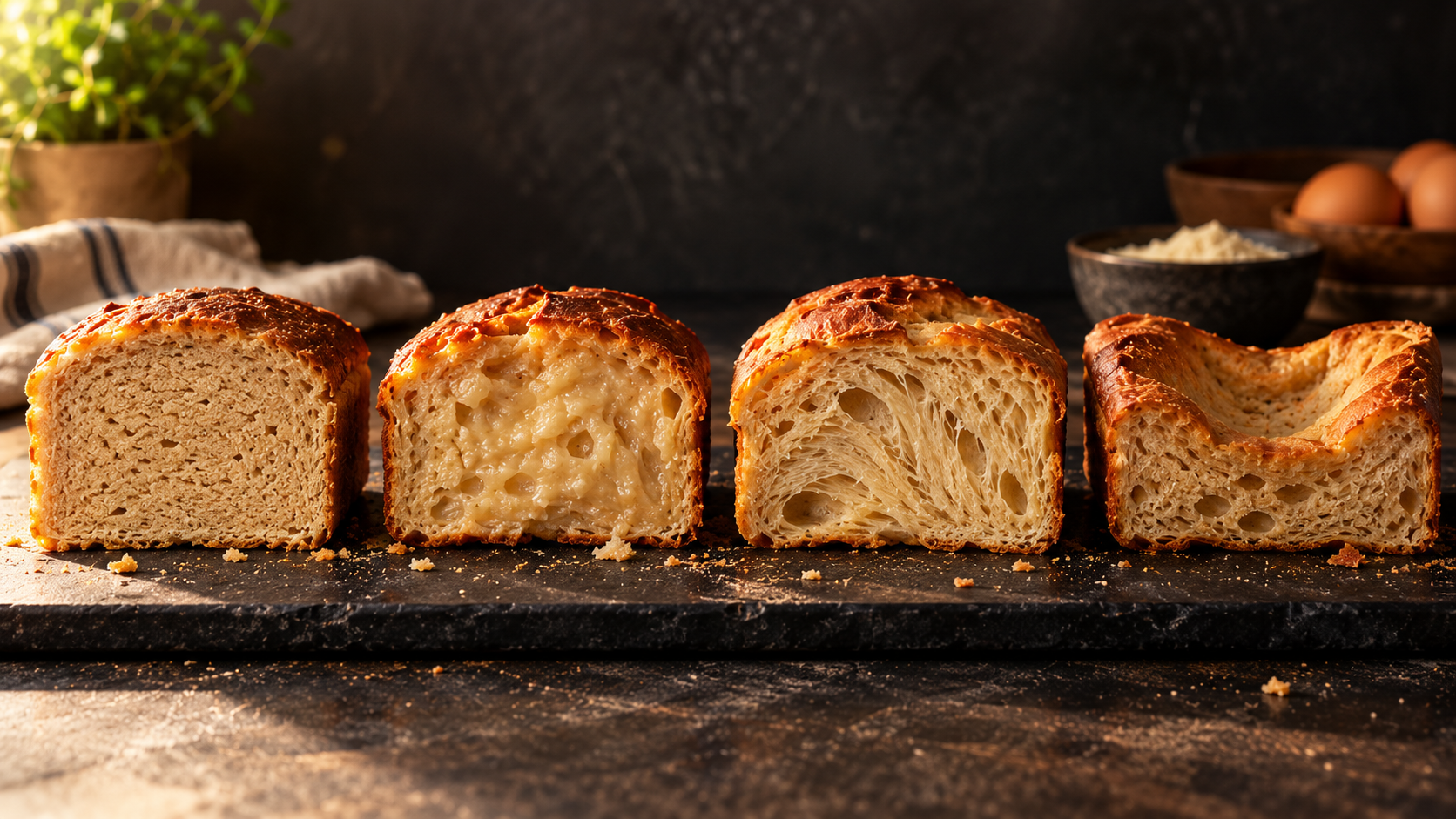
Dense
Heavy, compact crumb.
Gummy
Good-looking exterior. Wet or sticky center.
Rubbery
Springy, chewy, egg-forward texture.
Collapsed
Rises during baking, then sinks.
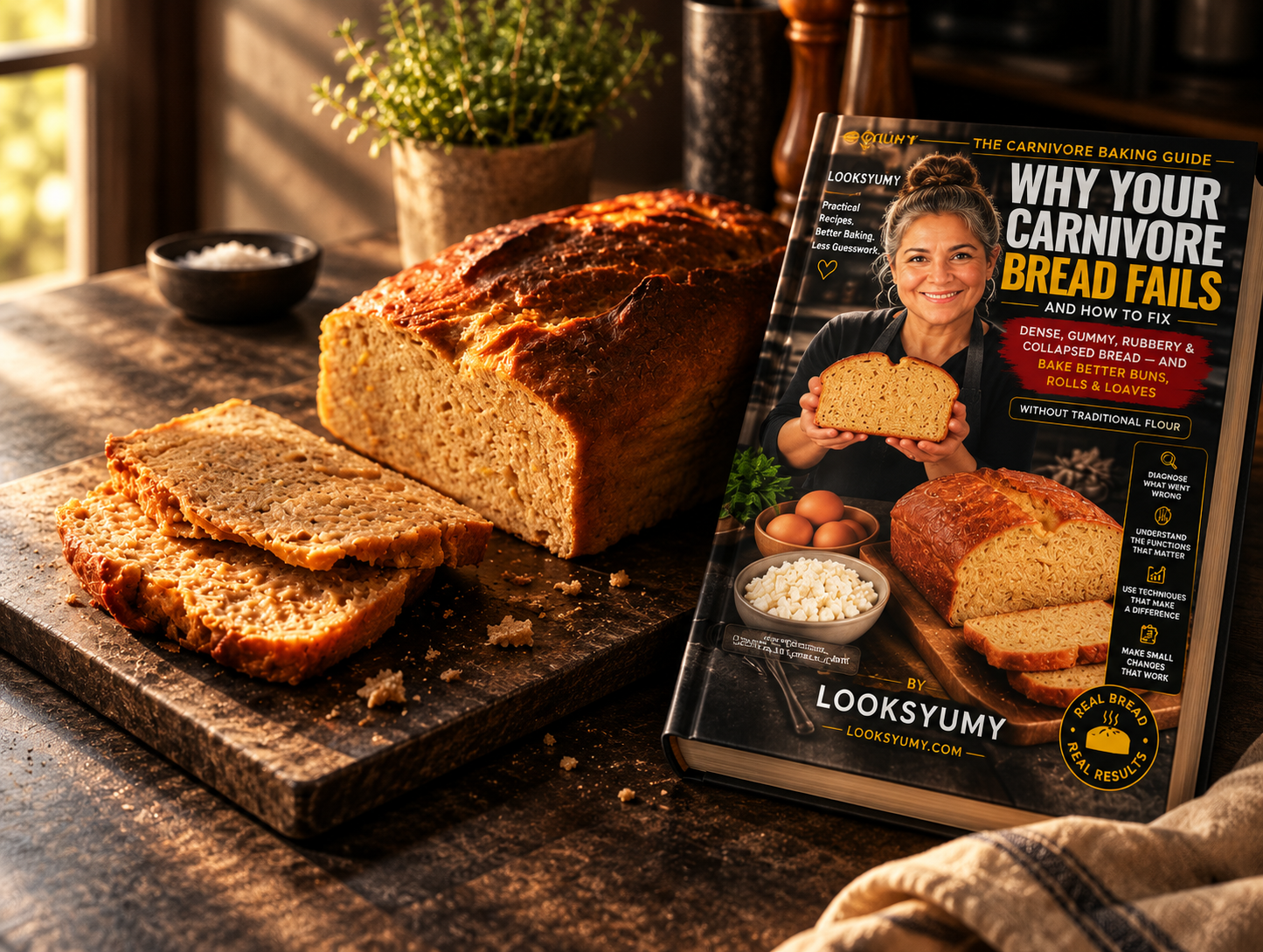
You followed the recipe. The ingredients looked right.
So why did the result still fail?
Because the same symptom can come from different causes. The guide helps you identify the failure pattern first, so you can stop guessing and choose a more targeted next step.
Stop guessing what went wrong.
Start diagnosing it.
When a carnivore bake fails, the instinct is often to add an ingredient, change the amounts, or try another recipe.
This guide gives you a repeatable way to look at the result first, identify the symptom, find the most relevant function, and test one meaningful change.
- Observe
- Classify
- Identify when it failed
- Form a hypothesis
- Change one variable
- Retest
You do not need another random fix. Get the diagnostic system you can return to.
Get the guide →Don’t ask: “What ingredient should I add?” Ask: “Which function isn’t working?”
That is the difference between following recipes and understanding your bake.
The guide teaches you to think in functions rather than simply memorizing ingredient lists, so you can make more informed changes when a result goes wrong.
Think in functions—not just ingredients.
Learn the system →See how the guide approaches a real baking failure.
Gummy is one recognizable failure pattern in carnivore baking.
But the symptom alone does not give you the answer. The useful question is what happened, when it happened, and which function may have failed.
Gummy is only one symptom.
The same diagnostic system can be used across dense texture, poor rise, collapse, rubbery texture, dryness, weak structure and other common carnivore baking failures.
Know what went wrong.
Know what to test next.
Understand the failure
See what changes when traditional flour and starch are removed — and why familiar baking assumptions no longer always apply.
Diagnose the symptom
Recognize the failure pattern before you start changing the formula.
Know what each ingredient is doing
Understand what eggs, cheese, fats, binders, dairy ingredients and leavening can contribute to the formula.
Control structure & aeration
Understand how volume is created — and why creating lift is not the same as holding it.
Control moisture & texture
See how moisture and fat influence crumb, tenderness, richness and stability.
Test with a clear process
Make controlled adjustments instead of changing several variables at once — so you can learn from the result.
Know what to look for when a bake goes wrong.
Get the guide →Stop thinking of ingredients
as just ingredients.
An ingredient is not defined only by what it is.
It is also defined by the job it is performing in the formula.
- Structure
- What is holding the shape?
- Aeration / Volume
- What is creating volume?
- Moisture
- Where is the water coming from, and where is it going?
- Fat / Tenderness
- What is creating richness and tenderness?
- Binding / Cohesion
- What keeps the finished product together?
Understand the job each part of the formula is doing.
Explore the guide →When your bake fails,
know exactly where to start.
Start with what you can observe.
Then narrow the problem down.
Then investigate the most relevant category.
Then test one meaningful change.
The flowchart gives you a starting point. From there, the guide helps you investigate the most relevant causes, test one meaningful change, and learn from the result.
A clearer next step starts with a better diagnosis.
Get instant access →See what you’re actually getting.
These are real pages from the 232-page guide — including diagnostic tools, troubleshooting references and ingredient-function pages.
Swipe to browse the pages. Tap a page to enlarge it.Select any page to enlarge it.
Page 7How to read a carnivore loafLearn what the crumb can tell you about the result. Page 19The diagnostic systemA structured process for investigating what went wrong. Page 22Failure diagnostic guideStart with the symptom and narrow down the possibilities. Page 23Failure diagnostic guideContinue the diagnostic process with the relevant failure patterns. Page 24Master troubleshooting matrixA quick-reference system for connecting symptoms to possible causes. Page 27Quick diagnostic flowchartKnow where to start when a bake doesn’t go as planned. Page 31Ingredient functionsUnderstand what each ingredient is actually doing in the formula.
These are real pages from the guide. The complete system goes further.
Get the complete guide →From guessing to troubleshooting
Stop guessing. Start knowing what to test.
BEFORE
- “Maybe I need more eggs?”
- Change several ingredients at once.
- Guess why the loaf collapsed.
- Bake another batch and hope.
- Save random fixes without knowing what worked.
WITH THE GUIDE
- Ask which function is failing.
- Classify the symptom you can actually see.
- Identify when the failure happened.
- Make one meaningful change.
- Retest with a reason behind the change.
The goal is not to promise a perfect bake every time. It is to give you a better way to understand a failed bake and decide what to investigate next.
Make your next test more intentional—not more complicated.
Start troubleshooting →232 pages built around one goal: less guesswork.
Part I — Understanding the system
- Chapter 1
Why Carnivore Baking Fails
Understanding what changes when traditional flour is removed and why common failures happen.
- Chapter 2
The Carnivore Baking Diagnostic System
How to identify what went wrong before making random changes.
- Chapter 3
The Ingredient Function Guide
Understanding the roles of eggs, cheese, fats, binders, dairy solids, and leavening.
- Chapter 4
Structure & Aeration
How to create volume and, more importantly, how to help the bake hold that volume.
Part II — Controlling the bake
- Chapter 5
Moisture, Fat & Texture Control
Understanding the balance between moisture, richness, tenderness, and stability.
- Chapter 6
Carnivore Bread Troubleshooting: A Symptom-by-Symptom Fix Guide
How to diagnose and fix common bread problems, symptom by symptom.
- Chapter 7
The Techniques That Make the Biggest Difference
The preparation, mixing, and baking techniques that most affect the final result.
- Chapter 8
The Carnivore Bread Formula System
How to build a recipe from function, not just from a list of ingredients.
Part III — Building better recipes
- Chapter 9
Recipe Adjustment & Testing
How to make controlled changes instead of guessing.
- Chapter 10
The Carnivore Bread Troubleshooting System
A practical diagnostic system for reading what a failed bake is telling you.
- Chapter 11
Practical Carnivore Bread, Bun & Roll Recipes
Putting the principles into practice with everyday recipes.
- Chapter 12
The Carnivore Baking Quick-Reference Guide
Cheat sheets, troubleshooting tables, testing worksheets, and practical reference tools.
A practical reference to return to when a bake fails.
View the guide →Understand the system.
Then put it into practice.
The guide doesn’t stop at theory.
Chapter 11 puts the principles into practical carnivore bread, bun and roll recipes.


Recipes are included—alongside a system for understanding the results.
Get the guide →If you’ve ever cut into a bake and thought, “What went wrong?”
- Your carnivore baking results are inconsistent.
- Your bread turns dense or heavy.
- Your center stays gummy or wet.
- Your bake becomes rubbery or overly eggy.
- Your bread rises and then collapses.
- Your loaf is dry or crumbly.
- Your bake falls apart when sliced.
- You keep changing several things at once and still don’t know what actually helped.
- You want a more systematic way to troubleshoot your baking.
If these problems sound familiar, this guide was built for your troubleshooting process.
See the guide →The complete troubleshooting system
The Carnivore Baking Guide
232-page digital guide
See current price on checkout
- Diagnose the problem before changing the recipe. Carnivore baking diagnostic system
- Know what each ingredient is actually doing. Ingredient function guide
- Structure & aeration guidance
- Moisture, fat & texture guidance
- Start with the symptom you can see. Symptom-by-symptom troubleshooting
- Formula system
- Test one meaningful change at a time. Recipe adjustment & testing
- Practical bread, bun & roll recipes
- Quick-reference tools and worksheets
This is not another recipe PDF you read once and forget.
It is a reference system you can return to whenever a bake goes wrong.
Get the Carnivore Baking Guide
232 pages · Digital guide · Instant access
Questions, answered.
What is The Carnivore Baking Guide?
The Carnivore Baking Guide is a digital guide from Looksyumy for understanding, diagnosing and troubleshooting carnivore baking. It covers ingredient functions, structure and aeration, moisture, fat and texture, symptom-by-symptom troubleshooting, a formula system, recipe testing, and practical bread, bun and roll recipes.
Is this just a recipe book?
No. Recipes are part of the guide (Chapter 11), but the core of it is a system: observe the result, classify the symptom, identify when it failed, form a hypothesis, change one variable and retest.
What baking problems does the guide cover?
The guide works through dense or heavy bread, gummy or wet centers, rubbery or chewy texture, dry or crumbly texture, flat or poor rise, collapse after rising, bread that falls apart, overly eggy results, and bread that is overbrowned outside but underdone inside.
How does the troubleshooting system work?
The guide treats symptoms as clues, not guaranteed diagnoses. You observe the result, classify it, identify when it failed, form a hypothesis, change one variable and retest. It also asks you to consider which function is not working: structure, aeration and volume, moisture, fat and tenderness, binding and cohesion, or baking.
How many pages is the guide?
The guide is presented as a 232-page digital guide.
What format do I receive?
It is a digital guide delivered through Gumroad after checkout. Check the Gumroad product page for the exact file format and download details.
Can I read it on a phone or tablet?
Because it is a digital guide, it is meant to be read on a screen. How comfortable a phone or tablet is depends on your device and reader app. Larger screens may be easier for tables and flowcharts. Check the Gumroad page for file details.
Is this useful if I already have carnivore recipes?
Yes. The guide is designed to help you understand and troubleshoot recipes you already use, not simply replace them with another fixed recipe. When a bake fails, the goal is to understand what happened and what to test next.
Is this only for beginners?
No. The guide is useful whether you are still learning carnivore baking or already have recipes that sometimes work and sometimes fail. The focus is on diagnosis, controlled testing and understanding ingredient functions.
Does the guide guarantee baking results?
No. Results depend on your ingredients, equipment, oven and technique. The guide gives you a structured way to investigate and test a bake. It does not promise identical results in every kitchen.
Ready to stop guessing what to change next?
Get the Carnivore Baking Guide →Stop guessing.
Start knowing what to change.
Stop wasting batches on random changes.Understand what went wrong.Know what to test next.
Get the Carnivore Baking Guide
Digital guide · Instant access