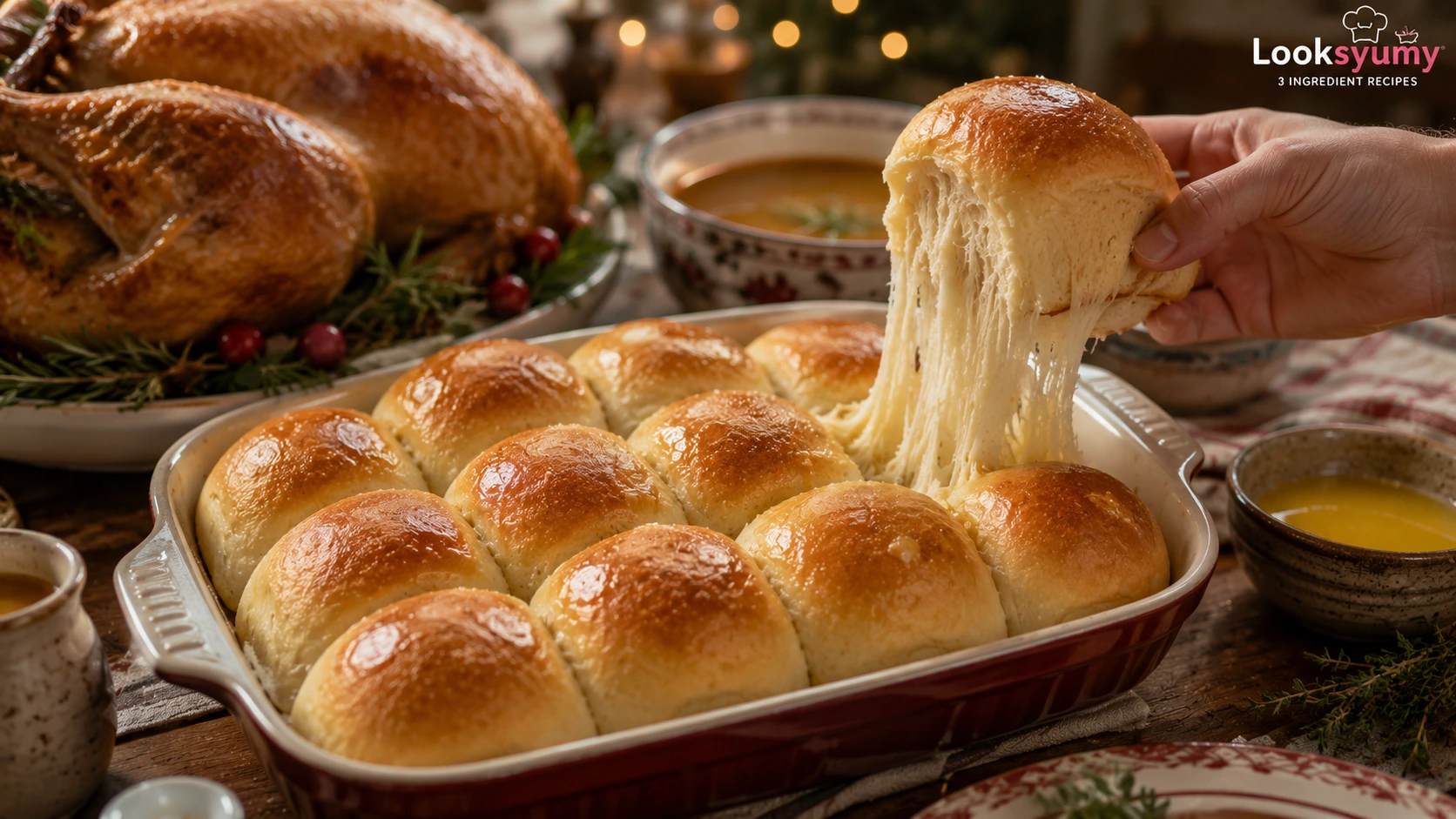
There’s a specific kind of isolation that sets in when everyone else at the holiday table is passing a basket of rolls and you’re not. Watching butter melt into someone else’s dinner roll while your plate has nothing to soak up the gravy or hold a bite of turkey together is one of the quieter frustrations of an animal-based lifestyle — small, but it adds up over every holiday meal.
To bake carnivore dinner rolls that stay soft, rich, and pillowy without a single plant starch, build the dough around a fat-and-egg emulsion rather than dry protein alone, shape it into small individual balls, and nest those balls close together in a baking dish so they steam each other soft as they rise. That close-contact steaming is the mechanical core of what I call the Looksyumy Soft Crumb Protocol — a method I built after one too many holiday seasons pulling rubbery, flat, or dried-out rolls out of the oven right before guests arrived. This is that fix, and it holds up under the higher demands of a festive table.
If you’re looking for an everyday version outside the holiday season, these soft carnivore bread rolls use the same whipped-egg foundation while baking as individually portioned rolls instead of a pull-apart holiday batch.
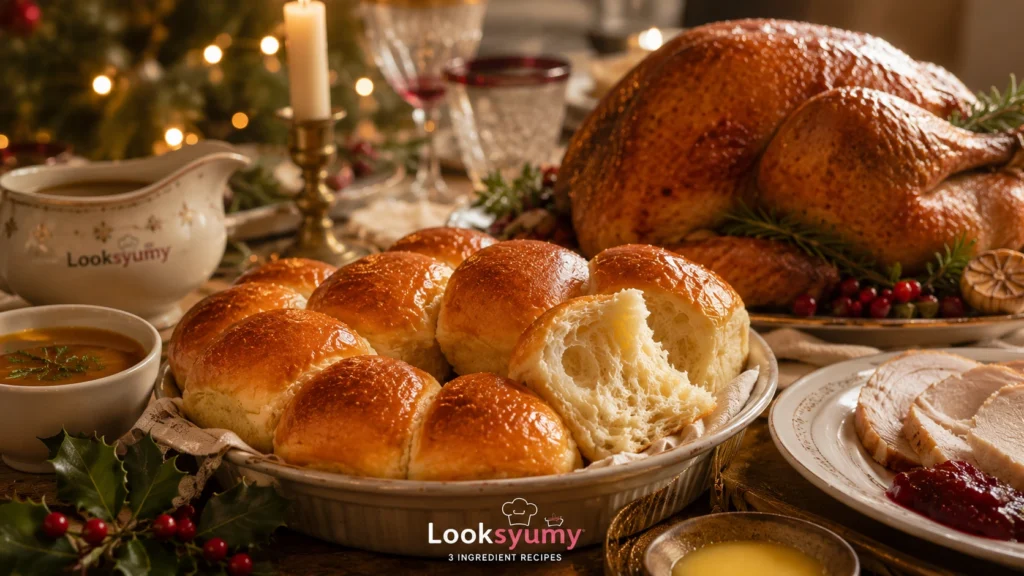
Table of Contents
The Soft Crumb Protocol, Step by Step
The Soft Crumb Protocol isn’t a single trick — it’s three sequential decisions that each protect the same thing: trapped moisture.
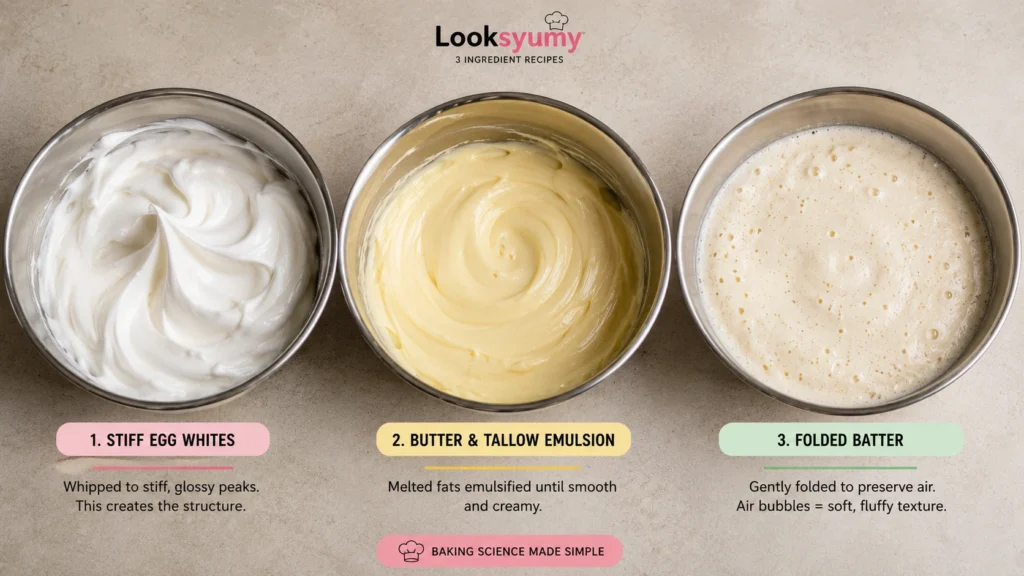
- Foam first. Whip the egg whites to a stable, unweighted peak before any fat touches them, so the protein network sets its air pockets before anything can compress them.
- Emulsify before you fold. Pre-blend every gram of fat into the yolk-and-solids mixture, so fat never makes direct contact with the whipped foam until it’s already suspended in a stable base.
- Cluster to steam. Nest the shaped rolls so they touch, turning the gaps between them into small humid pockets that slow surface moisture loss during the bake.
Skip any one of these three and the crumb tightens — this order is what makes the results repeatable rather than a matter of luck.
The success of this method also depends on achieving the right carnivore dough consistency, since a batter that’s too loose spreads before baking while one that’s too thick limits expansion.
Quick-View: Holiday Serving & Macros
| Metric | Per Festive Batch (14 Rolls) | Per Individual Roll |
|---|---|---|
| Prep Time | 18 minutes | — |
| Bake Time | 24–27 minutes | — |
| Yield | 14 rolls | 1 roll |
| Calories | 1,190 kcal | 85 kcal |
| Protein | 91 g | 6.5 g |
| Fat | 84 g | 6 g |
| Carbs | 1.4 g | 0.1 g |
Macros are estimated from standard values for egg white solids, whole eggs, and grass-fed butter; exact totals will shift slightly depending on the brands you use.
The Master Recipe
Print
Description
These soft carnivore dinner rolls are rich, fluffy, and perfectly pull-apart without flour or plant-based ingredients. Built around the Looksyumy Soft Crumb Protocol, they use a stable egg foam, a butter-and-tallow emulsion, and clustered baking to create tender holiday rolls that stay moist from the first bite to the last.
Ingredients
– 5 large egg whites, room temperature
– 3 large whole eggs, room temperature
– 1/3 cup (32 g) egg white solids (egg white protein powder)
– 4 tbsp grass-fed butter, melted and cooled
– 2 tbsp melted tallow
– 1/2 tsp cream of tartar
– 3/4 tsp fine sea salt
– 2 tbsp melted butter for brushing
– Flaky sea salt (optional)
Instructions
– Preheat oven to 320°F (160°C).
– Butter a 9×13-inch baking dish.
– Whip egg whites with cream of tartar until firm glossy peaks form.
– Whisk whole eggs, butter, tallow, egg white solids, and salt until fully emulsified.
– Fold a spoonful of whipped whites into the yolk mixture.
– Gently fold the remaining egg whites into the batter in three additions.
– Divide into 14 equal dough balls.
– Arrange the rolls so their sides gently touch.
– Brush with melted butter and sprinkle lightly with flaky sea salt.
– Bake for 24–27 minutes until deep golden.
– Brush again with melted butter immediately after baking.
– Cool for several minutes before serving.
Notes
The Looksyumy Soft Crumb Protocol relies on three key steps: building a stable egg foam, emulsifying the fats before folding, and baking the rolls touching one another so they create shared steam pockets. Avoid overmixing after folding, and never add warm fat directly to whipped egg whites.
Nutrition
- Serving Size: 1 roll
- Calories: 85
- Sugar: 0.1 g
- Sodium: 165 mg
- Fat: 6 g
- Saturated Fat: 3.6 g
- Unsaturated Fat: 2.1 g
- Trans Fat: 0 g
- Carbohydrates: 0.1 g
- Fiber: 0 g
- Protein: 6.5 g
- Cholesterol: 72 mg
Ingredients
- 5 large egg whites, room temperature
- 3 large whole eggs, room temperature
- 1/3 cup (about 32 g) egg white solids (egg white protein powder)
- 4 tbsp grass-fed butter, melted and cooled to just above room temperature
- 2 tbsp tallow, melted and cooled to just above room temperature
- 1/2 tsp cream of tartar
- 3/4 tsp fine sea salt, plus a pinch for topping
- 2 tbsp grass-fed butter, melted, for brushing before and after baking
Key Ingredients & Their Role
| Ingredient | What It Is | Why It’s In This Recipe |
|---|---|---|
| Egg white solids | Dehydrated, powdered egg white protein | Concentrates structural protein without adding extra liquid, keeping the batter thick enough to hold a domed shape |
| Cream of tartar | An acidic salt (potassium bitartrate) | Slightly lowers the pH of the egg whites, helping the proteins unfold and set into a more stable, less brittle foam |
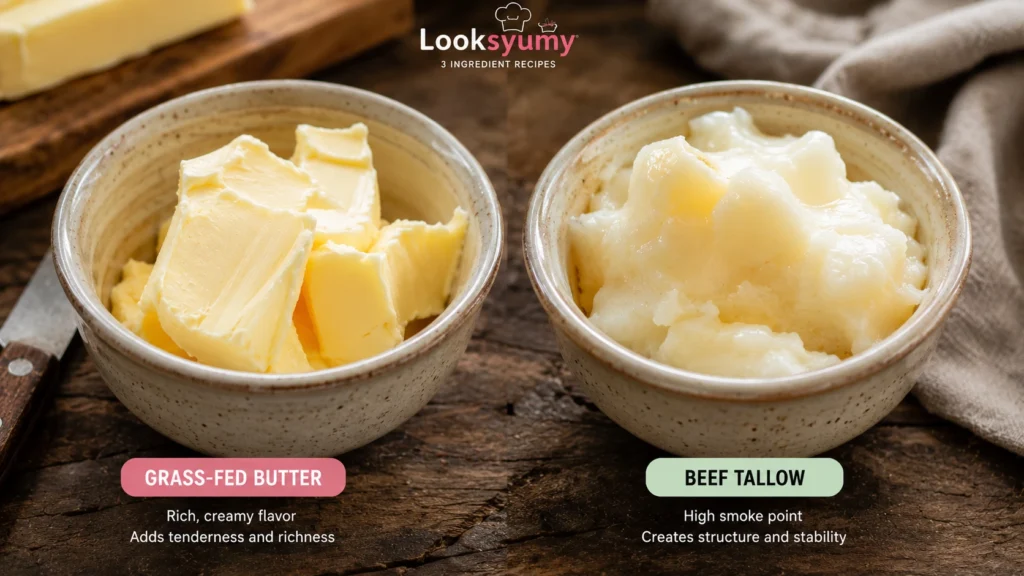
| Grass-fed butter | A dairy fat that’s roughly 80% fat, 15–16% water | The water content converts to steam during baking, which helps keep the interior tender rather than dry |
| Tallow | Rendered beef fat, almost entirely pure fat with no water | Adds richness and heat stability without diluting the batter, which is why it’s blended alongside butter rather than replacing it |
| Sea salt | Unrefined mineral salt | Beyond flavor, salt tightens the egg white foam slightly — one reason it’s whisked into the yolk mixture instead of beaten directly into the whites |
Which Fat Blend Should You Choose?
| If your goal is… | Best fat blend | Why |
|---|---|---|
| Soft holiday dinner rolls | More butter than tallow | Butter releases steam during baking, helping the crumb stay tender. |
| Rolls for sandwiches | Equal butter and tallow | Better structure with a soft interior. |
| Meal prep or freezing | Slightly more tallow | Improves stability after chilling and reheating. |
| Rich holiday flavor | Butter + tallow together | Combines buttery moisture with beef-fat structure. |
When Butter Isn’t the Best Choice
Butter creates the softest crumb when rolls are served immediately after baking. For meal prep, transport, or freezing, increasing the proportion of tallow slightly helps the rolls retain their shape during storage and reheating. The best fat choice depends on how the rolls will be served—not simply on flavor.
Directions
- Preheat the oven to 320°F (160°C). Butter a 9×13-inch baking dish generously, including the sides — this is what lets the rolls pull apart cleanly later instead of tearing.
- In a large, grease-free bowl, whip the egg whites with the cream of tartar until they hold a firm, glossy peak that stands upright without curling over. This foam is the skeleton the rest of the dough hangs on, so don’t stop early.
- In a separate bowl, whisk the whole eggs, melted butter, tallow, egg white solids, and sea salt until fully smooth — you’re building an emulsion here, so keep whisking until no streaks of fat are visible.
- Fold a spoonful of the whipped whites into the egg-and-fat mixture first, to loosen it. Then fold this loosened mixture back into the remaining whipped whites in three gentle additions, using a scooping motion until just combined.
- Using a spoon or a portion scoop, divide the dough into 14 equal mounds, each about the size of a golf ball. Roll each gently between your palms to smooth the surface into a dome.
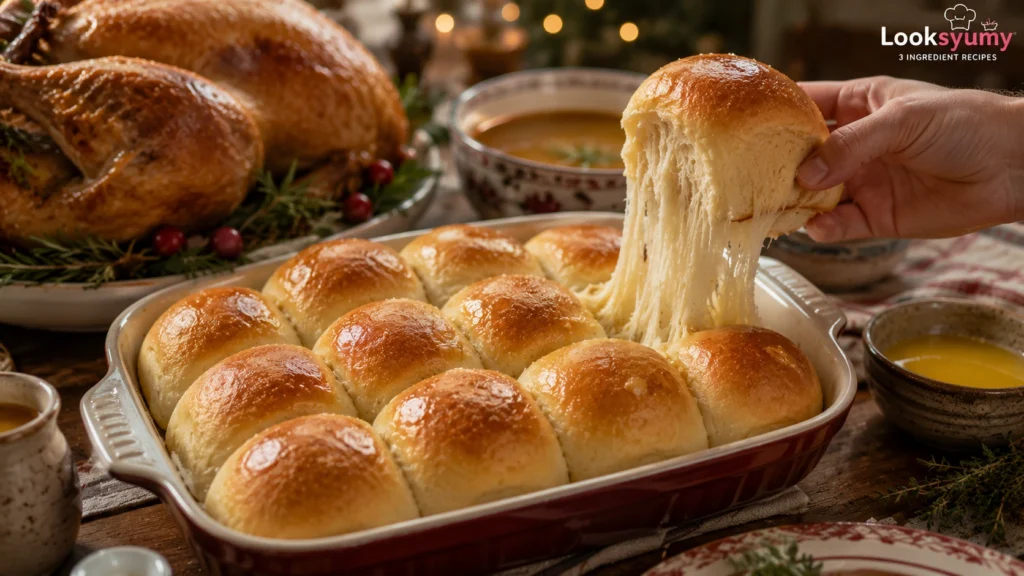
- Arrange the dough balls in the buttered baking dish so their sides just touch one another — this close spacing is what produces the classic pull-apart holiday roll effect.
- Brush the tops with melted butter and sprinkle with a pinch of sea salt.
- Bake for 24–27 minutes, until the tops are deep golden and the rolls spring back firmly when pressed.
- Brush the hot rolls with a second light coat of melted butter as soon as they come out of the oven — this keeps the exterior supple instead of setting into a hard shell as it cools.
A pattern I’ve noticed across dozens of holiday batches: rolls baked in a glass or ceramic dish come out with a noticeably softer touching-side crumb than the same recipe baked in a dark metal pan, because glass and ceramic heat and release heat more gradually. If your rolls keep browning before the centers finish, switching pan material — not just lowering the oven temperature — is often the faster fix. I’ve also noticed that egg whites separated straight from the refrigerator whip to a smaller, less stable foam than whites that have sat out for about twenty minutes; cold proteins unfold more slowly, so cold whites need noticeably longer beating time to reach the same peak.
What Changes If You Modify the Recipe?
| Change | Expected Result |
|---|---|
| Increase butter | Softer crumb but weaker structure if overdone. |
| Increase tallow | Richer flavor and firmer texture. |
| Under-whip egg whites | Dense, low-volume rolls. |
| Over-whip egg whites | Dry, fragile foam that’s difficult to fold. |
| Bake above 320°F | Faster browning and drier crumb. |
| Space the rolls apart | Crispier crust with less pull-apart softness. |
Before You Troubleshoot, Check These Four Variables
Most texture problems are caused by one of four factors—not the recipe itself.
- Foam stability
- Fat emulsification
- Roll spacing
- Oven temperature
Identifying the correct variable first usually fixes the problem faster than changing ingredients.
Ingredient Science: Making a Holiday Soft Crumb Possible
The primary factor behind a rubbery carnivore roll is a protein network with nothing to interrupt it. When egg proteins are left to coagulate on their own, they tighten into a dense, chewy mesh — fine for a firm bread, but not what you want holding a holiday table together.
Introducing a precise fat emulsion changes that outcome directly. Butter and tallow fat molecules physically wedge themselves between the egg proteins as they set, preventing the protein strands from linking into a tight, uniform mesh. The result is a crumb with more give — visually, you’ll see finer, more irregular air pockets in a cross-section of the roll, instead of the tight, uniform holes you get from egg protein baked without fat interference. The scaffolding itself comes from the whipped egg whites, where mechanical beating unfolds the proteins and lets them trap air at the surface of each bubble — a foam-forming process that has been documented in food science research on egg white protein structure, where the strength of that trapped-air network is what ultimately determines whether a bake holds its shape or falls flat.
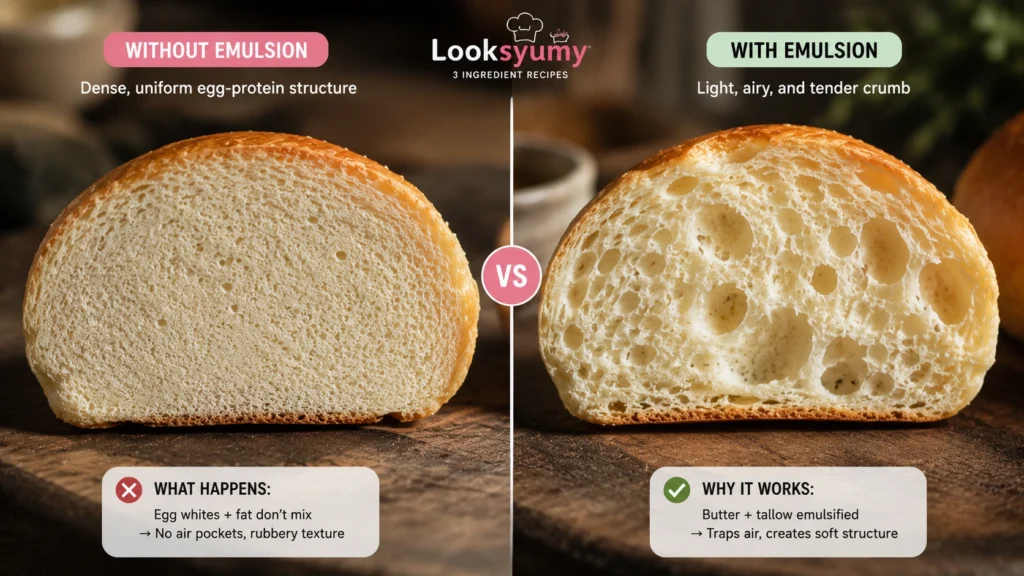
In my early kitchen trials, my holiday rolls turned out flat or rubbery because I was adding melted fat directly into the whipped egg whites instead of pre-blending it into the yolk-and-solids mixture first. The fat would pool at the bottom of the bowl and deflate the foam on contact, so the finished rolls set into a tight, chewy texture with almost no rise. Pre-emulsifying the fat with the whole eggs and egg white solids before it ever touches the whipped whites was the single change that fixed it — the fat gets distributed evenly through the batter instead of collapsing the air structure that’s supposed to carry it.
“A stable foam protects moisture better than extra fat ever can.”
How Each Ingredient Builds the Final Texture
| Ingredient | Main Function |
|---|---|
| Egg whites | Build the air structure. |
| Egg white solids | Strengthen the protein network. |
| Butter | Adds steam and softness. |
| Tallow | Improves stability and richness. |
| Cream of tartar | Stabilizes whipped egg foam. |
| Salt | Strengthens overall structure and balances flavor. |
Nesting the rolls so their sides touch does more than create a pull-apart shape — it changes the humidity immediately surrounding each roll. Every touching pair creates a small pocket of trapped steam between them, which slows evaporation on that side of the dough exactly where direct oven air would otherwise dry it out fastest. Rolls baked with open space on all sides lose moisture evenly across their whole surface; rolls baked touching lose moisture unevenly, and the touching sides finish noticeably softer than the exposed tops — which is also why brushing the tops with butter matters more than brushing the sides.
Butter and tallow behave differently once they hit oven heat, and that difference is worth understanding rather than treating the two as interchangeable. Butter is roughly 80% fat and 15–16% water, so as it heats, that water converts to steam inside the crumb, reinforcing the same moisture-retention effect the whipped egg foam is already providing. Tallow, by contrast, is close to pure fat with essentially no water, so it contributes richness and a cleaner mouthfeel but does none of that steam work. That’s the practical reason this recipe blends the two rather than choosing one: butter for moisture, tallow for structure and a higher smoke point that keeps the exterior from over-browning before the interior finishes.
| Fat | Water Content | Primary Job in the Crumb |
|---|---|---|
| Grass-fed butter | ~15–16% | Converts to steam during baking, reinforcing interior moisture |
| Tallow | Near 0% | Adds richness and heat stability without diluting the batter |
If your goal is maximum moisture instead of pull-apart texture, heavy cream carnivore bread uses a richer dairy-based formula designed for soft sandwich slices rather than dinner rolls.
“Moisture retention in an egg-based bread has less to do with how much fat you use, and more to do with when that fat is introduced.”
Read Your Rolls Like a Baker
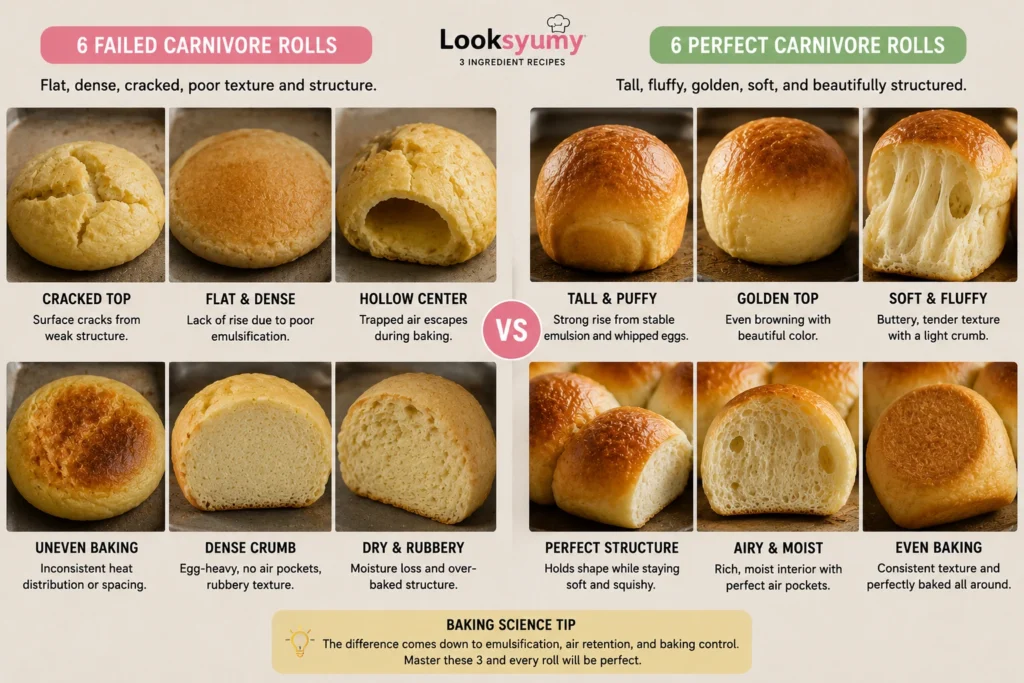
| What You See | Most Likely Cause |
|---|---|
| Tight air bubbles | Batter overmixed. |
| Large uneven holes | Foam under-folded. |
| Flat tops | Weak whipped egg foam. |
| Dry edges | Oven too hot. |
| Pale tops | Insufficient browning or no butter finish. |
| Wrinkled crust | Cooled too quickly. |
Troubleshooting & Diagnostics
| Problem | Root Cause | Kitchen Fix |
|---|---|---|
| Rolls dry out too fast under high heat | Oven temperature set too high, causing the surface to set and dehydrate before the center finishes | Bake at 320°F (160°C) rather than a higher holiday-oven temperature, and tent loosely with foil if the tops brown too quickly |
| Rolls flatten before or during baking | Egg whites were under-whipped, or the fat mixture was folded in too roughly, collapsing the trapped air | Whip whites to a firm peak first, and fold gently in three additions rather than stirring the mixtures together |
| Rolls lose their dome shape | Fat mixture was too warm when combined with the whipped whites, thinning the batter before it could hold structure | Cool melted butter and tallow to just above room temperature before whisking into the egg mixture |
| Dense, chewy texture instead of a soft crumb | Fat wasn’t fully emulsified into the egg mixture before folding, so the proteins set without enough interruption | Whisk the fat, whole eggs, and egg white solids until completely smooth with no visible fat streaks before folding in the whites |
| Tops brown unevenly | Rolls were spaced too far apart in the baking dish, exposing more surface to direct heat | Nest the dough balls so their sides touch, which shields them from direct heat and promotes even browning |
| Rolls stick together in a way that tears when separated | Baking dish wasn’t buttered thoroughly enough between the rolls and along the pan walls | Butter the dish generously, including the sides, so the rolls release cleanly along their touching edges |
| Rolls taste noticeably eggy | Egg white solids and whole eggs are both concentrated with nothing starchy to dilute the flavor | Increase the tallow-to-butter ratio slightly, or add an extra pinch of sea salt, which mutes egg-forward flavor without changing the structure |
Which Version Should You Bake?
| Situation | Best Choice |
|---|---|
| Holiday dinner | Pull-apart dinner rolls. |
| Everyday meals | Individual bread rolls. |
| Burgers | Carnivore burger buns. |
| Sandwiches | Carnivore sandwich bread. |
| Batch cooking | Double recipe in one larger baking dish while keeping rolls touching. |
Expanding the Bread Entity: Shifting from Rolls to Loaves
The real issue with scaling a holiday roll recipe up into a full loaf is that the close-contact steaming effect that makes rolls pull-apart soft disappears once the dough is baked as one solid mass. A technique built around small, touching mounds doesn’t translate directly to a loaf pan, because a loaf loses that shared surface area between individual portions.
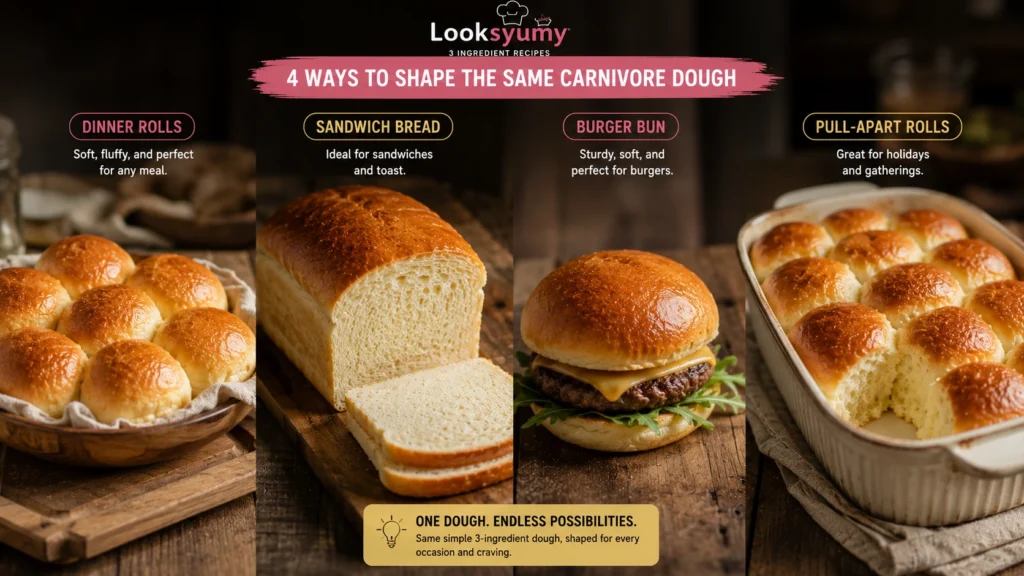
The same foundational technique also adapts well into carnivore sandwich bread, where a longer bake and a slightly different fat balance create slices sturdy enough for everyday sandwiches.
These holiday dinner rolls sit inside a broader Carnivore Bread Hub built on the same fat-emulsion, whipped-egg foundation, adjusted for whatever the meal calls for. A standalone bread roll — meant to be eaten on its own rather than pulled from a shared dish — uses a slightly wider spacing and a firmer fold so it holds an independent shape. A full loaf needs a longer, lower bake with the fat ratio slightly reduced, since a loaf’s thicker mass holds heat differently than a cluster of small rolls and can turn dense in the center if the emulsion is too rich. If your holiday gathering runs larger than usual, this same base recipe scales up cleanly by doubling the batter and using a bigger dish, keeping the rolls touching at the same close spacing so the pull-apart texture holds regardless of batch size.
How This Recipe Fits the Carnivore Bread Family
| Recipe | Best Use |
|---|---|
| Holiday Dinner Rolls | Holiday meals and family dinners. |
| Bread Rolls | Everyday serving. |
| Burger Buns | Burgers. |
| Sandwich Bread | Lunch sandwiches. |
| Bread Loaf | Toast and meal prep. |
This egg-foam approach solves the same structural problem gluten normally solves in traditional bread — trapping gas so the crumb rises instead of collapsing — but through a different mechanism. Wheat bread traps carbon dioxide from yeast inside a stretchy gluten network; this recipe traps air mechanically beaten into egg whites inside a coagulated protein network instead. Neither is leavening in the strict sense, since there’s no fermentation or gas-producing reaction happening — which is why the size of your rise is capped by how much air you beat in up front, not by how long the dough sits.
“In an egg-based bread, the rise happens before the oven, not during it.”
That distinction carries across the whole Carnivore Bread Hub: any loaf, bun, or roll built on this base gets exactly as much lift as its foam had going in, so the mixing bowl — not proofing time — is where the real work happens.
Five Rules That Never Change
- Always whip the egg whites before introducing fat.
- Always emulsify butter and tallow before folding.
- Never overmix after the foam is incorporated.
- Bake touching rolls when maximum softness is the goal.
- Let the rolls cool gradually before separating them.
FAQ
Can I make the dough ahead of time for busy holiday prep?
Yes — mix and fold the dough up to a day ahead, then cover the bowl tightly and refrigerate it unshaped. Shape the dough into balls and bake them fresh, since chilled batter loses some of its whipped structure once it sits, and shaping right before baking preserves more of the rise. If you need to prep even further ahead, bake the rolls fully, cool them completely, and freeze them; frozen items stay safe to eat indefinitely when kept at a consistent 0°F (-18°C), though the USDA’s food safety guidance notes that quality — not safety — is what limits how long you’d want to keep them frozen.
What’s the best way to reheat these rolls and restore the warm, buttery center?
Wrap them loosely in foil and warm in a 300°F (149°C) oven for about 8 minutes, then brush with a little more melted butter as they come out. The gentle, indirect heat re-softens the crumb without drying the exterior the way a microwave tends to.
How do I scale the batch size up for a larger holiday gathering?
Multiply every ingredient by the same factor and use a larger baking dish so the rolls can still nest with their sides touching — that close spacing is what drives the pull-apart texture, so resist the urge to spread a bigger batch across two pans. If you do need to split the batch across dishes, keep each dish’s rolls tightly nested rather than thinning them out to fill more space.
Why do carnivore dinner rolls sometimes taste noticeably eggy?
It usually comes down to ratio rather than a flaw in the method — egg white solids and whole eggs both concentrate egg flavor with nothing starchy present to dilute it. A slightly higher tallow-to-butter ratio, or an extra pinch of salt, mutes that flavor without changing the crumb structure.
Can I make this recipe dairy-free by using only tallow instead of butter?
You can, but expect a slightly denser result, since tallow carries almost no water content to convert into steam during baking. If you go tallow-only, brush the tops with a little extra melted tallow both before and after baking to help compensate for the moisture butter would normally have contributed.
Where a Visual Would Strengthen This Guide
Egg white foam stages (soft peak vs. firm peak vs. over-whipped) — best placed alongside Direction step 2. “Firm, glossy peak” is a visual judgment call that’s hard to standardize in words alone, and a side-by-side comparison would resolve the single most common failure point in this recipe faster than text can.
Cross-section comparison: fat-emulsified crumb vs. plain egg-protein crumb — best placed in the Ingredient Science section. Showing the finer, irregular air pockets described there next to a tighter, uniform-holed crumb would make the fat-interruption explanation immediately legible without asking the reader to picture it.
Nested vs. spaced roll layout in the baking dish — best placed alongside Direction step 6 and echoed in the Troubleshooting table. An overhead diagram of touching versus spaced rolls would clarify the steam-pocket mechanism far faster than the surrounding paragraph alone.
Diagnostic photo grid for the Troubleshooting table — one small reference image per failure mode (cracked skin, flattened roll, hollow center, uneven browning) would let a reader match their result by sight, which is typically faster than reading through root causes one at a time.
Butter vs. tallow texture and color comparison at room temperature — best placed next to the fat comparison table. Readers unfamiliar with rendered tallow specifically benefit from seeing its texture and color contrasted with butter before working with it for the first time.