
Moist carnivore bread with heavy cream powder stays soft because rehydrated dairy fat disperses evenly through whipped egg foam, helping the loaf retain moisture while maintaining structure during baking.
If you’ve baked a few carnivore loaves already, you know the usual result: something that looks like bread but eats like a dry sponge, or worse, like slightly savory cardboard by the second day. The primary factor behind that dryness is almost never the eggs themselves — it’s a lack of fat and moisture locked into the crumb during the bake, which is exactly what a properly hydrated heavy cream powder is built to fix.
That’s the whole idea behind what I call the Recovery Density Principle: rehydrate the cream powder fully before it goes anywhere near the egg foam, then bake at a lower, steadier heat so the loaf sets around that moisture instead of driving it back out. Get those two things right — proper rehydration and a gentler bake — and you get a loaf with a genuinely soft, moist crumb instead of the dry, airy texture most carnivore bread is known for.
If you’d rather make individual portions instead of a full loaf, the same moisture-retention technique works beautifully for heavy cream powder carnivore buns, where balancing fat and trapped air is just as important for achieving a soft crumb.
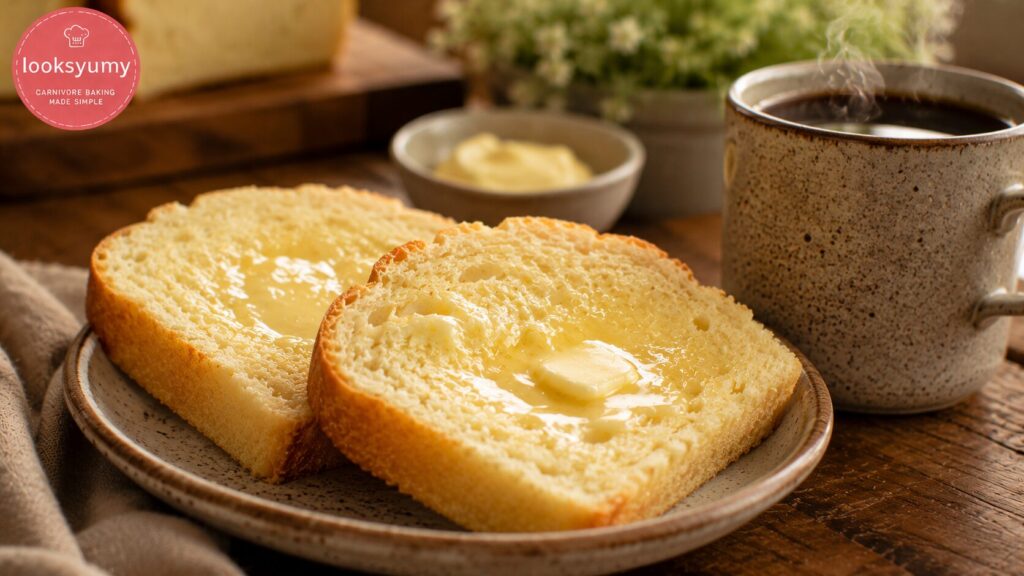
Table of Contents
Table of Contents
Quick-View Comparison & Macros
| Standard Dry Carnivore Loaf | Looksyumy Heavy Cream Soft Loaf | |
|---|---|---|
| Prep Time | 10 minutes | 15 minutes |
| Bake Time | 35 minutes | 42 minutes |
| Calories | 48 per slice | 76 per slice |
| Protein | 6g per slice | 6g per slice |
| Fat | 1.5g per slice | 5g per slice |
| Carbs | 0.5g per slice | 1g per slice |
The Master Recipe
Ingredients
- 8 large egg whites (or 1 cup liquid egg whites)
- ¼ tsp cream of tartar
- 4 whole eggs
- ½ cup heavy cream powder
- ⅓ cup warm water (for rehydrating the cream powder)
- ¾ tsp salt
- Butter, tallow, or lard, for greasing the loaf pan
At Looksyumy, moist bread isn’t created by adding more fat. It’s created by keeping moisture inside the structure from the first fold to the final slice.
Step-by-Step Directions
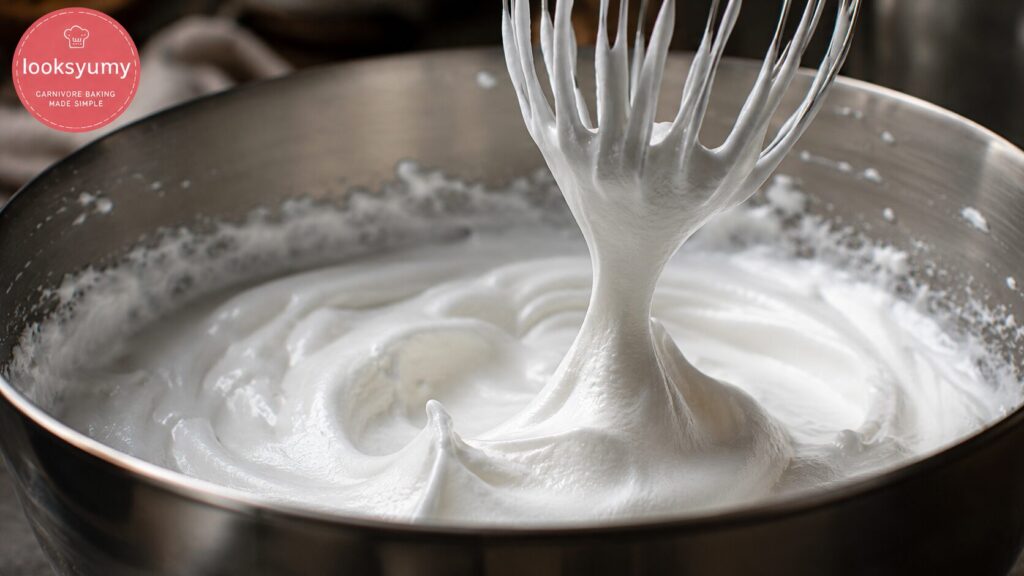
Whip the whites first. Beat the egg whites with the cream of tartar until they hold stiff, glossy peaks. This foam is what will trap moisture as the loaf bakes, so don’t stop until the peaks stand straight up when you lift the whisk.
Rehydrate the cream powder completely. Whisk the heavy cream powder into the warm water until it’s fully smooth, with no dry lumps left, then whisk in the whole eggs and salt. Skipping this step and adding the powder dry is the single most common reason loaves end up with dense, greasy streaks instead of an even crumb.
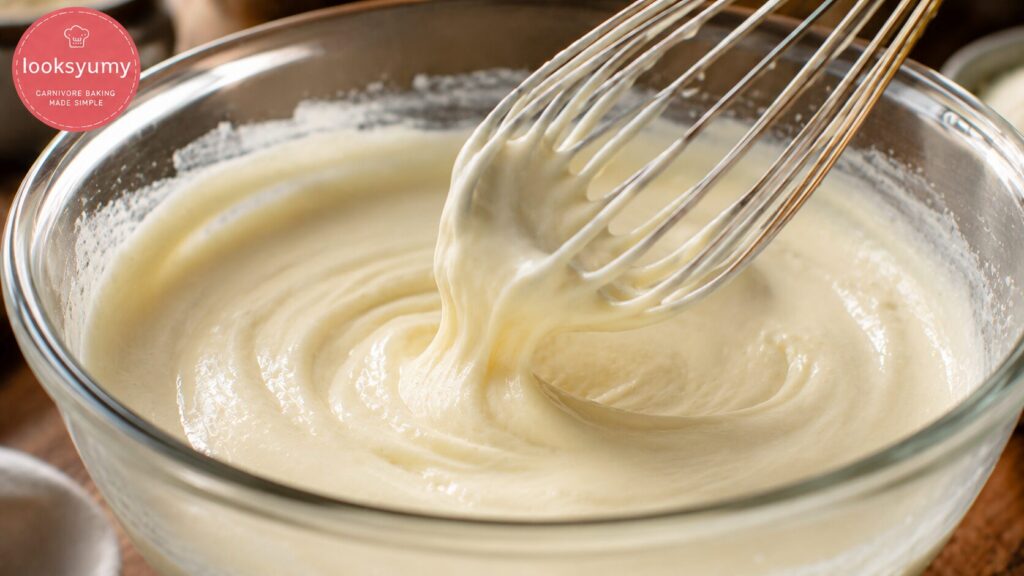
Fold in stages. Stir about a third of the whipped whites into the cream mixture to loosen it, then fold that back into the remaining whites in two or three gentle additions, turning from the bottom of the bowl up. Stop as soon as the streaks disappear — overworking the fold here is what flattens the loaf before it even reaches the oven.
Bake low, then rest before slicing. Pour into a greased loaf pan and bake at 300°F (149°C) for about 40–42 minutes, until the top is set and springs back lightly when pressed. Let the loaf cool in the pan for 10 minutes, then turn it out onto a rack and let it rest a further 15 minutes before slicing — cutting in too early lets steam escape and dries out the crumb you just worked to build.
Steam finishes building the crumb after baking. Cutting too early interrupts that process.
Ingredient Science: Making a Moist Soft Loaf Possible
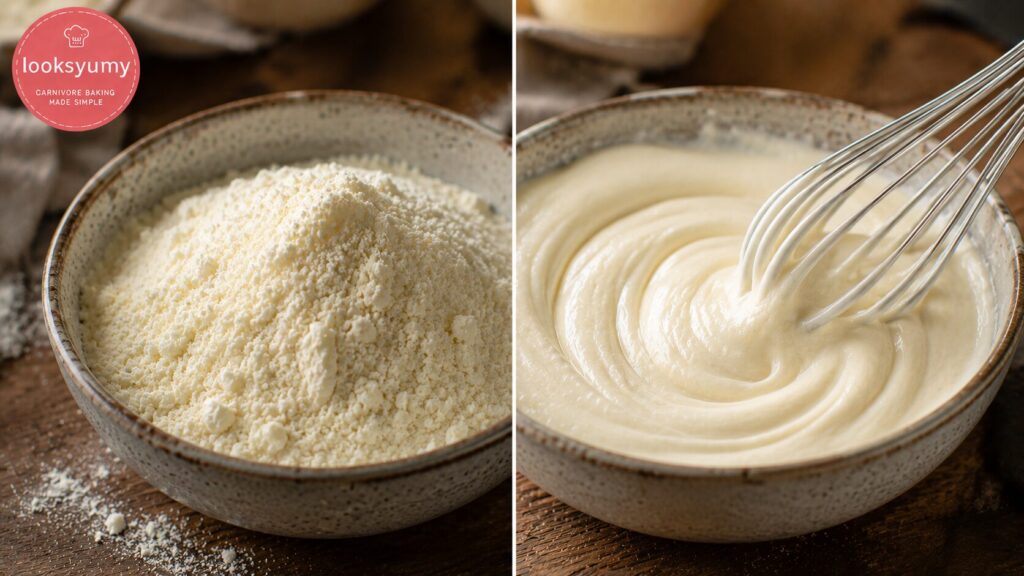
The real issue with most carnivore bread is that egg protein alone sets into a fairly dry, tight structure once it bakes, since there’s little fat or moisture built into that structure to soften it. Heavy cream powder changes that by adding concentrated milk fat directly into the batter in a form you can control.
When heavy cream powder is properly rehydrated, its fat disperses as tiny droplets throughout the batter rather than sitting in one place, and that fat physically coats and softens the network of egg proteins as they set during baking. The tradeoff is that fat molecules compete with egg proteins for space around each air bubble in a whipped foam, which is why the fold has to be gentle and gradual — add too much fat too fast and you lose the very structure you need to hold that moisture in place. Get the balance right, and the fat ends up working for the crumb instead of against it, giving you a loaf that stays moist for days instead of drying out by the next morning.
Troubleshooting & Diagnostics
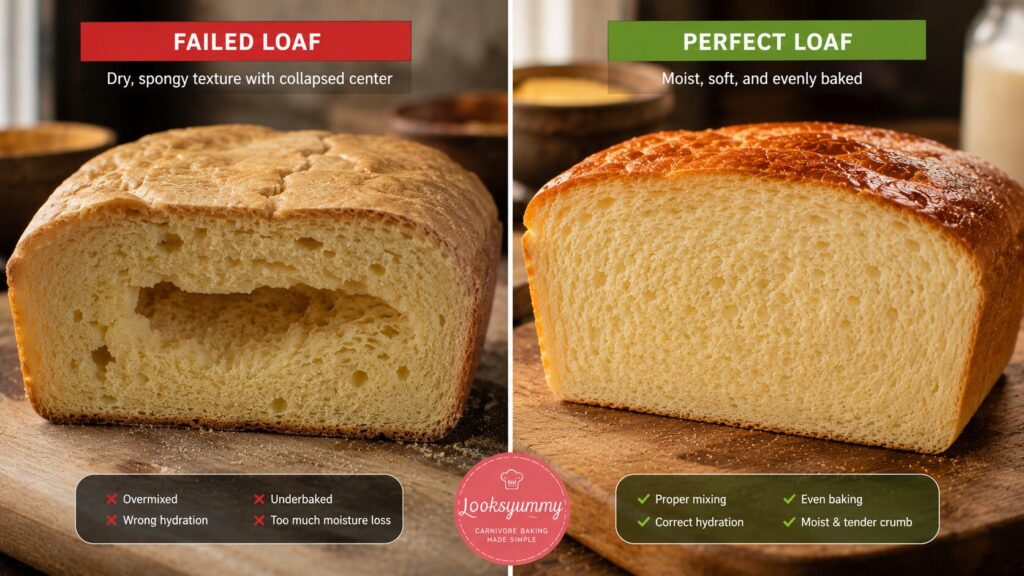
| Problem | Root Cause | Quick Fix |
|---|---|---|
| Crumb collapses in the center | Whites under-whipped or over-folded, so the structure couldn’t support the added fat | Whip to true stiff peaks and limit folding to 2–3 gentle additions |
| Rubbery, tough texture | Oven ran too hot, setting the crust before the center finished cooking | Bake at 300°F (149°C) and check doneness a few minutes early |
| Greasy streaks through the loaf | Cream powder added dry or only partially dissolved before folding | Fully whisk the powder into warm water until smooth before adding eggs |
| Over-browned crust, pale interior | Loaf baked too close to the top heating element or at too high a temperature | Move the rack to the center position and drop the temperature if the crust darkens early |
| Dry despite following the recipe | Sliced too soon after baking, letting trapped steam escape | Rest the loaf at least 15 minutes after cooling before the first cut |
Expanded Context: Shifting the Bread Hub
Why this happens across most carnivore bread recipes is that bakers often treat “carnivore bread” as one fixed formula, when really it’s a spectrum — different dairy powders behave differently, and the right one depends on whether you want a light sandwich texture or something denser and richer.
If you prefer a lighter sandwich loaf with less fat, milk powder carnivore bread uses a similar egg-foam foundation but produces a drier, lighter crumb that’s better suited to everyday sandwiches.
This heavy cream version sits on the richer, moister end of that spectrum within the Carnivore Bread Hub. If you’ve tried a Milk Powder Bread and found it a little too light or dry for sandwiches, this loaf is the direct upgrade — same egg-foam base, but with heavy cream powder standing in for milk powder to push the crumb toward something closer to a soft, moist sandwich bread. For a deeper look at how the fat content of different dairy powders changes texture, the broader Heavy Cream Guide walks through the comparison in more detail.
A loaf that stays moist for days starts with a batter that holds moisture from the very beginning.
Description
This moist carnivore bread with heavy cream powder delivers a soft, tender crumb without flour or starch. Rehydrating the heavy cream powder before folding it into whipped egg whites creates a rich, moist loaf that stays fresh longer and avoids the dry, spongy texture common in traditional carnivore bread.
Ingredients
8 large egg whites (or 1 cup liquid egg whites)
– 1/4 tsp cream of tartar
– 4 whole eggs
– 1/2 cup heavy cream powder
– 1/3 cup warm water
– 3/4 tsp fine sea salt
– Butter, beef tallow, or lard for greasing the loaf pan
Instructions
– Preheat oven to 300°F (149°C).
– Grease a standard loaf pan.
– Beat egg whites with cream of tartar until stiff glossy peaks form.
– Whisk heavy cream powder with warm water until completely smooth.
– Add whole eggs and salt to the cream mixture.
– Fold one-third of the whipped egg whites into the cream mixture.
– Gently fold the remaining egg whites in two or three additions.
– Pour into the loaf pan and smooth the surface.
– Bake for 40–42 minutes until lightly golden and springy.
– Cool in the pan for 10 minutes.
– Transfer to a cooling rack and rest 15 minutes before slicing.
Notes
Fully rehydrating the heavy cream powder is the key to preventing greasy streaks and creating an evenly moist crumb. Avoid overmixing after folding the egg whites, and never slice the loaf while it’s still steaming to preserve moisture.
Nutrition
- Serving Size: 1 slice
- Calories: 76
- Sugar: 0.8 g
- Sodium: 180 mg
- Fat: 5 g
- Saturated Fat: 3.2 g
- Unsaturated Fat: 1.5 g
- Trans Fat: 0 g
- Carbohydrates: 1 g
- Fiber: 0 g
- Protein: 6 g
- Cholesterol: 88 mg
Frequently Asked Questions
How long does this heavy cream carnivore loaf stay fresh?
Wrapped tightly and stored in the fridge, it holds its moisture for about 4 days. For longer storage, slice it first, then freeze individual slices so you can pull out only what you need and reheat gently.
Does the texture change after slicing, and how do I keep it soft?
Yes — cut sides dry out faster than the rest of the loaf once exposed to air, so store leftover slices with the cut side pressed against plastic wrap or another slice rather than left open. A quick warm-up in a low oven or toaster restores most of the softness before serving.
What’s the best fat to use for greasing the loaf pan?
Stick with a solid animal fat like butter, tallow, or lard rather than a liquid oil — solid fats coat the pan more evenly and hold up better at 300°F, which helps the loaf release cleanly once it’s cooled slightly.
If your loaf still turns out dry, dense, or collapses after cooling, reviewing the most common carnivore bread mistakes can help you identify the exact step that needs adjusting before changing the recipe itself.