
👉 Save or print the mixing speed reference guide below — tape it next to your stand mixer before your next carnivore bread or bun session to eliminate every avoidable batter failure at the bowl stage.
Ask most carnivore bakers what ruins their loaves and they will point immediately to the oven — temperature, timing, rack position. Very few will look back at the bowl. Yet the structural fate of a carnivore batter is often decided entirely before the pan goes anywhere near the heat. The physical mechanics of how you combine pure animal proteins, fats, and whipped foam — in what order, at what speed, using what motion — either preserve a fragile aerated matrix or systematically dismantle it one stroke at a time. Because carnivore batters contain no gluten network, no starch paste, and no hydrocolloid scaffold, there is no forgiving structural fallback to rescue a batter that has been mechanically over-sheared. What the mixing destroys, the oven cannot restore.
In carnivore baking, proper mixing technique means executing a strict mechanical sequence: high-speed whipping to build the egg white protein foam, then an immediate transition to slow, deliberate hand folding that integrates the yolk-fat component along the path of least resistance without collapsing the air cell matrix already locked inside the foam. Each rotation of a spatula applies shear force to the protein film surrounding every air bubble in the batter — too many rotations, too fast, or at the wrong angle, and those films rupture, the bubbles coalesce, and the aerated foam collapses into liquid. The entire rise, crumb structure, and moisture balance of the finished loaf is a direct reflection of how much mechanical shear was applied to the foam during the integration phase, because in the complete absence of gluten and starch, the egg white protein matrix is the only structural system available — and it has zero tolerance for aggressive post-whip mechanical agitation.
Why Physical Mixing Dictates Zero-Carb Structure
In an animal-protein-only batter, every air cell in the raw mixture is enclosed by nothing but a thin, protein-stabilized film — and any mechanical shear force applied after foam formation acts directly on those films, compressing them, stretching them, and eventually causing them to rupture and merge with neighboring cells in a process called bubble coalescence. The structural consequences of over-shearing a carnivore batter are irreversible: once those air cells have merged and the foam has begun liquefying, no amount of additional whipping or manipulation at the bowl stage can reconstitute the fine, uniform cell distribution that a properly constructed foam originally contained.
This is the core insight behind the Looksyumy Fold-First Framework — the recognition that the mixing stage in carnivore baking must be treated as two entirely separate mechanical operations with different tools, different speeds, and different physical objectives. The first operation is pure aerobic whipping: maximizing air incorporation into the egg white proteins at high speed, building the foam volume to its structural ceiling before any other ingredient contacts it. The second operation is integrative folding: combining the yolk-fat base with the foam using a wide, shallow spatula in slow, deliberate scooping arcs that carry material from the bottom of the bowl to the top without compressing or rotating the foam against itself. These two operations must never overlap — transitioning from whipping to folding is not a gradual speed reduction; it is a complete equipment change and a fundamental shift in the mechanical objective. The dough consistency guide at dough consistency(opens in new tab) maps out exactly what a correctly integrated batter should look, feel, and pour like at each stage of this two-phase process.
Understanding why the folding phase is so structurally critical requires understanding what happens to egg white foam under shear at the molecular level. The protein film surrounding each air cell in a well-whipped foam is a viscoelastic membrane — it can stretch a limited amount before rupturing, but it has no capacity for recovery once the rupture threshold is crossed. The shear rate experienced by batter near the wall of a rotating beater in a stand mixer has been measured at between 100 s−1 and 500 s−1 depending on mixer speed — values that exceed the rupture threshold of protein foam films by an order of magnitude. A spatula fold applied correctly generates shear rates several orders of magnitude lower than even the slowest machine speed. This is why the mechanical transition from electric mixer to hand spatula is not a stylistic preference — it is a structural necessity dictated by the shear tolerance limits of the protein membrane system you are working with.
Correct Mixing Mechanics for Animal-Based Batters
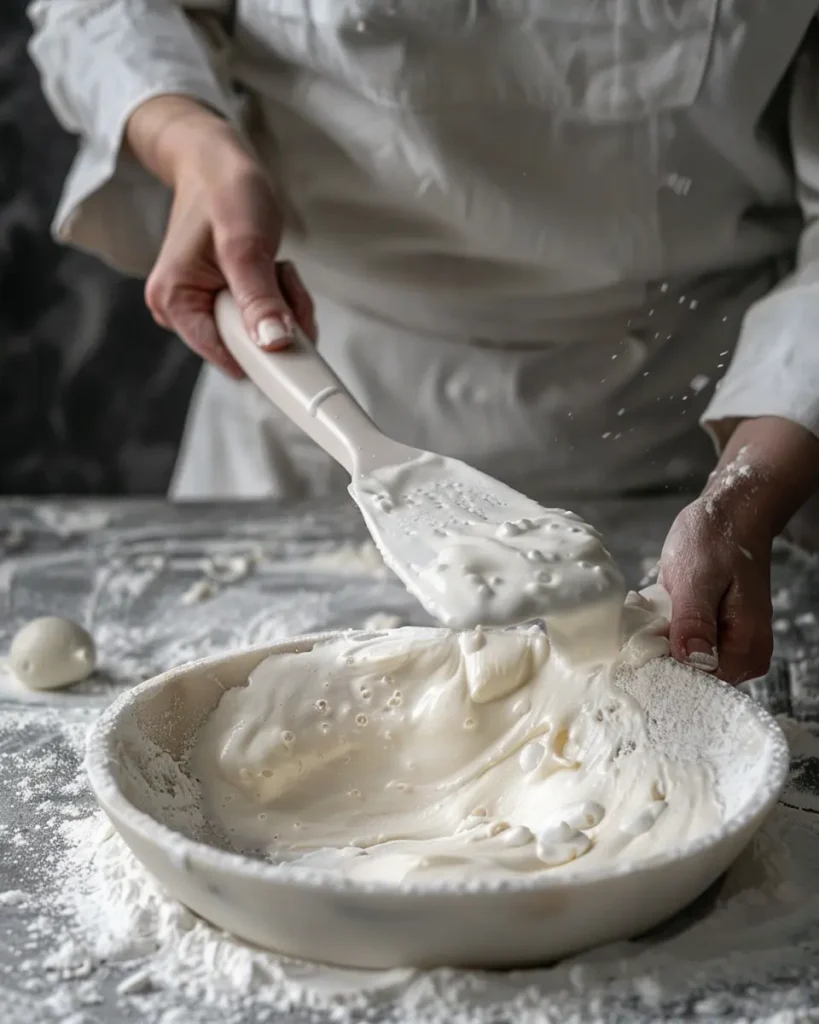
The single most damaging mechanical error in carnivore batter preparation is deploying a rotating electric beater during the final integration phase, when the whipped foam and the yolk-fat base are being combined — because the high shear rates generated by even a low machine speed collapse the foam faster than any amount of careful manual folding can rebuild it. The correct integration pathway moves in one direction only: from machine to hand, from high shear to near-zero shear, with the transition point occurring the moment the egg white foam reaches stiff peaks and before any other ingredient touches it.
The structural consequences of over-shearing a carnivore batter are irreversible because, as peer-reviewed egg white research confirms, foam collapses by three principal mechanisms — bubble disproportionation, lamellae rupture, and drainage(opens in new tab) — and excessive mechanical whipping produces a higher concentration of smaller, more unstable bubbles with decreased elasticity that fail faster under any continued shear.
The correct folding arc is a specific physical motion, not a generic “stir gently” instruction. The spatula enters the batter at the far edge of the bowl, scoops downward along the curved bowl wall to the base, then sweeps forward and lifts up through the center of the mass — carrying the denser yolk-fat material from the bottom up through the lighter foam rather than pushing the foam down into the yolk. The bowl rotates a quarter turn between each fold. This motion maintains a maximum shear path length of roughly half the bowl diameter per stroke, compared to the circular orbital path of a machine beater which generates continuous shear across the entire bowl volume on every revolution. Fifteen to twenty of these deliberate arcs is typically sufficient for full integration in a three-to-four egg carnivore batter. Beyond that point, additional folds are not improving homogeneity — they are consuming structural foam volume.
The yolk-fat component must also be prepared correctly before it contacts the foam, because temperature matters in ways that directly amplify or reduce shear damage. A cold yolk-fat mixture — cream cheese or fat-based dairy pulled directly from the refrigerator — has significantly higher viscosity than room-temperature material. When a high-viscosity base meets the low-viscosity foam during folding, the mechanical resistance to integration is greater, meaning more strokes are required to achieve homogeneity and more cumulative shear is applied to the foam in the process. Bringing the yolk-fat component to room temperature before beginning the whipping phase — so that both components are ready to combine immediately when the foam peaks — reduces integration resistance and minimizes the fold count needed to achieve a uniform batter. This timing detail alone consistently reduces the number of folds required for full integration by 30–40%, which directly translates to a measurable difference in final foam volume retention.
During one early batch of buns(opens in new tab), I learned exactly how fast this can go wrong. I had a beautifully stiff foam — glossy, holding hard peaks, the kind of foam that looks like it could support the weight of the spatula on its own. I added the cream cheese base, which was cold because I had forgotten to pull it early. Then, instead of switching to the spatula immediately, I dropped the stand mixer back to its lowest speed — thinking a brief “gentle blend” would be easier than folding by hand. I watched what happened in real time over the next forty-five seconds. I noticed the foam volume begin dropping immediately — the glossy, voluminous mass began thinning from the center outward, the peaks deflated, and within less than a minute the entire batter had gone from a thick, airy, pale mixture to a thin, yellowish, almost liquid pool that ran freely off the spatula rather than falling in thick ribbons. The foam was gone. Not partially reduced — completely liquefied. What went into the pan produced flat, dense, rubbery discs with no internal structure and a gummy, wet interior. Every single air cell that the whipping had built had been sheared to destruction by forty-five seconds of low-speed machine mixing during the integration phase. Nothing in the oven could recover that lost volume.
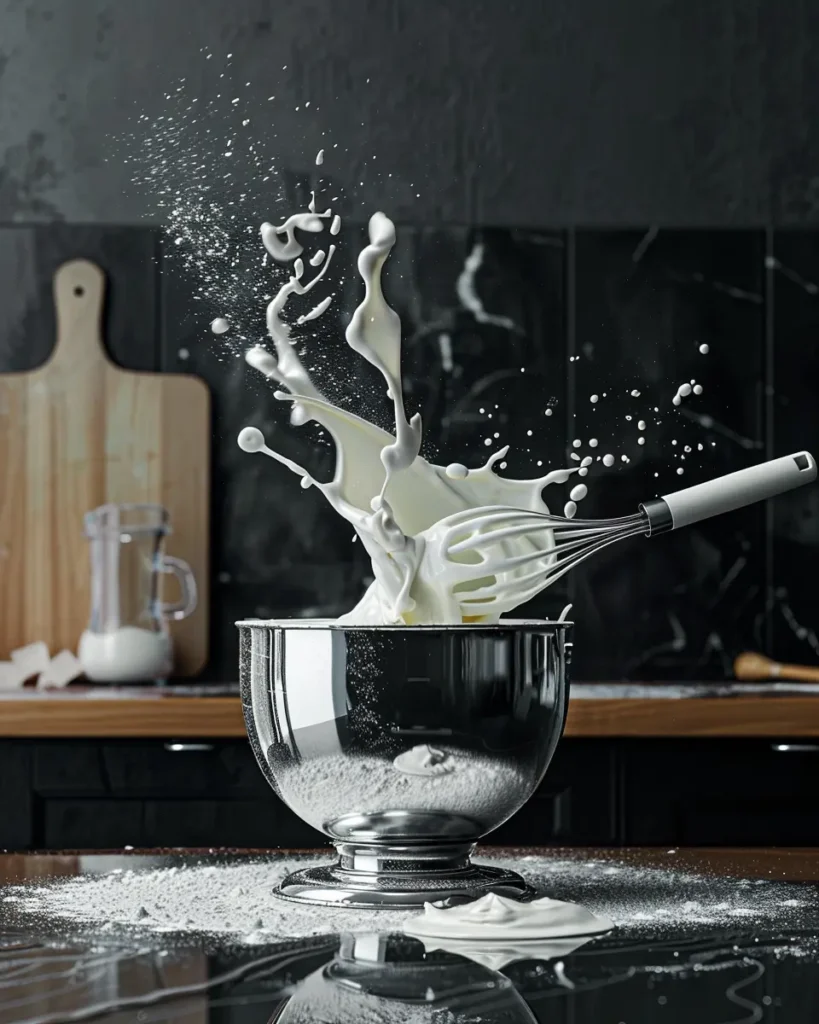
Overmixing Issues: Spotting a Ruined Emulsion
A carnivore batter that has been mechanically over-sheared displays a specific and unmistakable visual signature: it loses its opacity, thins dramatically in viscosity, and begins flowing and pooling freely rather than holding a semi-solid mound shape — and these changes are visible in real time as the shear damage accumulates, meaning they serve as live diagnostic signals for a baker who knows what to look for. The structural cause is bubble coalescence — the merging of adjacent air cells whose protein membrane walls have been ruptured by mechanical shear, reducing thousands of small discrete air pockets into a smaller number of large, unstable cavities that rapidly drain their gas into the liquid phase.
It is important to be completely explicit about what this structural stability during physical blending depends on: it is built entirely from the mechanical behavior of egg white proteins, egg yolk lecithin, and animal-derived fats — and nothing else. There is no almond flour acting as a thickening agent that masks foam collapse by adding viscosity to a thinning batter. There is no coconut flour absorbing the pooling liquid that drains from a destabilized foam, creating a false impression of structural hold. There is no psyllium husk forming a gel matrix that catches coalesced bubbles and temporarily suspends them in a viscous medium. There is no xanthan gum providing a shear-resistant network that props up a partially collapsed foam and delays the visual thinning signal. And there are no plant-based starches of any kind gelatinizing in the raw batter to create a secondary thickening phase that compensates for lost foam volume. Every structural property of a correctly or incorrectly handled carnivore batter — its viscosity, its opacity, its ability to hold a mound shape, its pour characteristics — is a direct and unmasked reflection of foam integrity. This transparency is why overmixing is so visually obvious and so instantly irreversible in carnivore baking: there is no ingredient in the matrix that can hide the damage.
The three-stage visual progression of over-shearing in a carnivore batter follows a consistent pattern that every baker should memorize as a real-time abort signal. In stage one — the first 5–8 strokes of aggressive over-mixing — the batter begins to lose the bright white opacity of the intact foam and takes on a slightly translucent, yellower tone as large air cells coalesce near the surface and the foam-to-liquid ratio at the batter’s surface begins shifting. In stage two — strokes 8–15 — the viscosity drops noticeably; the batter no longer falls from the spatula in thick ribbons but begins sheeting off in thin, runny curtains, and the surface of the mixture in the bowl starts showing a liquid sheen rather than a matte foam texture. By stage three, the process is complete: the batter is liquid, yellow-tinted, and flows freely. At any point during stage one, the mixing can be stopped and the damage is partial — some foam remains and the batter will still produce a usable, if somewhat reduced, result. By stage two, the outcome is significantly compromised. Stage three is unrecoverable.
Pro Tips for Balanced Friction Control 🔥
These are the mechanical checkpoints that separate consistently successful carnivore bakes from inconsistent ones. Most batter failures that appear to be ingredient problems are actually friction-control failures at the bowl stage. For the full mixing-to-oven transition checklist and how batter viscosity at pan-drop time predicts oven rise, see the tips(opens in new tab) master resource.
- Complete the whipping phase entirely before any other ingredient contacts the foam. Egg white proteins must reach stiff peaks — the foam holds a firm, glossy point that does not bend when the beater is lifted — before integration begins. Adding yolk-fat material to a foam that has only reached soft peaks means starting the integration phase with a structurally incomplete mesh that has far lower shear tolerance than a fully developed stiff-peak foam.
- Bring all fat-based dairy to room temperature before whipping begins. Cold cream cheese, cold mascarpone, or cold butter creates a high-viscosity integration barrier that forces more fold strokes than a room-temperature base requires. Every extra fold is additional shear applied to the foam. This single preparation step reduces total fold count and directly improves foam volume retention in the finished batter.
- Change equipment completely when transitioning from whipping to folding. Put the electric beater away. Switch to a wide silicone spatula or a large flat-bottomed scraper. The transition is not a speed reduction — it is a full equipment change. Any machine speed, including the lowest setting available, delivers shear rates that exceed the rupture threshold of a stiff egg white foam during the integration phase.
- Count your folds. For a three-to-four egg batter, full integration should require no more than 15–20 deliberate arcs. If you are approaching 25 folds and the batter still looks streaky, the problem is not insufficient folding — the yolk-fat base was too cold or too thick, and the correct fix is to warm the base, not continue folding.
- Fold from the bottom up, not from the top down. The denser yolk-fat material sinks below the lighter foam immediately upon contact. Every fold stroke that compresses foam downward into the denser base is working against gravity and applying maximum shear to the foam structure. Scooping from the base upward carries the dense material through the foam without compressing it, minimizing shear at every stroke.
- Watch the batter surface, not the clock. The correct stop point for folding is when the last visible streak of yellow yolk-fat material disappears into a uniformly pale, airy, opaque batter that still holds a mound shape in the bowl. Continuing past this point for the sake of “making sure it’s fully mixed” is the most common single cause of structural collapse in carnivore batters that were technically correct up to that moment.
- Transfer the batter to the pan immediately after folding. Every minute the mixed batter sits in the bowl, gravity-driven drainage — where the liquid phase of the egg white slowly descends away from the protein foam film — reduces foam volume at a measurable rate. The bowl-to-pan-to-oven sequence should be continuous, with no resting time between folding completion and batter deposition.
Frequently Asked Questions
Can I use a stand mixer for the entire carnivore batter process?
A stand mixer is the correct tool for exactly one phase of carnivore batter preparation — the whipping phase — and the wrong tool for every phase that follows. During whipping, the stand mixer’s wire whisk attachment at medium-to-high speed (6–8 on a standard household model) delivers the rapid, high-shear aerating action that folds air into the egg white proteins at the rate and intensity needed to build a full stiff-peak foam in three to five minutes. No manual whisk can match this efficiency for foam building. However, the moment the foam is complete, the stand mixer becomes a liability. Even its lowest speed setting applies shear forces that rupture protein foam films faster than they can be integrated with the yolk-fat component. The practical workflow for carnivore batters is therefore: stand mixer at medium-high for the whipping phase, then bowl removed from the mixer stand entirely, with all subsequent manipulation performed by hand with a silicone spatula. Bakers who attempt to use the stand mixer on its lowest setting for the fold-in phase consistently report the same outcome — a thin, liquefied batter that produces flat, dense bakes — because the machine’s mechanical action is fundamentally incompatible with the shear sensitivity of an intact egg white foam, regardless of the speed setting used.
What should I do if my fats separate during the blending phase?
Fat separation during the blending phase — where visible pools of liquid butter, rendered fat, or melted cream cheese appear around the edges of the batter rather than remaining emulsified within it — is a temperature management failure, not a technique failure. Animal fats have a significantly higher proportion of saturated fatty acids compared to plant oils, and saturated fat molecules, with their straight-chain linear structure, have a strong tendency to crystallize and separate from the aqueous egg protein phase when the temperature differential between the fat component and the egg white foam is too large. When warm or partially melted fat contacts cold egg white foam, the temperature shock accelerates phase separation before the egg yolk lecithin — the natural emulsifier in the batter — has had time to migrate to the fat-water interface and stabilize the droplets. The fix is temperature equilibration: both the egg white foam and the fat-dairy base should be at room temperature (20°C–22°C / 68°F–72°F) before combination. If separation has already begun during folding, the batter is not automatically ruined — stop folding immediately, allow the mixture to sit undisturbed for 60–90 seconds while the lecithin system partially stabilizes the interface, then complete integration with three to five very slow, deliberate fold strokes. Do not attempt to re-emulsify by adding more mixing speed or more mechanical action.
How does the speed of mixing affect final oven expansion?
Mixing speed affects oven expansion through a direct mechanical chain: higher speed during the integration phase means higher shear rates on the protein foam film, which means more bubble coalescence, which means fewer and larger air cells in the batter when it enters the oven, which means a lower volume ceiling for oven expansion and a coarser, less uniform crumb in the finished loaf. The relationship is not linear — the damage threshold for egg white foam films is crossed at relatively low shear rates, meaning even a modest increase from hand-folding speed to the slowest machine speed produces a disproportionately large amount of structural damage. Conversely, a correctly folded batter — where mixing speed never exceeded slow manual strokes during integration — enters the oven with the maximum possible number of small, uniformly distributed air cells, each individually stabilized by an intact protein membrane. Under oven heat, each of those cells expands proportionally to the others, producing a uniform, fine-grained crumb with high volume and even internal structure. This is why two carnivore bakers using identical ingredients, identical oven settings, and identical bake times can produce radically different results — the variable is not in the recipe or the oven, it is in the shear history of the batter between the whipping phase and the moment the pan entered the heat.