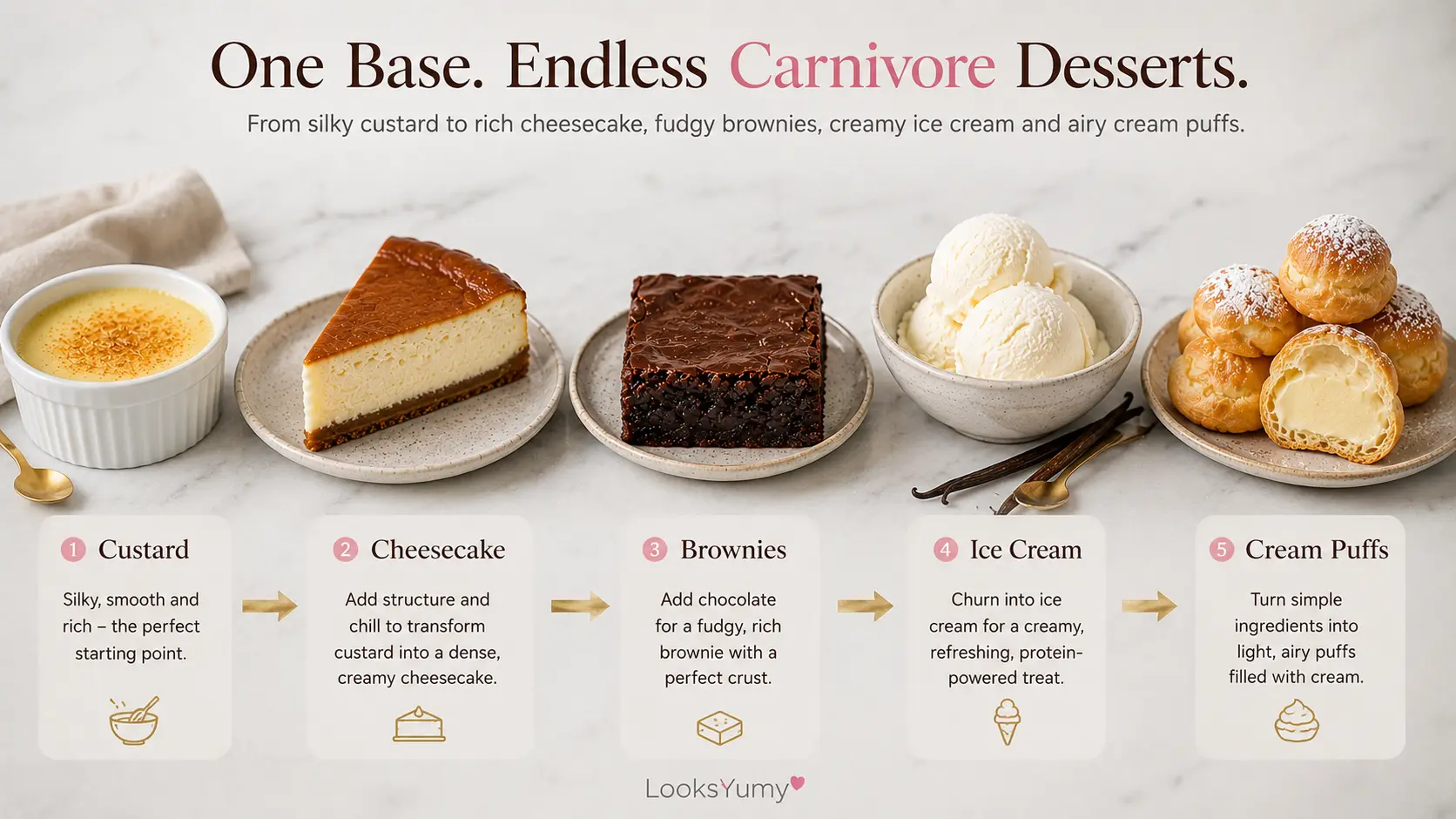
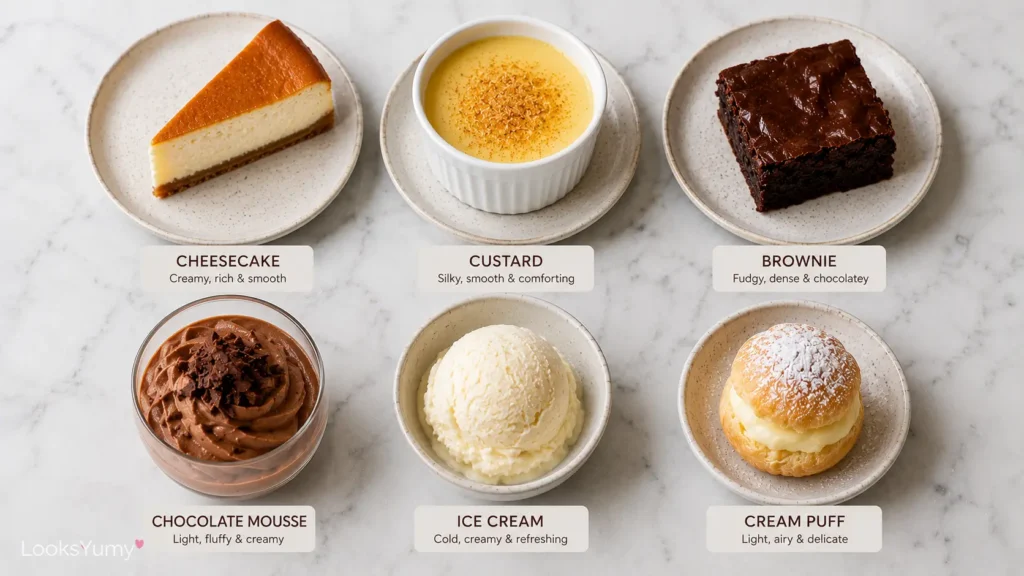
Cheesecake, custard, brownies, mousse, ice cream, and cream puffs — all built from the same handful of ingredients, each one solving a different texture problem.
Carnivore desserts are baked or chilled sweets made almost entirely from eggs, dairy fat, and sometimes gelatin or collagen — no flour, no sugar, no fruit, no plant-based sweeteners of any kind. The texture and richness come from how those few ingredients are handled, not from anything added to bulk them out. If you’re new to this, cheesecake and custard are the easiest starting points, since both rely on the same basic technique: gentle heat and a good ratio of fat to protein.
That’s really the whole category in a sentence. Everything below is about which dessert fits which craving, why each one behaves the way it does in the kitchen, and how they all connect to the same handful of ingredients doing different jobs.
Not sure where to start?
✔ Want something creamy? → Cheesecake
✔ Want something silky? → Custard
✔ Want chocolate? → Brownies
✔ Want a frozen dessert? → Ice Cream
✔ Want something quick? → Mousse
✔ Want a baking challenge? → Cream Puffs
Chocolate lovers can choose between rich carnivore brownies with a dense, fudgy texture or airy carnivore chocolate mousse for a lighter dessert.
What Actually Makes a Dessert “Carnivore”
The real question people ask first is whether cutting out flour and sugar means cutting out dessert entirely. It doesn’t — it just means the dessert leans on different ingredients to do the same job.
A traditional dessert gets its structure from flour and starch, and its sweetness from sugar. A carnivore dessert replaces that structure with egg protein and dairy fat, and skips the sweetness altogether or leans on natural richness instead. This isn’t a downgrade — it’s a different set of tools solving the same three problems every dessert has to solve: how it holds together, how rich it tastes, and how it feels in your mouth.
Here’s where most beginners get surprised: without flour or sugar acting as a buffer, small mistakes show up more obviously. A cheesecake with slightly too much egg cracks. A custard cooked slightly too hot curdles. That’s not a flaw in carnivore baking — it’s just a category where the ratios matter more, which is exactly why the guides in this hub go deep on ratios and technique instead of treating every recipe as interchangeable.
Which Dessert Fits What You’re Craving
The primary factor in choosing a dessert isn’t difficulty — it’s texture. Most people already know whether they want something creamy, something chocolatey, or something frozen; the table below just maps that craving to the right recipe.
| You Want… | Best Dessert | Why |
|---|---|---|
| Rich, creamy, sliceable | Cheesecake | Dense custard-like texture, holds its shape when cut |
| Light, spoonable, silky | Custard | Softer set, eaten straight from the ramekin |
| Deep chocolate flavor | Brownies | Fat and chocolate-forward, no egg-heavy taste |
| Frozen and scoopable | Ice Cream | Same fat-and-egg base, churned instead of baked |
| Something for a party or gathering | Cheesecake Bites | Individual portions, easy to serve a crowd |
| Fast, no-bake option | Mousse | Whipped and chilled, ready in under an hour |
| Delicate, hollow shell to fill | Cream Puffs | Built on steam and egg protein instead of fat |
Creamy desserts rely on eggs and dairy fats to create a smooth texture. If you prefer sliceable desserts, try carnivore cheesecake. For a lighter spoon dessert, carnivore custard offers a silky finish with many of the same ingredients.
The Textures, Compared
Why do a cheesecake and a custard taste so similar in flavor but feel completely different in the mouth? It comes down to how much egg protein is in the mix relative to fat, and how long each one spends at heat.
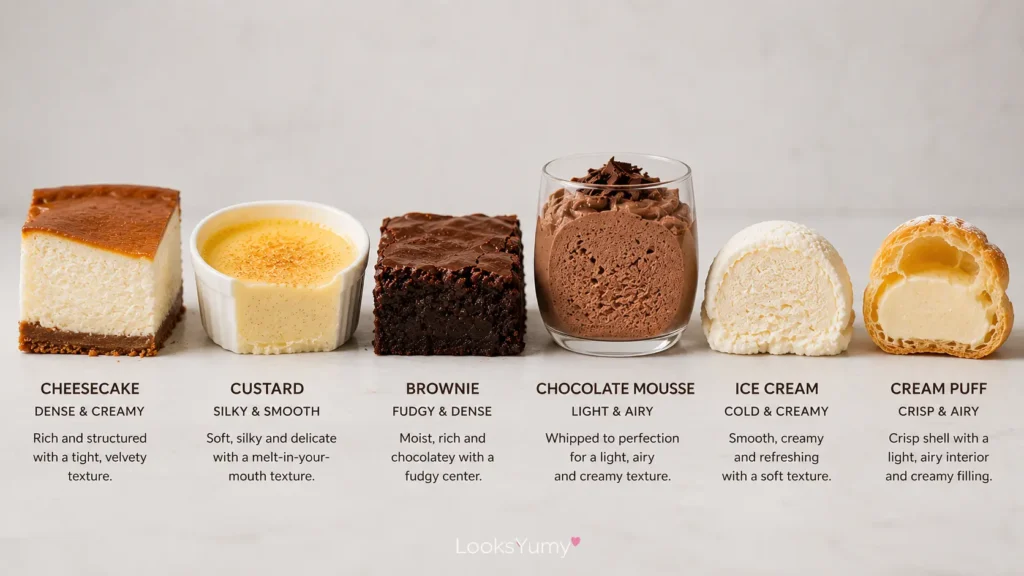
Cheesecake uses cream cheese as its main structural ingredient, with just enough egg to bind it — that’s why it slices cleanly instead of sagging on the plate. Custard flips that ratio, using mostly egg with dairy added for richness, which is why it holds a soft set but never firms up enough to cut into clean slices. Brownies drop the water-heavy dairy almost entirely in favor of melted chocolate and solid fat, which is why they’re dense and chewy rather than creamy. Mousse gets its texture from air, not heat — it’s whipped and chilled rather than baked, which is why it’s light despite being just as rich. Ice cream uses a similar custard base to the ramekin version, but freezing and churning introduce a completely different set of rules around ice crystals and fat content. Cream puffs are the outlier here — their hollow shell comes from steam trapped inside a cooked egg-and-fat paste, not from a poured batter at all.
| Dessert | Texture | Structural Ingredient | Cooking Method |
|---|---|---|---|
| Cheesecake | Dense, sliceable, custard-like | Cream cheese + egg | Baked, water bath |
| Custard | Silky, soft-set, spoonable | Egg-heavy, dairy for richness | Baked, water bath |
| Brownies | Dense, fudgy, chewy | Melted chocolate + fat | Baked, no water bath |
| Mousse | Light, airy, spoonable | Whipped fat and/or egg | Whipped, chilled, no baking |
| Ice Cream | Smooth, scoopable, frozen | Custard base | Cooked, then churned and frozen |
| Cream Puffs | Hollow, crisp shell, soft interior | Egg and fat paste | Baked, steam-driven rise |
For lighter desserts, carnivore cream puffs create an airy shell, while zero carb carnivore crepes can be filled with whipped cream or cream cheese for endless variations.
How Hard Each One Actually Is
The real question beginners have isn’t “which dessert is best” — it’s “which one am I going to mess up.” Difficulty here mostly comes down to how narrow the margin for error is, not how many steps are involved.
Custard and cheesecake are more technical than they look, because egg protein has a genuinely narrow safe temperature range — go a little too hot or too long and you get curdling or cracking. Brownies are far more forgiving, since fat and chocolate don’t have anywhere near that same sensitivity to overheating. Mousse is arguably the easiest entry point precisely because there’s no baking involved at all — the risk is mostly about whipping technique, not heat control.
| Dessert | Difficulty | Main Risk |
|---|---|---|
| Mousse | Beginner | Under-whipping or over-whipping |
| Brownies | Beginner | Wrong fat-to-egg ratio |
| Cheesecake | Intermediate | Overmixing, wrong bake temperature |
| Custard | Intermediate | Curdling from heat shock |
| Ice Cream | Intermediate | Ice crystal texture from improper churning |
| Cream Puffs | Advanced | Steam control, structural collapse |
What’s Doing the Work in Every Recipe
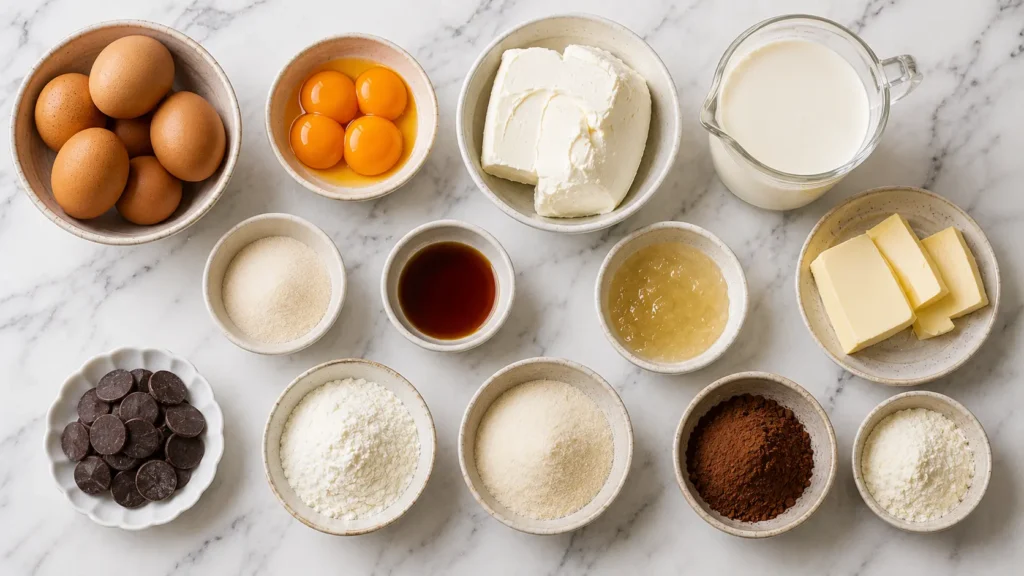
Here’s what most people miss about carnivore desserts: it’s really just a handful of ingredients being asked to do different jobs depending on the recipe, and once you understand each ingredient’s role, every recipe in this hub gets easier to troubleshoot.
Eggs are the backbone of almost everything here — their protein is what sets a custard, binds a cheesecake, and gives a cream puff shell its structure. Egg yolks specifically bring fat and richness with much less of that structural toughness, which is why recipes chasing a silkier texture (like custard) lean toward extra yolks, while recipes needing more hold (like a sliceable cheesecake) use a more balanced ratio of whole eggs to yolks.
Heavy cream and cream cheese both bring fat, but in different forms. Heavy cream is closer to pure liquid fat and is used to add richness and smoothness without much structure of its own, while cream cheese carries its own protein network and becomes the main structural ingredient in a cheesecake specifically. Butter functions similarly to heavy cream in some recipes and adds a rounder flavor plus a small amount of structural fat in others, like brownies.
Gelatin and collagen show up less often, but they solve a specific problem: adding flexibility or a soft gel structure that egg protein alone can’t provide. This matters most in something like a crepe, where the egg needs to bend without cracking, but it’s a useful tool anywhere a purely egg-based structure ends up too stiff.
Protein, fat, texture, baking, and cooling all interact throughout every dessert in this hub. Protein sets the structure. Fat controls richness and how moist or dense the final texture feels. Baking (or whipping, for no-bake desserts) is what triggers the actual transformation. And cooling is almost never optional — nearly every dessert here continues firming up after it leaves the heat, which is why pulling something “a little early” is usually correct, not a mistake.
| Ingredient | Primary Job | Shows Up In |
|---|---|---|
| Eggs | Structure, binding, richness | Cheesecake, custard, brownies, cream puffs |
| Egg yolks | Richness without added toughness | Custard, ice cream, cheesecake |
| Heavy cream | Fat, smoothness, richness | Cheesecake, custard, mousse, ice cream |
| Cream cheese | Main structural fat-protein base | Cheesecake, cheesecake bites |
| Butter | Flavor, moisture retention, fat | Brownies, cream puffs |
| Chocolate | Flavor, fat contribution from cocoa butter | Brownies, chocolate mousse |
| Gelatin/Collagen | Flexible structure, soft gel texture | Crepes, some mousse variations |
| Term | Meaning |
|---|---|
| Water bath | Gentle baking using hot water around the baking dish |
| Protein coagulation | Eggs firming up as they cook |
| Residual heat | Cooking that continues after removing the dessert from the oven |
| Emulsion | Fat and liquid blended into one smooth mixture |
Where Things Usually Go Wrong
Most dessert failures in this whole category trace back to one of three things: too much heat, too much egg relative to fat, or cutting the cooling time short. Once you know which of those three is the likely culprit, troubleshooting almost any recipe here gets a lot faster.
If something cracked, curdled, or turned grainy, heat moved too fast through the egg protein — either the oven was too hot, the dairy was added too quickly, or the batter was overmixed and trapped air that expanded and collapsed. If something turned out dry, crumbly, or rubbery, the fat-to-protein ratio was probably off, usually meaning not enough fat relative to how much egg or structural protein was in the mix. And if a finished dessert seemed underdone but firmed up strangely once chilled, or seemed perfect out of the oven but disappointing once cold, the cooling stage was skipped or rushed — almost every dessert on this list keeps changing texture well after it comes off the heat.
| Problem | Likely Cause | Where to Start |
|---|---|---|
| Cracked or curdled surface | Heat applied too fast | Lower oven temp, use a water bath, mix gently |
| Dry, crumbly, or rubbery texture | Not enough fat relative to protein | Increase fat, check egg-to-fat ratio in the specific recipe |
| Grainy texture | Cold ingredients or overcooking | Bring ingredients to room temp, pull dessert slightly early |
| Never fully sets | Underbaked or under-chilled | Extend bake time slightly, or allow more chill time before judging |
| Tears or cracks when handled | Missing flexible protein (gelatin/collagen) | Add hydrated gelatin or collagen where the recipe calls for it |
Starting Point vs. Where to Go Next
If you’re brand new to carnivore baking, the real question isn’t which dessert tastes best — it’s which one gives you the most forgiving first attempt. Mousse and brownies both have wider margins for error than a custard or cheesecake, which makes them a more comfortable place to build confidence before tackling anything water-bath dependent.
Once the basics feel comfortable, custard and cheesecake are worth the extra attention, since they teach you to read a jiggle and control heat precisely — skills that transfer directly into other desserts, including ice cream, which uses a nearly identical custard base before it ever reaches the freezer. Cream puffs are worth saving for last, since steam control and structural collapse are genuinely trickier to manage than anything else in this collection.
| Stage | Recommended Desserts | Why |
|---|---|---|
| First attempt | Mousse, Brownies | Wide margin for error, no water bath needed |
| Building confidence | Cheesecake, Custard | Teaches heat control and doneness cues |
| Comfortable with the basics | Ice Cream | Builds directly on custard technique |
| Ready for a challenge | Cream Puffs | Requires precise steam and structure control |
How Everything in This Hub Connects
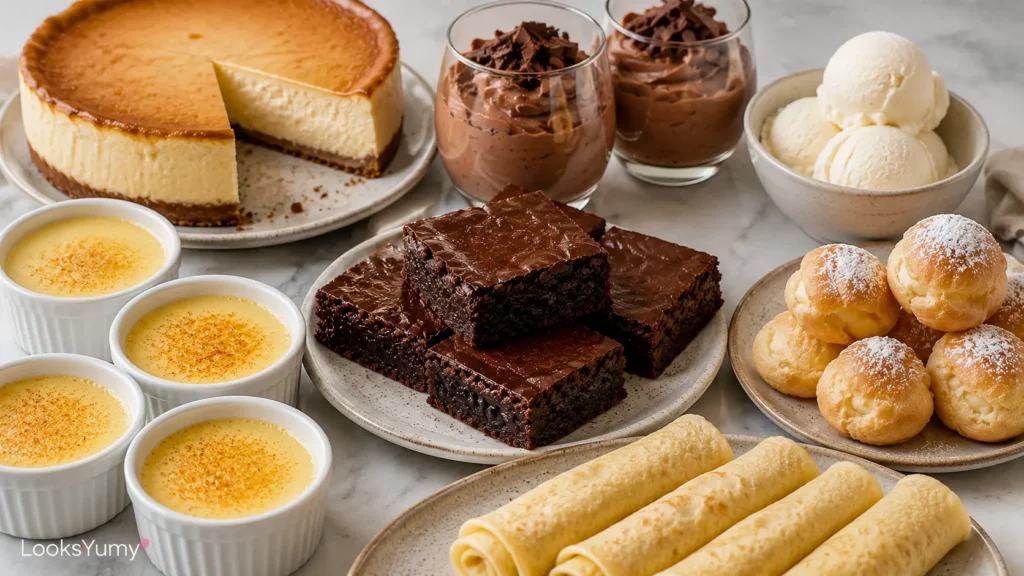
Cheesecake and custard are close cousins — cheesecake is really a custard with cream cheese added for structure, which is why the troubleshooting for cracking and curdling overlaps so heavily between the two. Brownies and chocolate mousse share a fat-and-chocolate foundation, just handled differently — one baked dense, one whipped light — so understanding why brownies stay fudgy also explains why mousse holds its airy structure once chilled.
Ice cream sits downstream of custard technique specifically, since most versions start as a cooked custard base before freezing changes the rules entirely around ice crystals and texture. Cream puffs stand a little apart from the rest, relying on steam and egg-white protein rather than fat content, which makes them a useful contrast for understanding just how differently egg protein can behave depending on what job it’s being asked to do.
Beyond the recipes themselves, the ingredient guides break down individual ingredients like cream cheese, gelatin, and chocolate in more depth than any single recipe page can cover. The dessert science section goes deeper into the “why” behind coagulation, emulsification, and moisture retention across the whole category. And the troubleshooting guides pull together the most common failure patterns — cracking, curdling, dryness — so you’re not hunting through five different recipe pages to solve one texture problem.
A few things worth keeping in mind as you work through this hub:
- A great carnivore dessert isn’t defined by sweetness — it’s defined by texture.
- Every recipe here is really the same three ingredients — egg, fat, and heat — asked to behave differently.
- The dessert that looks the simplest on the ingredient list is often the one with the least room for error.
- Cooling isn’t the end of the recipe. For most of these desserts, it’s still part of the cooking.
- If a dessert cracked or curdled, the mistake happened earlier than you think — usually at the mixing or heating stage, not at the very end.
| New to Carnivore? | Start Here |
|---|---|
| First dessert ever | Custard |
| Love chocolate | Brownies |
| Love creamy desserts | Cheesecake |
| Need meal prep | Cheesecake Bites |
| Want something cold | Ice Cream |
Finding Your Next Recipe
Carnivore desserts aren’t a limited category — they’re a small set of ingredients that can go in a surprising number of directions once you understand what each one is actually doing. Whichever dessert you start with, the skills carry over: read the jiggle, mind the fat ratio, and let things cool properly before you judge the result.
From here, pick based on what you’re craving, not what feels safest, and use the comparison tables above whenever you’re deciding between two similar options. The rest of this hub — every recipe, ingredient guide, and troubleshooting page — is built to answer the next question you run into along the way.