
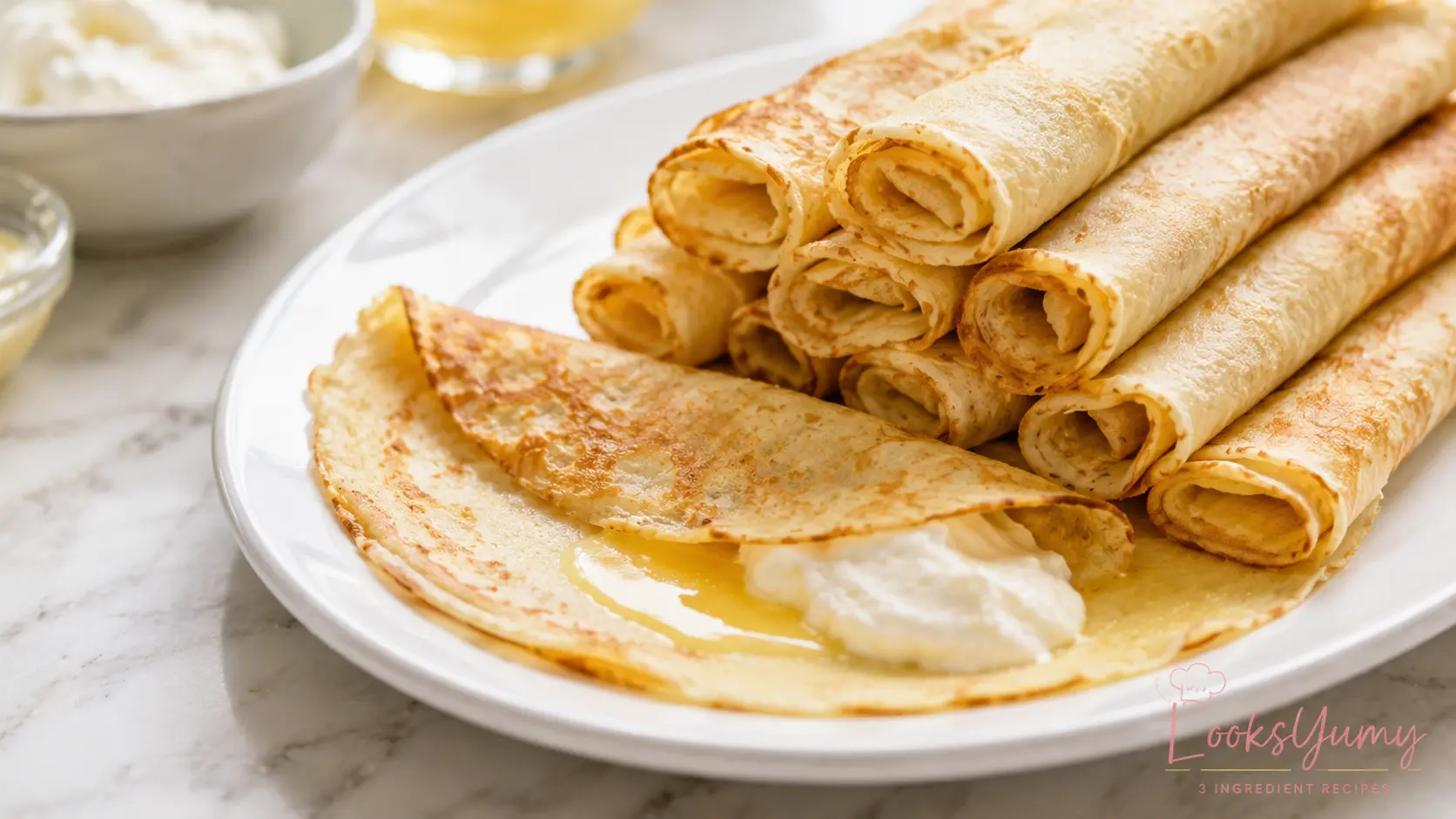
One protein ratio and one cooking temperature rule stand between a crepe that folds beautifully and one that cracks the second you touch it.
Carnivore crepes fail in a very specific way. They don’t usually burn or taste wrong — they just come out too thick, too rubbery, or too stiff to roll without splitting down the middle. That’s almost never a flavor problem. It’s a protein and moisture problem, and it’s fixable once you know where it’s coming from.
This guide walks through the Looksyumy Flexible Crepe Method, built around controlling egg protein, fat, and moisture so the batter cooks into something thin and pliable instead of a thick egg pancake. You’ll get the full recipe, the reasoning behind each step, a troubleshooting map, and the decision points that actually change how well these fold.
If your last batch tore when you tried to roll it, that’s not a sign you need a better pan. It’s almost always one of a few specific things, all covered below.
How to make zero carb carnivore crepes that stay soft, flexible, thin, and easy to roll without becoming rubbery, dry, thick, or tearing: Whisk the eggs with a bit of hydrated gelatin or collagen and a small amount of liquid fat, pour a thin layer into a well-heated, well-greased pan, and cook briefly over medium heat, flipping once the edges release on their own rather than waiting for full browning.
If you prefer a spoonable dessert instead of a flexible wrap, carnivore custard uses many of the same animal-based ingredients while creating a silky, creamy texture.
Table of Contents

| Detail | Info |
|---|---|
| Prep time | 10 minutes |
| Cook time | 2–3 minutes per crepe |
| Total time | About 25 minutes for a full batch |
| Yield | 6–8 crepes, 8-inch pan |
| Method | Looksyumy Flexible Crepe Method |
| Texture | Thin, soft, flexible enough to roll |
| Skill level | Beginner to intermediate |
What You’ll Need
- 6 large eggs
- 2 tablespoons (14g) collagen peptides or unflavored gelatin
- 3 tablespoons (45ml) water, for blooming the gelatin
- 2 tablespoons (30ml) heavy cream
- 1 tablespoon (14g) melted butter or beef tallow, plus more for the pan
- Pinch of salt
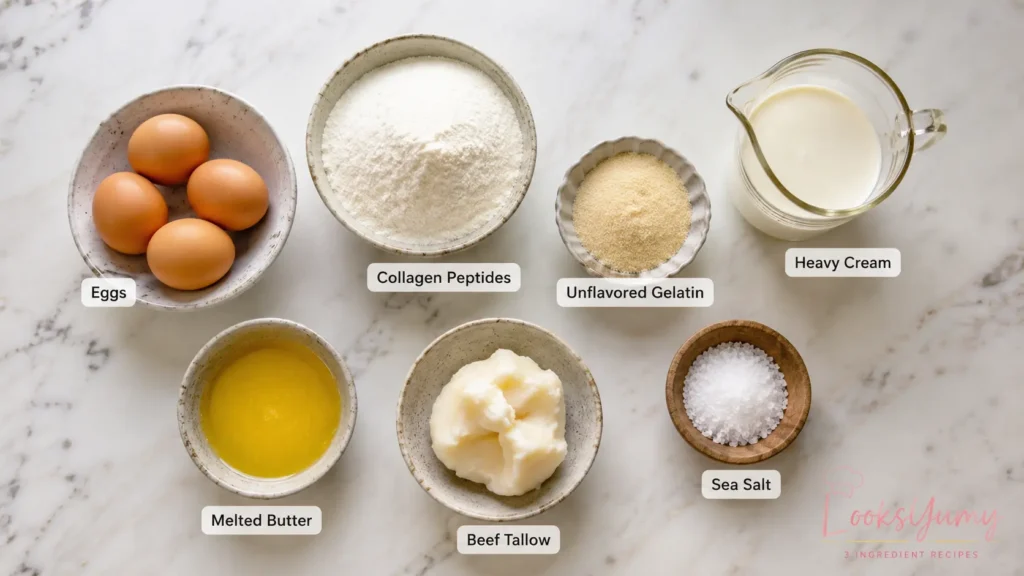
No flour, no starch — the flexibility in this recipe comes from a specific combination of egg protein, added collagen, and just enough fat, which is exactly why skipping or guessing at any one of these tends to end in a batch that tears.
How to Make It
Before You Start Cooking
Before heating the pan, decide how you’ll use the finished crepes.
If they’re for wraps, pour a slightly thicker layer so they can support heavier fillings.
If they’re for rolled desserts, keep the batter as thin as possible. A thinner crepe stays softer, folds more easily, and creates cleaner layers once filled.
1. Bloom the gelatin first. Sprinkle the collagen peptides or gelatin over the water in a small bowl and let it sit for 2–3 minutes. This step hydrates the protein before it goes anywhere near heat, which matters more than it sounds like it should for how the crepe holds together later.
2. Whisk the eggs until smooth, not foamy. Whisk just until the yolks and whites are fully combined. You’re not trying to add volume here — a foamy, aerated batter bakes up thicker and more like a soft egg pancake than a thin crepe.
3. Add the bloomed gelatin, cream, melted fat, and salt. Whisk everything together until the batter looks completely smooth with no streaks or lumps. The batter should be noticeably thinner than a pancake batter — closer to heavy cream than to a cake mix.
4. Heat a non-stick or well-seasoned pan over medium heat. Add a small amount of butter or tallow and let it get hot enough that a drop of batter sizzles gently on contact. A pan that’s too cool is one of the most common reasons crepes stick and tear when you try to flip them.
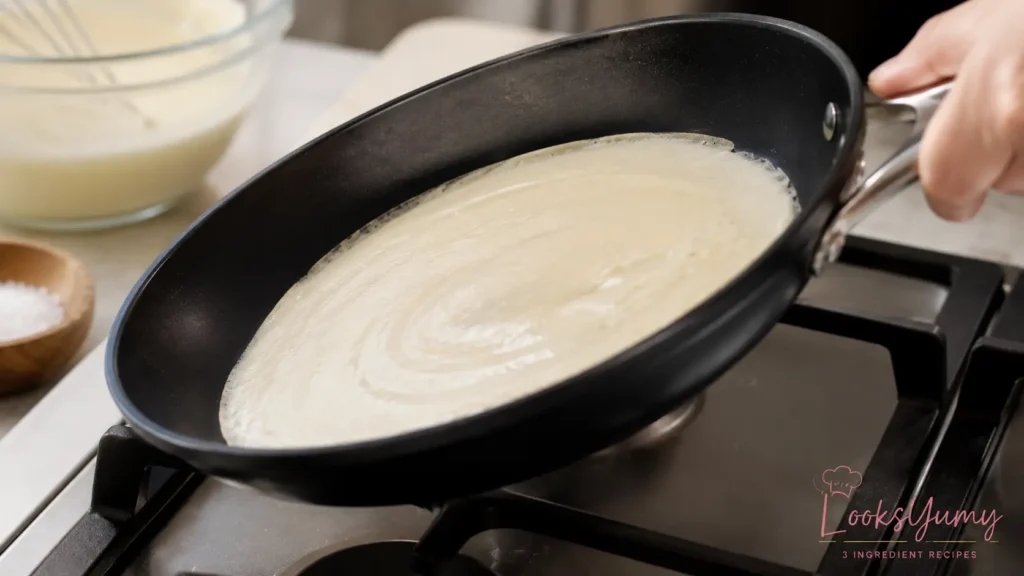
5. Pour a thin layer of batter and swirl immediately. Use about ¼ cup of batter for an 8-inch pan, pouring it in and tilting the pan right away so it spreads into an even, thin layer before it starts to set.
6. Cook for about 60–90 seconds, until the edges release. Watch the edges, not the center. Once they lift and look slightly dry, and the crepe moves freely when you shake the pan, it’s ready to flip — this is well before it looks fully cooked on top.
7. Flip and cook the second side for 20–30 seconds. The second side needs far less time than the first. Pull it as soon as it’s set but still pale — a crepe cooked too long on the second side turns stiff and tears easily once cooled.
8. Stack cooked crepes with parchment between them. This keeps them from sticking together as they cool and stay warm, ready to fill and roll.
Why This Method Exists
A carnivore crepe has no starch to fall back on for flexibility — a normal wheat crepe stays pliable partly because of how gluten and starch behave when they cool, and none of that is available here. Egg protein is doing the entire structural job, and egg protein has a narrow range between “flexible” and “rubbery” depending on how much heat it gets and for how long.
The Flexible Crepe Method controls that range from two directions at once. It adds a small amount of hydrated gelatin or collagen, which forms a soft, pliable gel network alongside the coagulated egg protein instead of a stiff one, and it keeps the cook time short and the batter thin so the eggs never get the chance to overcook and tighten. Both of those choices work in the same direction — toward a texture that bends instead of cracks.
Use this approach any time you need an egg-based wrap or thin sheet with no starch — this applies just as well to a savory carnivore wrap as it does to this specific crepe recipe. If a recipe skips the gelatin step or cooks the batter low and slow like a frittata, expect a thicker, less flexible result no matter how thin you try to pour it.
Choosing Your Ingredients
Whole eggs versus separated eggs comes down to how much structure versus lightness you want. Whole eggs give you the full protein-and-fat balance this recipe is built around, while separating the eggs and whipping the whites before folding them back in adds air that makes a noticeably lighter, softer crepe — closer to a delicate French-style crepe than a sturdy wrap.
| Option | Texture | Best For |
|---|---|---|
| Whole eggs (recommended) | Balanced, sturdy enough to roll and fill | Wraps, everyday use |
| Separated, whites whipped | Lighter, more delicate | Dessert-style crepes, careful handling |
Collagen peptides and gelatin do a similar job but behave a little differently once they’re in the batter. Collagen peptides are more broken down and don’t set into a firm gel, which gives a softer, more consistently pliable crepe, while gelatin forms more of a true gel structure that adds a bit more chew and hold. USDA research on collagen and gelatin production notes that gelatin is essentially collagen broken down through cooking or processing, which is exactly why the two behave on a spectrum rather than as completely different ingredients.
| Option | Texture Effect | Best For |
|---|---|---|
| Collagen peptides | Softer, evenly flexible | Most bakers, easiest to work with |
| Unflavored gelatin | Slightly more structured, a bit more chew | Crepes meant to hold heavier fillings |
Heavy cream versus coconut cream changes both fat content and flavor. Heavy cream is close to 36% fat with very little else going on, while coconut cream carries a similar or higher fat percentage alongside its own distinct flavor and a different fat profile. If you want a neutral-tasting crepe, heavy cream is the safer choice; if a mild coconut flavor fits what you’re filling the crepe with, coconut cream works as a fair swap in similar quantities.
| Option | Fat % (approx.) | Flavor | Best For |
|---|---|---|---|
| Heavy cream | ~36% | Neutral, mild dairy | Default, savory or sweet fillings |
| Coconut cream | ~30-40% | Distinct coconut flavor | Sweet fillings, dairy-free preference |
Butter versus beef tallow in the batter itself is a smaller decision than it is in something like brownies, since it’s a small quantity mostly there for pan release and a touch of richness. Butter gives a slightly rounder flavor, while tallow keeps things more neutral and lets the egg flavor lead — either works, and the choice mostly comes down to what you’re filling the crepes with.
Thin crepes are more flexible and roll more easily but hold less filling per layer, while a slightly thicker crepe is a little sturdier for heavier, wetter fillings but sacrifices some of that easy fold. If you’re making wraps for something substantial, err slightly thicker; for delicate rolled fillings, keep the batter as thin as it will reasonably spread.
Sweet fillings and savory fillings both work with this exact same base — the batter itself carries no sweetness or strong flavor, which is part of what makes it so versatile. For wraps, keep the crepe on the sturdier side and let it cool slightly before filling so it holds its shape; for a breakfast roll-up, filling it warm right off the pan gives the softest, most tender result.
Fresh crepes have the best texture right off the pan, but they hold up well made ahead too — stacked with parchment between them and kept in the fridge, they reheat gently in a warm pan without losing much flexibility. This makes them a solid meal-prep option compared to some other carnivore recipes that don’t reheat as gracefully.
What’s Actually Happening in the Pan
Protein coagulation is the foundational science here, same as in a custard or cheesecake — as the eggs heat, their proteins unfold and link together into a network that holds the crepe’s shape. The difference is how thin and quick this cook is: a crepe spends far less time at heat than a baked custard, which is exactly why it firms up into a flexible sheet instead of a set, jiggly texture.
Collagen hydration is a separate process happening alongside that egg coagulation. When you bloom gelatin or collagen peptides in water before adding them to the batter, the protein strands absorb moisture and begin to soften and unwind, which lets them integrate smoothly into the egg mixture instead of clumping. Skipping this step and adding dry collagen straight to the batter is a common reason for a gritty texture or uneven set.
Moisture retention explains a lot of the difference between a soft, pliable crepe and a dry, tearable one. The fat in the recipe — the cream and melted butter or tallow — coats the egg proteins as they set, which slows moisture loss during cooking and keeps the finished crepe supple rather than dried out. Cut the fat too far and the crepe will taste fine but tear the moment you try to roll it.
The same egg proteins that give these crepes their structure also create the rich texture found in carnivore cheesecake, although the cooking method and final texture are completely different.
Fat distribution also affects how evenly the crepe cooks and releases from the pan. A batter with fat mixed evenly throughout, rather than just brushed on top of the pan, cooks more uniformly and browns more evenly at the edges, which is part of why whisking the fat fully into the batter works better than trying to compensate with extra pan grease alone.
Carryover cooking matters here too, even though the cook time is short. A crepe pulled at the very edge of doneness continues to firm up slightly as it cools on the stack, which is why pulling it a touch earlier than feels intuitive usually gives the better result once it’s had a minute to rest.
Whipping egg whites separately, when you choose that route, incorporates air that expands slightly during the brief cook and creates a lighter, softer crumb within the crepe itself. This is a legitimate variation for a more delicate, dessert-style crepe, but it works against you if you’re trying to build a sturdier wrap for a heavier filling.
| Problem | Cause | Fix |
|---|---|---|
| Crepe tears when rolled | Not enough fat or gelatin, or overcooked | Check ratios, pull the crepe as soon as edges set |
| Rubbery texture | Cooked too long, or batter too thick | Cook briefly, thin the batter, watch edges not the clock |
| Crepe is too thick | Too much batter poured, or not swirled fast enough | Use less batter, swirl the pan immediately after pouring |
| Sticking to the pan | Pan not hot enough, or not enough fat | Preheat fully, test with a drop of batter before pouring |
| Gritty or uneven texture | Collagen or gelatin added dry, not bloomed | Always bloom in water first before adding to batter |
| Cracks after cooling | Overcooked, or cooled without stacking flat | Pull slightly earlier, stack flat with parchment between layers |
| You Want | Adjust This |
|---|---|
| More flexible, softer crepe | Increase collagen peptides slightly, reduce cook time |
| Sturdier crepe for wraps | Use gelatin instead of peptides, cook a touch longer |
| Thinner crepe | Use less batter per pour, swirl faster |
| Richer flavor | Swap heavy cream for coconut cream, or add extra butter |
| Cooking Temperature | Result |
|---|---|
| Low-medium | Cooks too slowly, risks a thicker, more rubbery texture |
| Medium (recommended) | Quick, even cook with flexible texture |
| Medium-high | Faster but higher risk of uneven browning or tearing on flip |
| High | Not recommended — cooks too fast for even protein set |
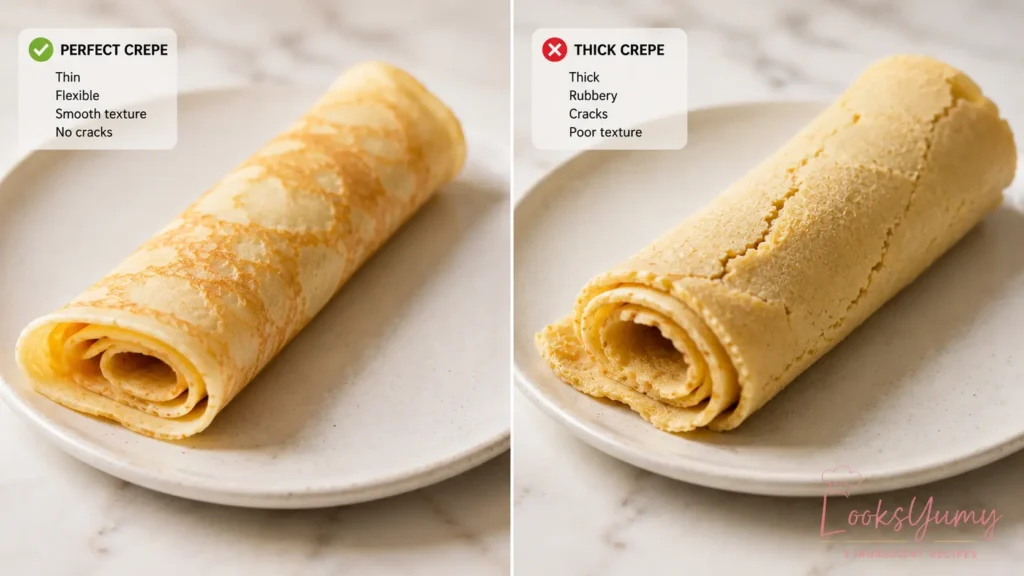
Read Your Crepe Before You Fill It
A carnivore crepe tells you a lot before you ever add a filling. Learning these visual cues makes it much easier to adjust your next batch without guessing.
| What You See | What It Usually Means |
|---|---|
| Smooth, pale surface | Perfectly cooked and ready to roll |
| Dark brown spots | Pan was slightly too hot |
| Thick center | Too much batter or not enough swirling |
| Dry edges | Cooked a little too long |
| Small cracks while lifting | Slightly overcooked or not enough fat |
If Something Goes Wrong
The real issue behind most tearing crepes is timing on the flip, not the recipe itself — pulling a crepe too early leaves it too soft to move, while leaving it too long tightens the egg protein past the point of flexibility.
If your crepes are consistently coming out thick, check how much batter you’re pouring and how fast you’re swirling the pan. A few extra seconds before the batter sets is often the difference between a crepe you can roll and one that’s closer to a thin omelet.
If they taste fine but crack the moment you try to fold them, this almost always traces back to too little fat or collagen relative to egg. Increasing either slightly, or making sure your gelatin was properly bloomed, usually solves it within a batch or two.
If crepes stick stubbornly to the pan, the pan likely wasn’t hot enough when the batter went in. Test with a small drop of batter before pouring the full amount — it should sizzle gently right away.
What I Learned Making This the Hard Way
In my first batches of carnivore crepes, I skipped the gelatin step entirely, figuring eggs alone would hold together fine since that’s essentially what a crepe is. The batter cooked up thin enough, but every single one cracked the moment I tried to roll it, even when I pulled them off the heat quickly.
I assumed the problem was cook time, so I started pulling them earlier and earlier. That helped a little, but even a crepe cooked for barely a minute still tore along the fold line as soon as it cooled.
One thing I also noticed is that letting the finished crepes rest for about five minutes before filling them made rolling much easier. Fresh off the pan they were still releasing steam, but after a short rest they became noticeably more flexible without drying out.
The actual gap was structural, not a timing issue. Egg protein alone sets into a texture that’s more stiff than flexible once it cools, and without something to soften that network, no amount of adjusting the heat was going to fix it. Adding bloomed gelatin changed everything — the same eggs, the same pan, the same cook time, but a completely different, foldable result once that gelatin was properly hydrated and mixed in.
Where This Fits in the Carnivore Breakfast World
Zero carb carnivore crepes share more with other recipes in this hub than they might seem to at first, and understanding those connections makes the whole category easier to work with.
Carnivore pancakes rely on a similar egg-and-fat base but skip the flexibility requirement entirely, which is why they’re cooked thicker and don’t need the added gelatin this recipe depends on — a pancake is allowed to be a little more set and sturdy since it’s never being rolled.
Carnivore waffles push egg protein even further toward a firm, structured set, using higher heat and longer cook times since a waffle’s texture goal is crisp rather than pliable — a useful contrast if you’re trying to understand why this crepe recipe cooks so differently.
| Recipe | Texture | Best Use |
|---|---|---|
| Carnivore Crepes | Thin & flexible | Wraps and rolled desserts |
| Carnivore Pancakes | Thick & fluffy | Breakfast |
| Carnivore Waffles | Crisp outside | Crispy meals |
| Carnivore Custard | Silky | Spoon desserts |
Carnivore custard and carnivore cheesecake both depend on the exact same protein coagulation science covered above, just at a much longer cook time and lower temperature, which is why they set into a jiggly, sliceable texture instead of a thin, foldable one.
For more on ingredient behavior, our ingredient guides and breakfast science pages cover egg protein and collagen behavior in more depth than fits into a single recipe, and our troubleshooting guides cover tearing, sticking, and texture issues across multiple carnivore breakfast recipes, not just this one.
A few things worth remembering:
- A flexible crepe is created by gentle heat, not extra ingredients.
- Egg protein alone sets stiff — collagen is what teaches it to bend instead of crack.
- The edges tell you when to flip. The center will lie to you every time.
- A crepe that looks slightly underdone on top is usually a crepe that’s about to fold perfectly.
- Tearing isn’t a pan problem. It’s almost always a protein-and-fat ratio problem wearing a pan problem’s disguise.
“The best carnivore crepes aren’t judged by how brown they are—they’re judged by how easily they bend without breaking.”
Best Fillings for Different Crepes
| Filling | Best Served |
|---|---|
| Whipped cream | Cold crepes |
| Cream cheese | Warm or cold |
| Melted butter | Warm crepes |
| Ground beef | Warm wraps |
| Scrambled eggs | Breakfast crepes |
Common Questions
Why do my carnivore crepes keep tearing when I roll them?
This usually means too little fat or collagen relative to egg, or the crepe was cooked slightly too long. Check your ratios first, then watch your cook time.
Can I make these without gelatin or collagen peptides?
You can, but expect a stiffer, more tear-prone result, since egg protein alone doesn’t have the same pliability once it cools. The gelatin step is doing real structural work, not just adding nutrition.
How do I know when to flip a crepe?
Watch the edges, not the center or a timer. Once the edges lift and look slightly dry and the crepe moves freely in the pan, it’s ready.
Can I use coconut cream instead of heavy cream?
Yes, in similar quantities. It brings its own distinct flavor and a different fat profile, so expect a slightly different taste, but the texture holds up well.
Can I make carnivore crepes ahead of time?
Yes — stack them with parchment paper between layers and refrigerate. Reheat gently in a warm pan, and they’ll stay flexible enough to fill and roll.
Why did my batter turn out gritty?
This usually means the gelatin or collagen peptides were added dry instead of bloomed in water first. Always hydrate them before mixing into the eggs.
Zero carb carnivore crepes are one of the more technical recipes in this hub, mostly because there’s no starch to hide behind if the protein and fat balance is off. Get the gelatin bloomed properly, keep the batter thin, and watch the edges instead of the clock.
That’s really the whole method — a little collagen, a little fat, and just enough heat to set the eggs without tightening them past the point of bending.
Looking for more animal-based treats? Explore our complete Carnivore Desserts collection for cheesecakes, custards, brownies, and other zero-carb recipes made with simple ingredients.