If you’ve already got standard egg-white buns down and moved on to heavy cream powder for extra richness, you’ve probably run into the same wall most advanced bakers hit: the buns come out heavier, sometimes with a slightly wet or gummy bottom, even though the recipe looks nearly identical on paper. The real issue is weight, not flavor — heavy cream powder carries a lot more fat per scoop than liquid cream or egg whites alone, and that fat sits on top of a whipped egg foam like a weight on a balloon, pressing the air back out before the bun ever sets in the oven.
That’s the exact problem the Moisture Balance System is built to solve: instead of dumping the cream powder in all at once, you manage how much fat hits the foam and when, so the bun keeps its lift instead of collapsing under its own richness. Once you see it as a weight-versus-air problem rather than an ingredient problem, the fixes below get a lot more intuitive.
Understanding the correct carnivore dough consistency before baking makes it much easier to support heavier ingredients like cream powder without losing volume.
Heavy cream powder doesn’t make buns dense by itself. Density happens when concentrated fat overwhelms the air trapped inside the whipped egg whites before the proteins have a chance to set in the oven.

Table of Contents
Table of Contents
Quick-View Comparison & Macros
| Standard Egg-White Bun | Looksyumy Heavy Cream Bun | |
|---|---|---|
| Prep Time | 10 minutes | 14 minutes |
| Bake Time | 15 minutes | 18 minutes |
| Calories | 55 per bun | 88 per bun |
| Protein | 6g per bun | 6g per bun |
| Fat | 2g per bun | 6g per bun |
| Carbs | 0.5g per bun | 1g per bun |
The Master Recipe
Most dense heavy cream buns aren’t caused by the ingredient itself. They’re caused by how that ingredient is introduced into the batter.
Ingredients
- 6 large egg whites (or ¾ cup liquid egg whites)
- ¼ tsp cream of tartar
- 3 whole eggs
- ⅓ cup heavy cream powder
- 2 tbsp warm water (to loosen the cream powder before folding)
- ½ tsp salt
- Butter or tallow, for greasing
At Looksyumy, richer batter doesn’t require more mixing—it requires better balance.
Step-by-Step Directions
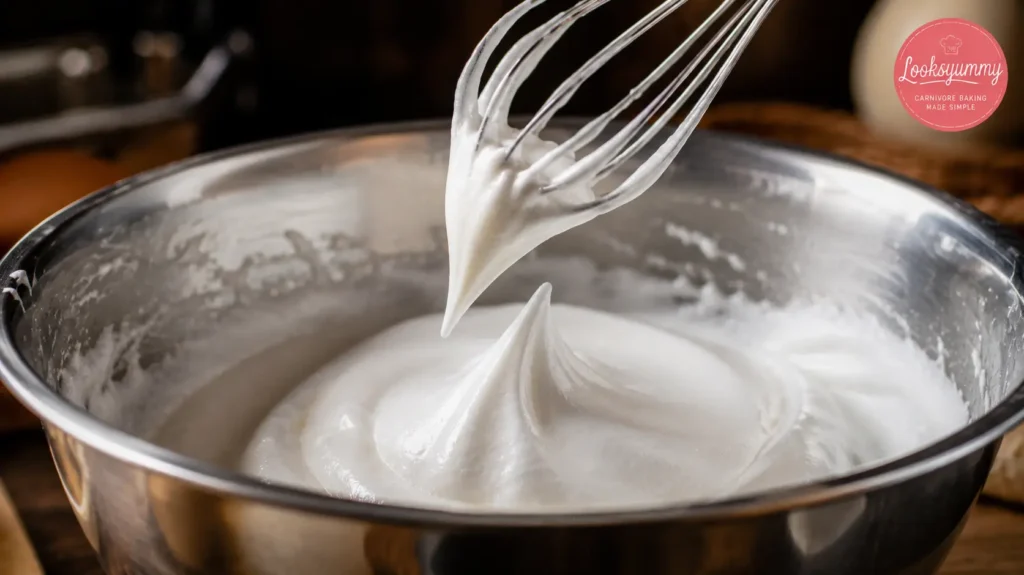
Whip the whites to full volume. Beat the egg whites with the cream of tartar until they hold stiff, glossy peaks. This foam is what carries the weight of the cream powder later, so don’t stop at soft peaks — you need the extra structure.
Loosen the cream powder first. Whisk the heavy cream powder with the warm water and whole eggs until smooth and pourable, with no dry clumps left. Adding it dry straight into the whipped whites is what usually causes pockets of unmixed fat that sink to the bottom during baking.
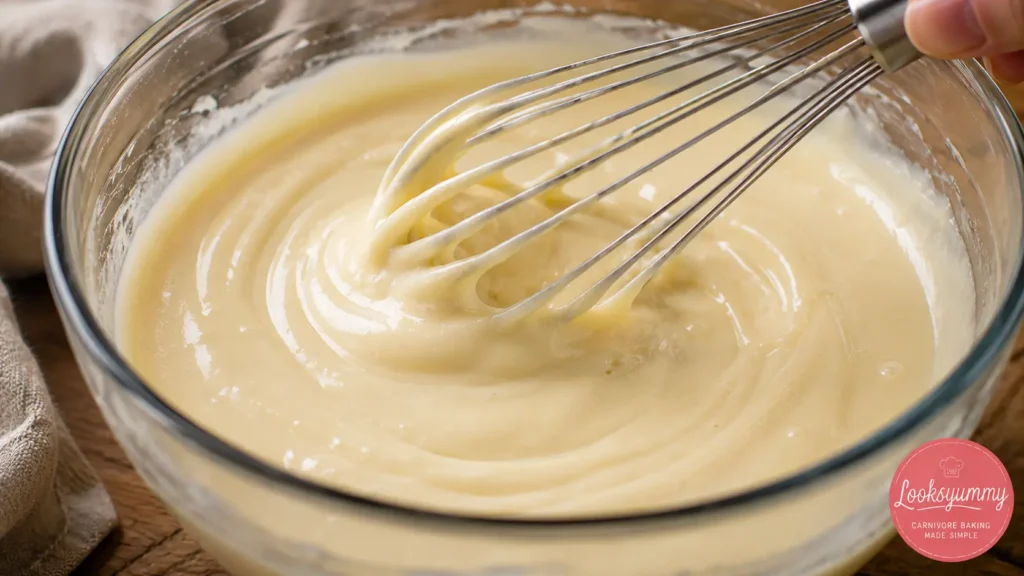
Fold in stages, not all at once. Stir about a third of the whipped whites into the cream mixture to loosen it, then fold that lightened mixture back into the remaining whites in two or three additions. Turn the spatula gently from the bottom of the bowl up and over, stopping as soon as the streaks disappear — every extra stir knocks out air you can’t get back.
Shape, bake, and cool with a plan. Portion into rounds on a greased, parchment-lined sheet and bake at 300°F (149°C) for 16–18 minutes, until the tops are set but still pale. Let the buns cool in the pan for 5 minutes before moving them to a rack — pulling them too early, while the center is still loose, is what leads to a wet bottom once they’re out of the oven.
A soft crumb isn’t created by adding more fat. It’s created by balancing fat with enough trapped air to support it during baking.
Ingredient Science: Making Fluffier Buns Possible
The main reason heavy cream powder behaves differently than liquid cream comes down to what dehydration does to the fat inside it. Removing the water concentrates the fat and milk solids into a dense powder, so a small scoop delivers a lot more richness — and a lot more weight — than the same volume of liquid cream would.
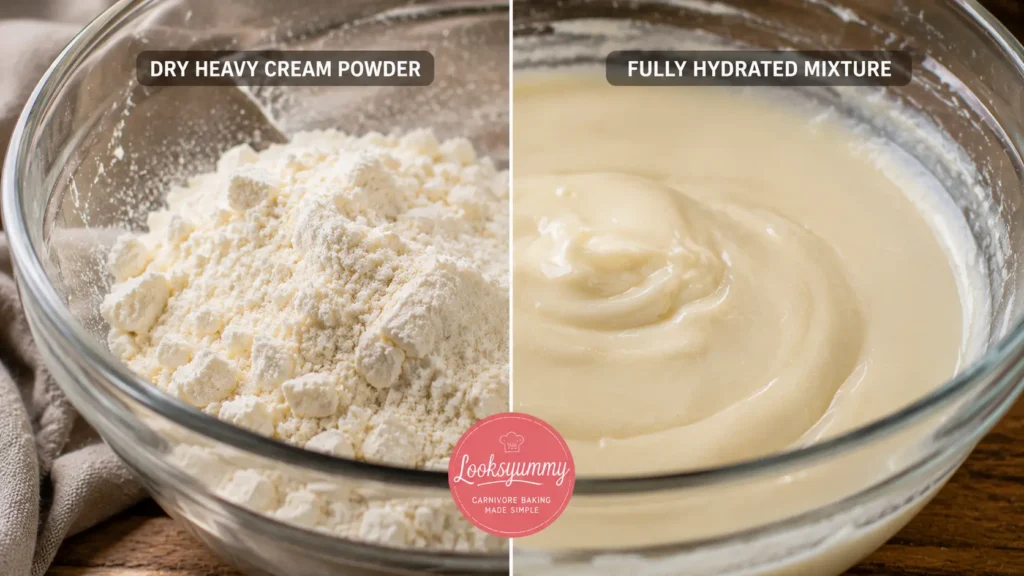
That concentrated fat doesn’t dissolve into a foam the way water does; it needs to be dispersed as small droplets throughout the batter, or it clumps together and drags the structure down. The This moisture-balancing technique works by rehydrating the powder into a smooth liquid before it ever touches the whipped whites, and by folding it in gradually so the fat gets distributed evenly instead of pooling in one spot. That’s the difference between a bun with a fine, even crumb and one with a heavy, greasy layer sitting at the bottom.
The same protein structure used for soft carnivore buns still applies here—the only difference is learning how to manage a richer batter.
Heavy ingredients don’t destroy structure. Poor distribution does.
Troubleshooting & Diagnostics
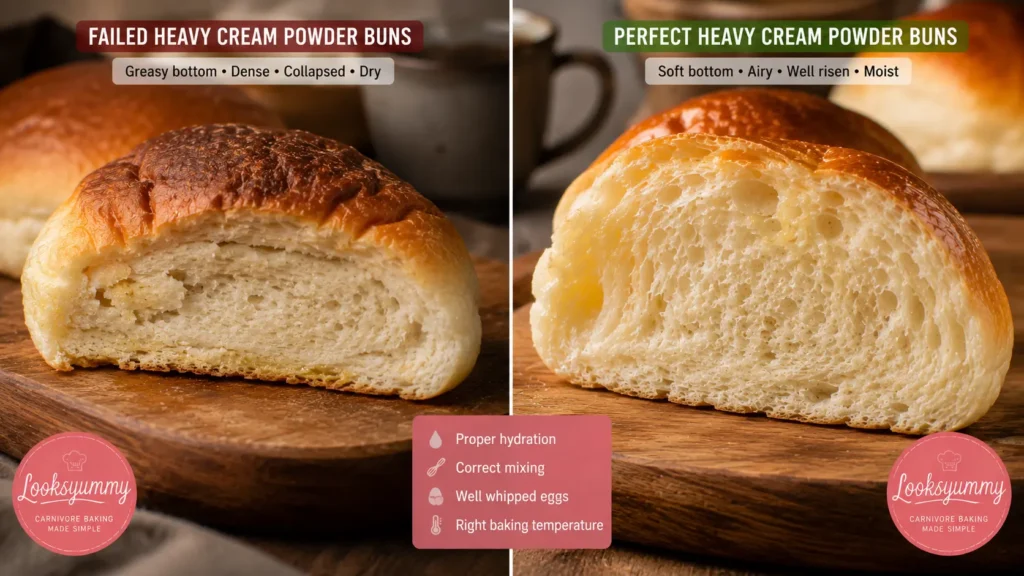
| Problem | Root Cause | Quick Fix |
|---|---|---|
| Wet or greasy bottom | Cream powder fat pooled at the base of the batter instead of distributing evenly | Fully rehydrate the powder into a smooth liquid before folding; don’t add it dry |
| Deflated, flat dome | Whites were under-whipped or over-folded, losing their air before baking | Whip to true stiff peaks and fold in no more than 2–3 additions |
| Rubbery or tough texture | Oven ran too hot, setting the outside before the inside finished rising | Drop the oven to 300°F (149°C) and check a few minutes early |
| Buns collapse after cooling | Pulled from the oven before the centers fully set | Bake until the tops feel firm to a light touch, not just golden |
Expanded Context: The Heavy Cream Bread Guide
In my early kitchen trials, I noticed that scaling this same batter up into a full loaf pan needed a slightly longer, gentler bake — the extra height means the center takes more time to set, so a full sandwich loaf typically wants 300°F for closer to 35–40 minutes instead of the 18 minutes a single bun needs. The core folding method doesn’t change; only the timing does.
Once you’ve got the Once you’ve mastered this technique down at bun scale, it carries over cleanly into other builds in the Buns Hub — a rich Heavy Cream Bread loaf for sandwiches, or an everyday Burger Bun where you want extra richness without the bun falling apart under a patty. Same fat-versus-air balancing act, just adjusted for size and shape.
Once the balance between air and fat becomes predictable, heavy cream powder turns from the hardest carnivore ingredient to one of the easiest to work with.
Fat creates richness. Air protects softness. Great buns need both.
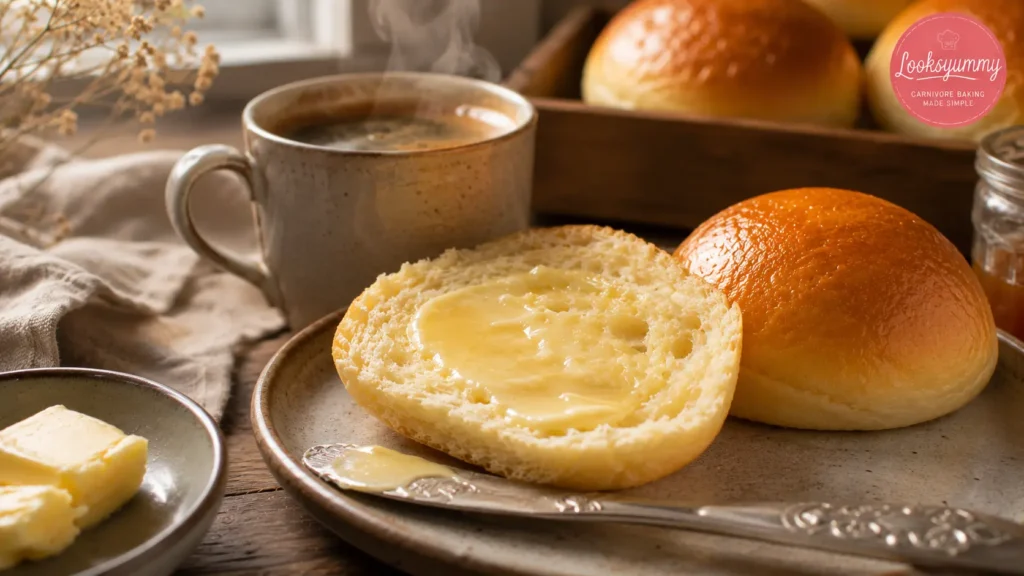

Heavy Cream Powder Carnivore Buns That Stay Soft, Never Dense
- Prep Time: 14 minutes
- Cook Time: 18 minutes
- Total Time: 32 minutes
- Yield: 8 buns 1x
- Category: Bread
- Method: Baking
- Cuisine: Carnivore
- Diet: Gluten-Free
Description
These heavy cream powder carnivore buns are rich, soft, and surprisingly light thanks to a carefully balanced folding method. Rehydrating the cream powder before mixing creates a fluffy crumb while preventing dense, greasy, or collapsed buns. Perfect for burgers, sandwiches, or everyday carnivore baking.
Ingredients
– 6 large egg whites (or 3/4 cup liquid egg whites)
– 1/4 tsp cream of tartar
– 3 whole eggs
– 1/3 cup heavy cream powder
– 2 tbsp warm water
– 1/2 tsp fine sea salt
– Butter or beef tallow for greasing
Instructions
– Preheat oven to 300°F (149°C).
– Grease a baking sheet or muffin-top pan.
– Beat egg whites with cream of tartar until stiff glossy peaks form.
– Whisk heavy cream powder with warm water and whole eggs until smooth.
– Stir one-third of the whipped egg whites into the cream mixture.
– Gently fold the remaining egg whites into the batter in two or three additions.
– Portion into even bun rounds.
– Bake for 16–18 minutes until lightly golden and set.
– Cool in the pan for 5 minutes before transferring to a cooling rack.
Notes
Never add heavy cream powder directly to whipped egg whites. Rehydrating it first improves fat distribution and helps preserve the airy structure. Avoid overmixing after folding and remove the buns before they become deeply golden to keep the crumb soft.
Nutrition
- Serving Size: 1 bun
- Calories: 88
- Sugar: 0.8 g
- Sodium: 165 mg
- Fat: 6 g
- Saturated Fat: 3.8 g
- Unsaturated Fat: 1.9 g
- Trans Fat: 0 g
- Carbohydrates: 1 g
- Fiber: 0 g
- Protein: 6 g
- Cholesterol: 82 mg
Frequently Asked Questions
How long do these heavy cream buns stay fresh?
Stored in an airtight container in the fridge, they hold their texture for about 4 days. For longer storage, freeze them individually wrapped for up to 2 months and thaw in the fridge overnight.
Does the cream powder fully reconstitute during baking, or does it need pre-mixing?
It needs pre-mixing. Heavy cream powder dissolves into a smooth liquid when whisked with warm water and eggs before it goes anywhere near the batter — baking alone won’t fully rehydrate dry powder mixed straight into the foam, which is what leaves those dense, greasy pockets.
Can I substitute liquid heavy cream for the powder, and does the ratio change?
Yes, but the ratios aren’t a straight swap. Since the powder is concentrated, you’ll typically need close to 1 cup of liquid heavy cream to replace ⅓ cup of powder, and you should reduce the added water in the recipe since the liquid cream is already bringing its own moisture.