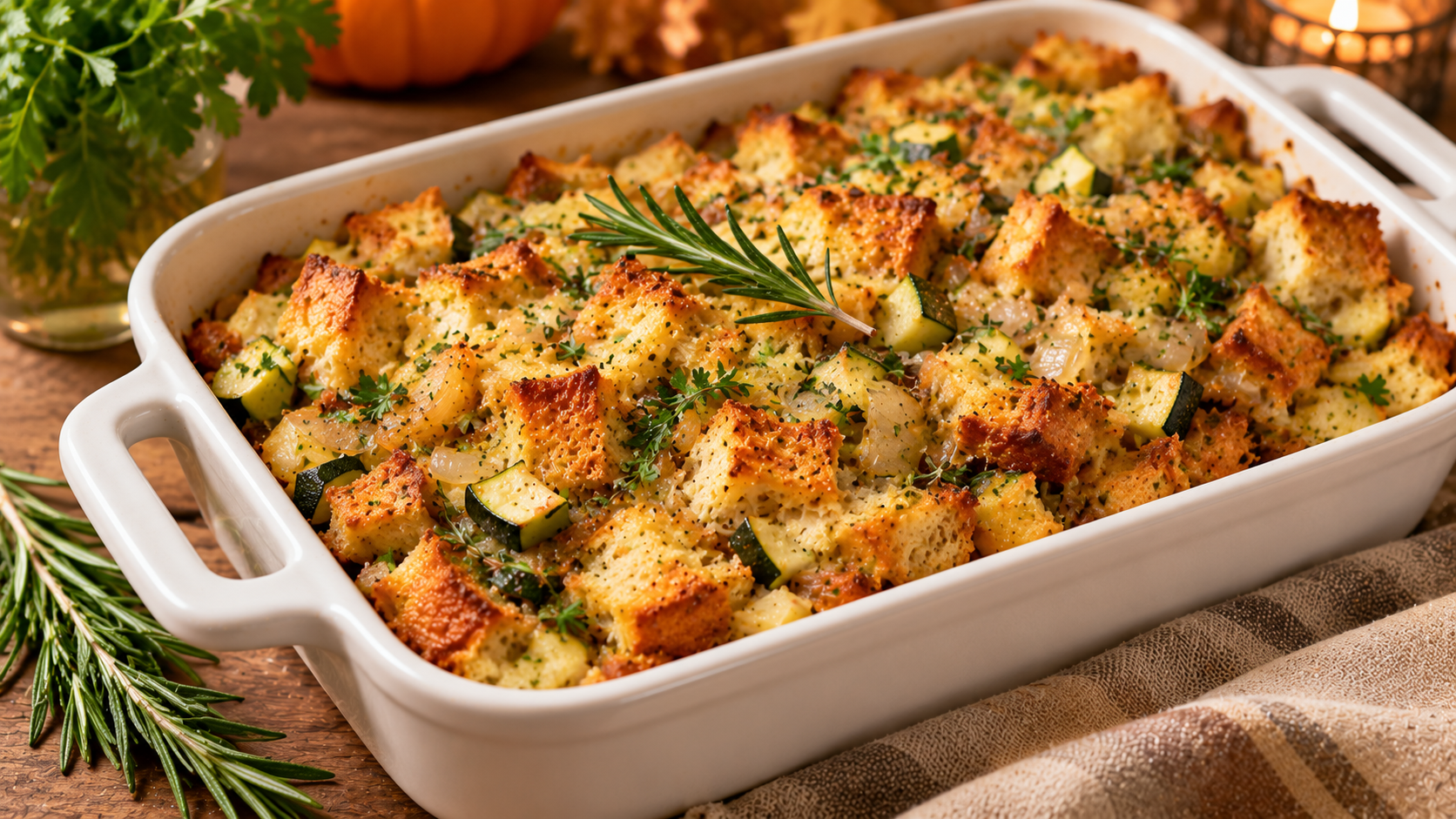
What’s a holiday dinner without a delicious stuffing on the table? If you enjoy traditional stuffing but want an alternative made without regular wheat bread, this Grain-Free Keto Stuffing is worth adding to your holiday menu.
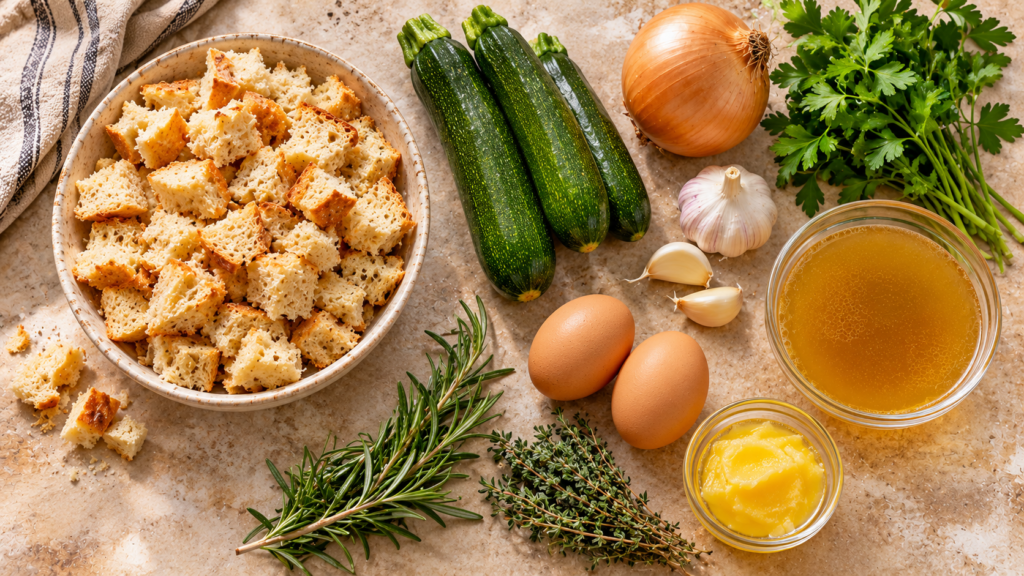
This homemade version combines grain-free bread, zucchini, onion, garlic, parsley, thyme, rosemary, broth, and eggs. The bread absorbs the savory liquid while baking, while the fresh herbs bring the familiar flavors many people associate with Thanksgiving stuffing.
The best part is that you don’t need complicated cooking techniques. Dry the bread, soften the vegetables, combine everything, and bake until the center is set and the top is lightly golden.
There is one important detail when making stuffing with grain-free bread: different breads absorb liquid differently. That’s why adding the broth gradually is one of the most useful steps in this recipe. It helps you avoid a mixture that is too wet before it even reaches the oven.
Whether you’re preparing Thanksgiving dinner, Christmas dinner, or a Sunday roast, this recipe makes a flavorful homemade side dish.
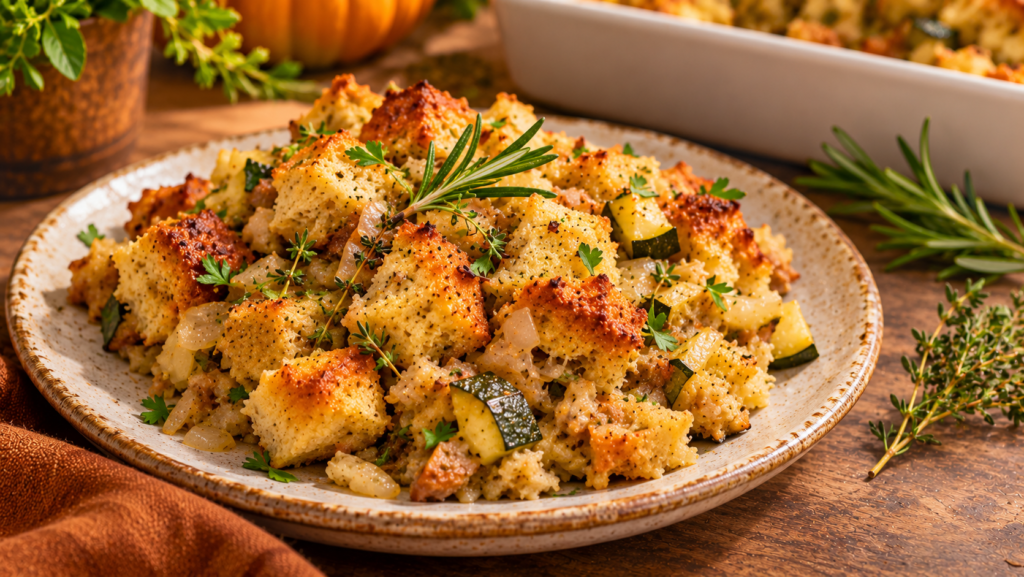
Grain-Free Keto Stuffing at a Glance
| Recipe detail | Information |
|---|---|
| Recipe name | Grain-Free Keto Stuffing |
| Main ingredient | Grain-free bread |
| Vegetables | Zucchini and onion |
| Fresh herbs | Parsley, thyme, rosemary |
| Binding ingredients | Eggs and broth |
| Oven temperature | 350°F (175°C) for baking |
| Bread drying temperature | 200°F (93°C) |
| Prep time | 20 minutes |
| Bread drying time | 15–20 minutes |
| Baking time | Approximately 55 minutes |
| Servings | 8 |
| Best occasions | Thanksgiving, Christmas, holiday dinners |
Important: The recipe can be grain-free when made with suitable grain-free bread, but it is not automatically keto. Check the bread’s carbohydrate content before describing your finished dish as low-carb.
What Makes This Grain-Free Keto Stuffing Different?
Traditional stuffing usually starts with wheat-based bread cubes. This version uses grain-free bread and combines it with zucchini, aromatic vegetables, fresh herbs, broth, and eggs.
There are three details worth understanding before you start:
- The bread determines the texture. A dry, sturdy loaf generally holds its shape better than a soft, freshly baked loaf.
- Zucchini contributes moisture. Cooking it before mixing helps release some of its water.
- The broth needs to be adjusted. The amount absorbed depends on the bread’s density, dryness, and ingredients.
These details matter because grain-free breads are not all made the same way. A recipe that works perfectly with one loaf may need a small liquid adjustment with another.
Grain-Free vs. Keto vs. Gluten-Free Stuffing
These terms describe different things, so it is useful to understand the distinction before choosing your bread.
| Type | What it means | What to check |
|---|---|---|
| Grain-free | Made without grain ingredients | Check the bread ingredients |
| Keto | Designed to fit a low-carbohydrate eating pattern | Check total carbohydrates and serving size |
| Gluten-free | Made without gluten-containing ingredients | Check gluten-free labeling and cross-contact information |
| Paleo | Made according to a particular ingredient philosophy | Check the actual ingredients |
| Traditional sourdough | Usually made with wheat or another grain flour | Not automatically grain-free or keto |
A bread can be grain-free without being low-carb. Likewise, gluten-free bread can still contain starches and carbohydrates.
Why You’ll Love This Grain-Free Keto Stuffing
- A homemade holiday side: A flavorful alternative to conventional bread stuffing.
- Fresh herb flavor: Thyme, rosemary, and parsley give it a familiar savory aroma.
- Zucchini instead of celery: A different vegetable combination that works beautifully in stuffing.
- Easy preparation: The bread, vegetables, broth, and eggs come together in simple steps.
- Make-ahead potential: You can prepare several components before your holiday meal.
Ingredients for Grain-Free Keto Stuffing
Here is what you need to make this recipe.
1. Grain-Free Bread
Use one loaf of grain-free bread, preferably a loaf with enough structure to hold its shape after absorbing broth.
A homemade paleo-style white sandwich bread is one option.
For a keto version, check the carbohydrate content of the bread rather than relying on the words grain-free or paleo alone.
2. Ghee or Coconut Oil
Use one tablespoon of ghee or coconut oil to soften the vegetables.
Ghee provides a buttery flavor, while coconut oil is a dairy-free alternative.
3. Onion
One large diced onion adds sweetness and savory depth.
Keep in mind that onion contains fermentable carbohydrates that can be problematic for some people with IBS.
4. Zucchini
Three large diced zucchini replace celery in this recipe.
Zucchini softens during cooking and contributes moisture. Because it contains a considerable amount of water, cooking it before assembling the stuffing is particularly useful.
5. Garlic
Two minced garlic cloves add aromatic flavor.
Garlic is another ingredient that may trigger symptoms for some people with IBS.
6. Fresh Parsley, Thyme, and Rosemary
The fresh herbs give the stuffing its recognizable holiday flavor.
You’ll need:
- ½ cup chopped parsley
- 1 tablespoon minced fresh thyme
- ½ tablespoon freshly chopped rosemary
Fresh herbs are especially useful here because they distribute their fragrance throughout the bread and vegetable mixture.
7. Cooking Broth
The original recipe uses four cups of cooking broth.
Broth adds savory flavor and moistens the dried bread. However, you may not need every drop.
Start with less and add more gradually until the bread is evenly moistened. The exact amount depends on your loaf.
If you are watching sodium intake or following a specific dietary plan, check the broth label for sodium and other ingredients.
8. Eggs
Two large beaten eggs help bind the stuffing as it bakes.
They contribute to the structure of the finished dish, helping the mixture hold together when served.
9. Salt and Black Pepper
Season to taste. Remember that some commercial broths already contain salt, so taste the vegetable mixture before adding too much.
Ingredient Substitution Guide
| Original ingredient | Possible alternative | What to expect |
|---|---|---|
| Grain-free bread | Suitable paleo bread | Check carbohydrate content for keto suitability |
| Ghee | Coconut oil | Changes the flavor slightly |
| Zucchini | Celery | Gives a more traditional stuffing flavor |
| Fresh thyme | Dried thyme | Use a smaller amount and adjust to taste |
| Fresh rosemary | Dried rosemary | A more concentrated flavor |
| Cooking broth | Homemade broth | Check seasoning and salt content |
| Regular onion | A suitable tolerated alternative | Depends on individual dietary needs |
These substitutions are suggestions, not guaranteed one-to-one replacements. Different breads and vegetables can change the moisture and texture of the finished stuffing.
How to Make Grain-Free Keto Stuffing
Follow these steps for a flavorful stuffing with a moist center and lightly golden top.
Step 1: Cut and Dry the Bread
Preheat your oven to 200°F (93°C).
Tear the grain-free bread into bite-sized pieces and spread them in a single layer on a baking sheet.
Bake for approximately 15–20 minutes.
The goal is to remove some of the bread’s moisture, not necessarily to brown or toast it heavily.
Why does this matter?
Fresh bread is already moist. If you add several cups of broth before drying it, the stuffing may become too soft or heavy. Drying the bread first gives it more room to absorb the seasoned liquid.
Remove the bread from the oven and increase the oven temperature to 350°F (175°C).
Step 2: Cook the Onion and Zucchini
Place a large skillet over medium heat.
Add one tablespoon of ghee or coconut oil.
Add the diced onion and cook until softened.
Stir in the zucchini, minced garlic, parsley, thyme, and rosemary.
Cook for another minute, seasoning with salt and black pepper.
Extra texture tip: If your zucchini releases a lot of liquid, continue cooking until some of that excess moisture evaporates. You want tender vegetables, not a skillet full of watery liquid.
This small step can make a difference to the finished stuffing.
Step 3: Combine the Bread and Vegetable Mixture
Place the dried bread pieces in a large mixing bowl.
Add the cooked vegetable and herb mixture.
Toss gently to distribute the ingredients.
Now begin adding the broth.
Rather than pouring in all four cups immediately, add it in stages. Toss after each addition and give the bread a moment to absorb the liquid.
The mixture should feel moist throughout, but the bread should still retain some structure.
Step 4: Add the Eggs
Beat the two eggs in a separate bowl.
Pour them over the bread mixture and toss gently until everything is evenly combined.
The eggs help bind the stuffing as it bakes.
Avoid crushing the bread while mixing. Keeping some larger pieces intact creates a more interesting texture.
Step 5: Transfer to a Baking Dish
Transfer the mixture to a suitable baking dish.
Spread it evenly without packing it down too tightly.
Cover the dish with a lid or aluminum foil.
Step 6: Bake Until Set
Bake at 350°F (175°C) for approximately 45 minutes, covered.
Remove the lid or foil and bake for another 10 minutes, or until the top is lightly golden.
Because bread types and baking dishes vary, use the texture and temperature of the center as your guide. Since this recipe contains eggs and broth, the center should reach 165°F (74°C) for food safety.
Allow the stuffing to rest briefly before serving.
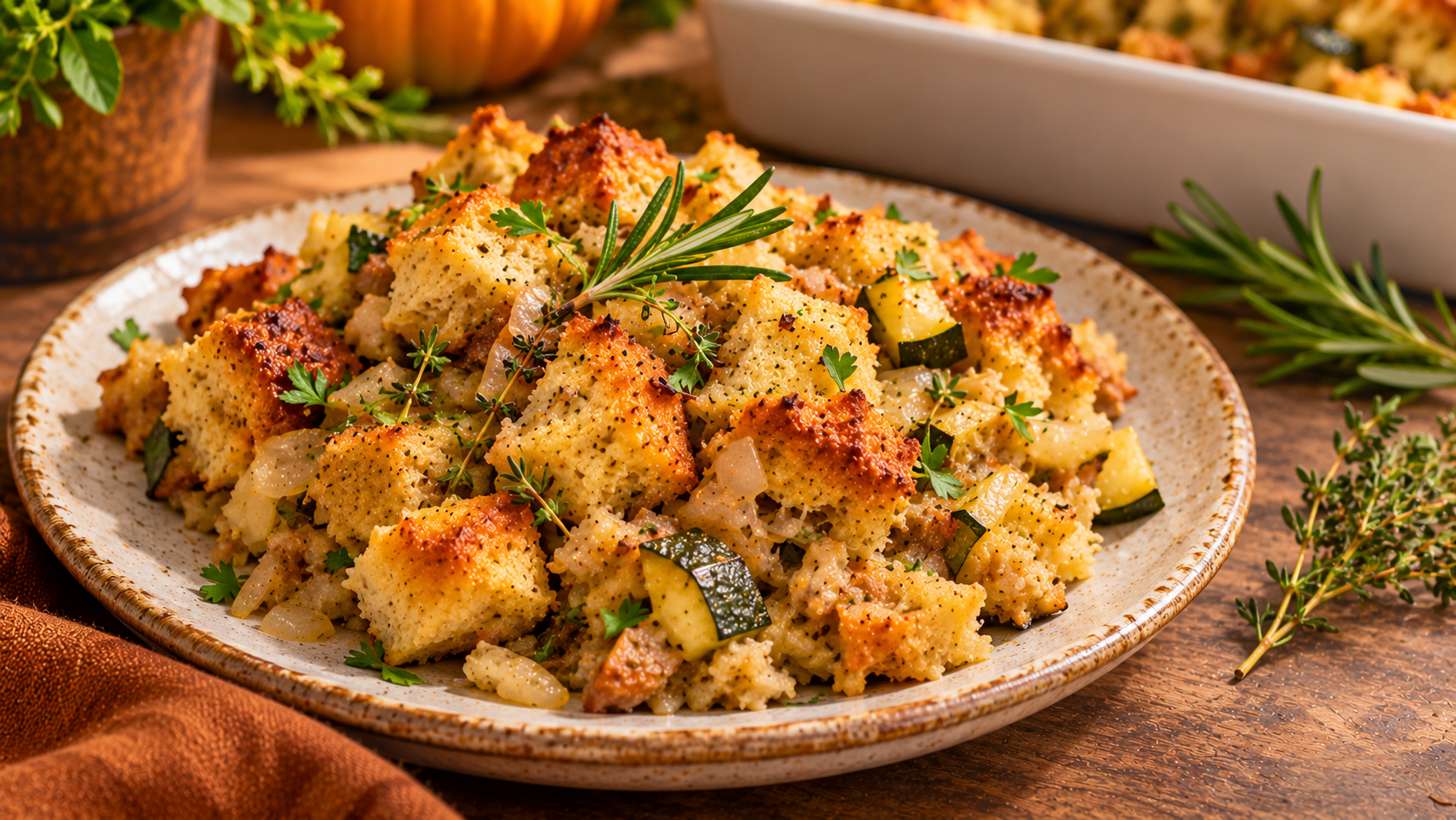
How to Keep Grain-Free Stuffing From Becoming Soggy
This is one of the most important parts of making a good grain-free stuffing.
Unlike conventional bread, grain-free bread recipes can have very different textures. Some are soft and moist, while others are dense or crumbly.
Here are the main things to watch.
Dry the Bread Before Adding Broth
Don’t skip the bread-drying step.
The purpose is to remove excess moisture so the pieces can absorb the broth more evenly.
If your bread is particularly soft, you may need a little more drying time. Check it rather than relying only on the clock.
Don’t Pour in All the Broth at Once
Four cups is the quantity listed in the original recipe, but it should not be treated as a guaranteed amount for every loaf.
Start with part of the broth and add more only as needed.
| What you notice | What it means | What to do |
|---|---|---|
| Bread is dry and firm | It may need more liquid | Add broth gradually |
| Bread is moist but holds its shape | Good starting texture | Stop adding broth |
| Liquid pools at the bottom | Too much broth has been added | Avoid adding more |
| Bread turns into a paste | The mixture is too wet or has been overmixed | Check bread moisture and liquid quantity next time |
| Top browns before center sets | The center needs more baking time | Cover again and continue baking while monitoring temperature |
A good visual guide is:
- The bread feels moist.
- There is no large pool of liquid at the bottom.
- The pieces are still recognizable.
- The mixture is not falling apart into a paste.
Cook the Zucchini First
Zucchini releases water as it cooks.
If you mix it into the bread while it is still sitting in excess liquid, the stuffing may become wetter than expected.
Cooking the vegetables first helps you control the moisture.
Choose the Right Baking Dish
A deep, tightly packed mixture can take longer to heat through than a shallow, evenly spread one.
Spread the stuffing evenly and avoid compressing it too much.
Give the Stuffing Time to Rest
After baking, allow the stuffing to rest briefly.
This gives the egg mixture time to settle and makes serving easier.
What Bread Works Best for Grain-Free Keto Stuffing?
The bread is one of the most important decisions in this recipe.
You want a loaf that can absorb broth without completely losing its shape.
| Bread option | Grain-free? | Keto-friendly? | Texture considerations |
|---|---|---|---|
| Grain-free sandwich bread | Depends on ingredients, but can be | Not automatically | Check moisture and structure |
| Paleo bread | Often, depending on recipe | Not automatically | Can vary from soft to dense |
| Traditional wheat sourdough | No | Not generally | Can provide a familiar bread texture |
| Gluten-free bread | Not necessarily | Not automatically | Often contains starches |
Grain-Free Sandwich Bread
A grain-free sandwich loaf is a natural choice for this recipe.
Choose a loaf that is sturdy enough to be torn into pieces and dried before use.
Paleo Bread
Paleo bread can work as a grain-free option, depending on its ingredients.
However, paleo does not automatically mean keto. Some paleo breads contain ingredients that contribute more carbohydrates than expected.
Traditional Sourdough
Traditional sourdough can be used as an alternative if you are not following a strict grain-free or keto eating pattern.
It should not be described as grain-free or automatically low-carb simply because it is fermented.
My recommendation: For this recipe, choose the bread according to your dietary requirements first, then adjust the broth according to its texture.
How to Adjust the Recipe for Different Bread Textures
| If your bread is… | Try this approach |
|---|---|
| Very soft | Dry it thoroughly before mixing |
| Dense | Add broth slowly and allow time for absorption |
| Crumbly | Mix gently to avoid breaking it down further |
| Already dry | Check the texture as you add broth |
| Freshly baked | Allow it to dry before assembling |
This is why the broth should be treated as an adjustable ingredient rather than a fixed quantity that must always be used in full.
Is This Grain-Free Keto Stuffing IBS-Friendly?
The original recipe was inspired by an IBS-conscious approach, including zucchini instead of celery.
However, there is an important distinction between a recipe that uses a few potentially gentler substitutions and one that has been properly evaluated for a low-FODMAP diet.
Grain-free does not automatically mean IBS-friendly.
Two ingredients deserve particular attention:
- Onion: Contains fructans, a type of fermentable carbohydrate that can trigger symptoms in some people with IBS.
- Garlic: Also contains fructans and may be poorly tolerated by some people.
Broth and bread can also contain ingredients that matter to someone following an IBS-conscious eating plan.
Possible Ingredient Adjustments
Depending on individual tolerance and professional dietary guidance, some alternatives may include:
- Garlic-infused oil instead of pieces of garlic.
- The green tops of spring onions instead of regular onion.
- A broth with ingredients that fit the person’s dietary plan.
- A suitable low-FODMAP bread instead of an unverified grain-free loaf.
These changes do not automatically make the recipe low-FODMAP. Portion size, ingredients, and individual tolerance still matter.
If you’re following a structured low-FODMAP elimination or reintroduction plan, check the recipe with a registered dietitian who understands IBS.
Can You Make Grain-Free Keto Stuffing Ahead of Time?
Yes. Preparing some of the components in advance can make holiday cooking much easier.
The Day Before
You can:
- Tear and dry the bread.
- Allow it to cool completely.
- Store it in an airtight container in a cool, dry place.
- Cook the vegetable and herb mixture.
- Refrigerate the cooked vegetables in a covered container.
Before Baking
When you’re ready to prepare the stuffing:
- Combine the bread and refrigerated vegetable mixture.
- Add the broth gradually.
- Mix in the beaten eggs.
- Transfer to your baking dish.
- Bake until the center reaches 165°F (74°C).
For food safety, refrigerate prepared ingredients promptly. Do not leave the egg-and-broth mixture at room temperature for an extended period.
How to Store Leftover Grain-Free Stuffing
If you have leftovers, proper storage helps maintain quality and food safety.
| Storage method | Recommended guidance |
|---|---|
| Refrigerator | Store in airtight, shallow containers for 3–4 days |
| Freezer | Freeze portions for approximately 2–3 months for best quality |
| Reheating | Heat until the center reaches 165°F (74°C) |
| Thawing | Thaw in the refrigerator before reheating |
Transfer cooked stuffing to shallow containers and refrigerate within two hours.
When reheating, add a small amount of broth if the stuffing has become dry.
What to Serve With Grain-Free Keto Stuffing
This savory stuffing is a natural addition to a holiday dinner.
Try serving it alongside:
- Roasted turkey
- Herb-roasted chicken
- Roast beef
- Roasted vegetables
- Homemade gravy
- A fresh holiday salad
For Thanksgiving, it works especially well as part of a table filled with roasted meats and homemade side dishes.
Common Grain-Free Stuffing Mistakes to Avoid
| Mistake | Why it affects the result | Better approach |
|---|---|---|
| Skipping the bread-drying step | Bread may become too soft | Dry bread before assembling |
| Adding all the broth immediately | Different breads absorb different amounts | Add gradually |
| Leaving excess zucchini liquid | Adds unwanted moisture | Cook vegetables until excess liquid evaporates |
| Packing the dish too tightly | Makes heating less even | Spread the mixture evenly |
| Baking without checking the center | The middle may remain undercooked | Check the center temperature |
| Using bread without checking its ingredients | Grain-free does not guarantee keto | Read the bread’s nutrition label |
Frequently Asked Questions
Is grain-free stuffing automatically keto?
No. Grain-free bread can still contain carbohydrates from ingredients such as starches, nuts, seeds, or other flour alternatives. Check the nutrition label and serving size if you’re following a low-carb eating pattern.
Can I make this stuffing without celery?
Yes. This recipe uses zucchini instead of celery. Dice the zucchini evenly and cook it before combining it with the bread.
Why is my grain-free stuffing soggy?
Common reasons include bread that was not dried enough, too much broth, excess moisture from zucchini, or a mixture that was packed too tightly. Add the broth gradually and cook the vegetables until excess liquid has evaporated.
Can I use sourdough bread?
Yes, if you are not following a strict grain-free or keto eating pattern. Traditional sourdough is generally made with grain-based flour, so it is not a grain-free substitute.
Can I use dried herbs instead of fresh herbs?
Yes. Dried parsley, thyme, and rosemary can be used when fresh herbs are unavailable. Start with smaller quantities because dried herbs are more concentrated, then adjust to taste.
Can I prepare grain-free stuffing the night before?
Yes. Dry the bread and cook the vegetables ahead of time. Store them separately in appropriate containers, then combine with broth and eggs closer to baking time.
How do I know when stuffing is fully cooked?
The top should be lightly golden and the center should be hot and set. Because this recipe contains eggs and broth, use a food thermometer to check that the center reaches 165°F (74°C).
Is zucchini better than celery in stuffing?
Neither is universally better. Zucchini has a different texture and releases more moisture during cooking. It works well in this recipe when cooked first, but celery is also an option if it suits your preferences.
Can I freeze grain-free stuffing?
Yes. Cool the cooked stuffing, divide it into portions, and freeze in airtight freezer-safe containers. Thaw in the refrigerator and reheat until the center reaches 165°F (74°C).
Final Thoughts
This Grain-Free Keto Stuffing brings together dried bread, zucchini, onion, garlic, fresh herbs, broth, and eggs for a flavorful homemade holiday side dish.
The secret to a good result is not simply following the ingredient list. It’s understanding how your bread absorbs liquid, controlling the moisture from the vegetables, and allowing the stuffing to bake until the center is properly set.
Make the components ahead, adjust the broth to your bread, and serve it alongside your favorite holiday main dish.
If you try this recipe, save it for your next Thanksgiving or Christmas dinner!
for what more