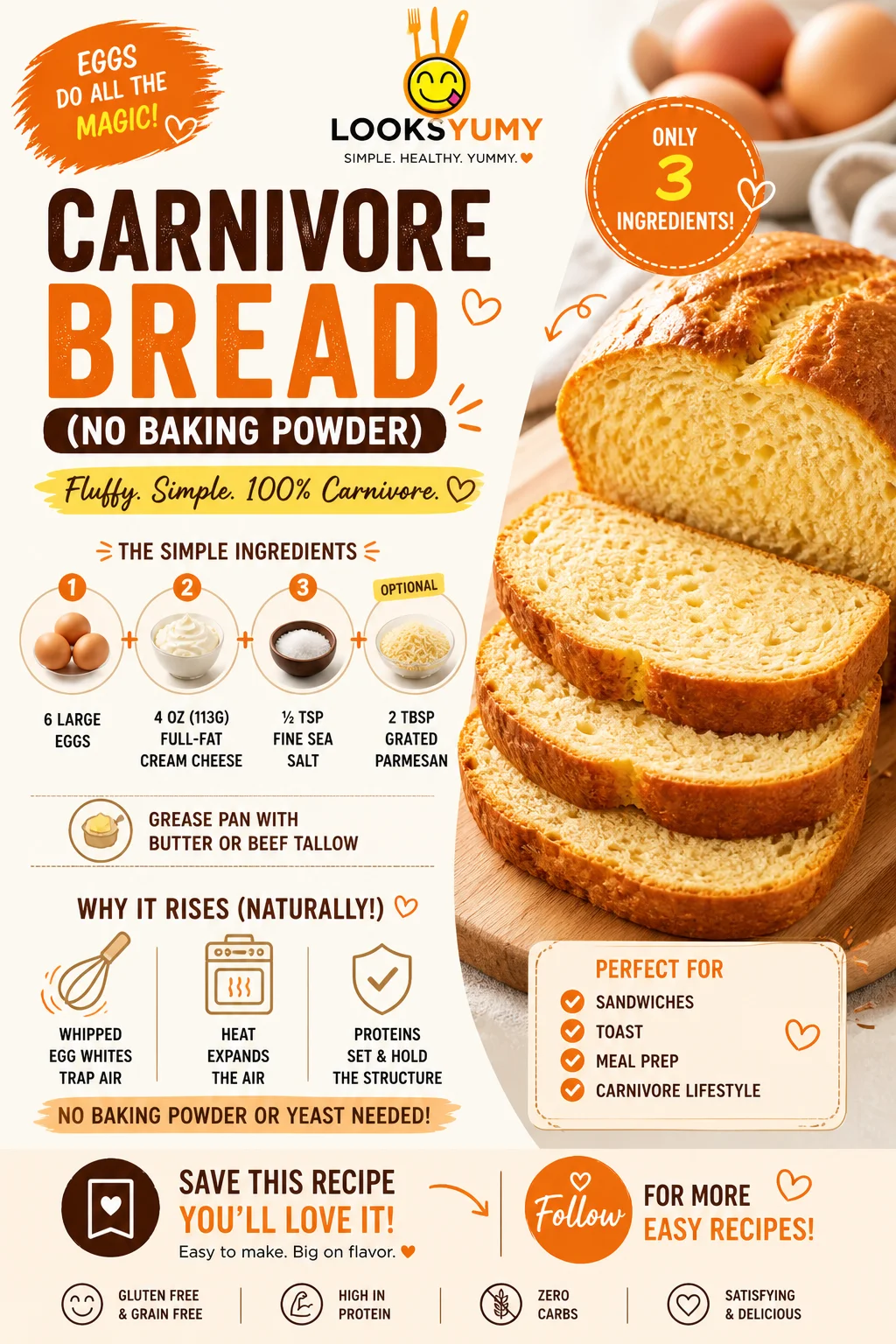
Carnivore bread without baking powder rises using whipped egg whites that trap air and expand in the oven. This natural method replaces chemical leavening and creates a stable, protein-based bread structure with extremely low carbohydrates.
Carnivore bread without baking powder is not a compromise or a workaround. It is a technique.
Every pocket of air, every slice of lift, comes from one ingredient: the egg.
This guide covers the science behind it, the exact method, the mistakes that ruin it, and every variation worth trying — whether you want a dense sandwich loaf or something lighter and fluffier.
Carnivore bread without baking powder is not a compromise or a workaround. It is a technique — and once you understand it, you will never reach for a leavening agent again. Every slice of lift, every pocket of air in the crumb, comes from one ingredient you already have: the egg.
This guide covers the science behind it, the exact method, the mistakes that ruin it, and every variation worth trying — whether you want a dense sandwich loaf or something lighter and fluffier.
Table of Contents
Table of Contents
How does carnivore bread rise without baking powder?
It uses whipped egg whites to trap air. When heated, the air expands and proteins set, creating a natural rise without yeast or baking powder.
This method is also known as egg white bread without baking powder, commonly used in keto and carnivore recipes. By relying on whipped egg whites instead of chemical leavening, the bread rises naturally while staying completely low-carb and grain-free.
What Is Carnivore Bread Without Baking Powder?
Traditional bread creates lift through gas. Yeast produces carbon dioxide over time. Baking powder produces it instantly through a chemical reaction between an acid and a base. Both methods push gas into the dough, the bubbles expand in the oven, and the bread rises.
Carnivore bread without baking powder does none of that. Instead, it uses whipped egg whites — beaten to stiff peaks — as the sole source of lift. When you whip egg whites, you denature the albumin proteins and force air mechanically into the structure, creating a stable foam. That foam, folded gently into the yolk-and-cheese base, carries millions of tiny air pockets into the batter. In a hot oven, those pockets expand. The surrounding proteins set around them as the heat climbs past 144°F, locking the structure in place permanently. The bread rises without a single chemical compound.
This is sometimes called the egg rise technique or natural rise bread in carnivore and keto communities. It is the same principle behind soufflés, chiffon cakes, and génoise — applied here to a fully animal-based recipe.
If you have been working through basic bread recipes and wondering why most of them call for baking powder, the answer is convenience, not necessity. The egg is fully capable of doing that job on its own.
From a scientific perspective, this process relies on protein denaturation and coagulation — Research on egg protein structure and foam stability helps explain how whipped egg whites create lift without chemical leavening (egg protein structure explained).
Carnivore Bread Without Baking Powder: How Eggs Naturally Rise Your Loaf
- Prep Time: 15 minutes
- Cook Time: 30 minutes
- Total Time: 45 minutes
- Yield: 8–10 slices 1x
- Category: Bread
- Method: Baking
- Cuisine: Carnivore / Keto
- Diet: Low Calorie
Description
Carnivore bread made without baking powder using whipped egg whites for natural rise. Zero carb, high protein, and fully animal-based.
Ingredients
– 6 eggs (separated)
– 113g cream cheese
– 1/2 tsp salt
– 2 tbsp parmesan (optional)
Instructions
1. Preheat oven to 325°F (163°C)
2. Separate eggs carefully
3. Beat yolks with cream cheese
4. Whip egg whites to stiff peaks
5. Fold gently in 3 stages
6. Pour into pan
7. Bake 25–30 minutes
8. Cool completely before slicing
Notes
Do not overmix.
Do not open oven early.
Use room temperature ingredients.
Nutrition
- Serving Size: 1 slice
- Calories: 90
- Sugar: 0g
- Sodium: 150mg
- Fat: 7g
- Saturated Fat: 3g
- Unsaturated Fat: 3g
- Trans Fat: 0g
- Carbohydrates: <1g
- Fiber: 0 g
- Protein: 6g
- Cholesterol: 120mg
Why Remove Baking Powder Entirely?
The most immediate reason is compliance. Standard baking powder contains three components: sodium bicarbonate, an acid like cream of tartar or monocalcium phosphate, and a filler — almost always cornstarch. That cornstarch is a plant-derived carbohydrate. Even baking powder labeled grain-free typically substitutes tapioca or arrowroot starch. Either way, you are introducing a non-animal ingredient into what should be a purely animal-based recipe.
Beyond compliance, there is a texture argument. Chemical leavening is fast and somewhat uncontrolled. The gas produces a rapid rise that can outpace the protein structure setting around it, leading to collapse once the bread cools. The result is often a gummy or dense interior despite the appearance of lift. A properly whipped egg white rise is more stable. The air is distributed more evenly, the proteins set gradually, and the crumb holds its shape when sliced.
There is also the question of flavor. Baking powder leaves a faint metallic or bitter aftertaste that many people never consciously notice until they eat bread made without it. Once you bake without it, the egg flavor becomes cleaner, more forward, and more satisfying.
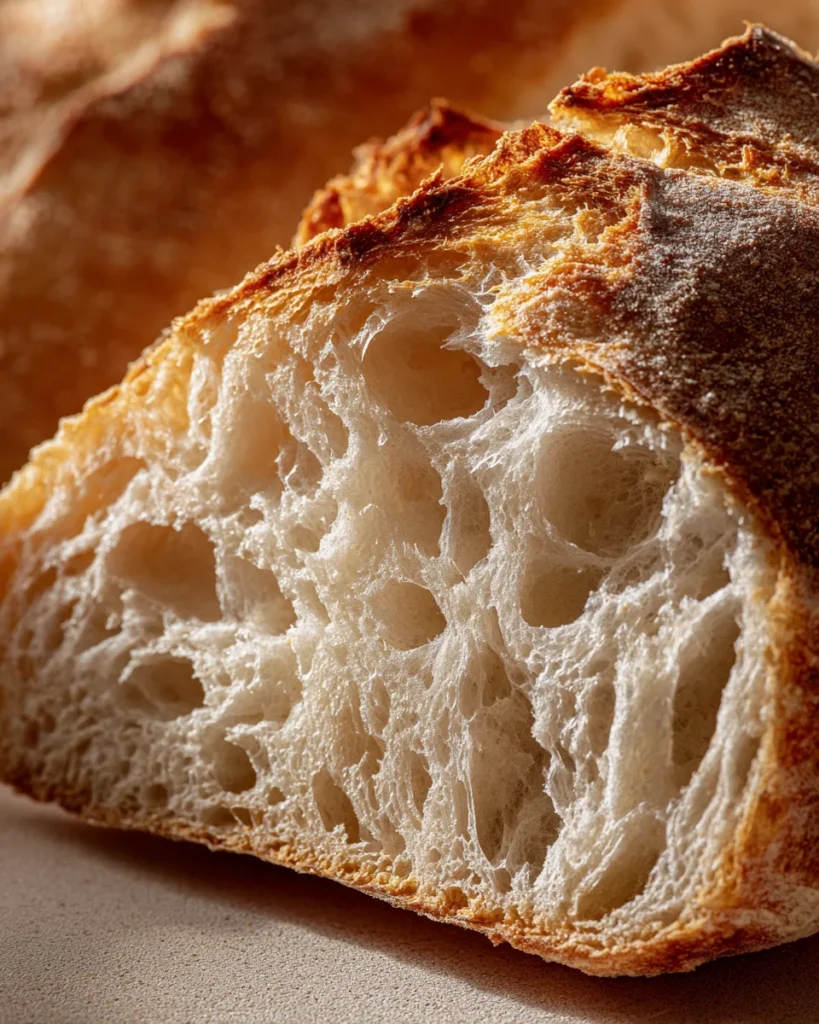
Ingredients
The list is short. Every item earns its place.
6 large eggs, separated. The whites provide lift. The yolks provide fat, richness, color, and binding. Both are essential and neither is optional.
4 oz (113g) full-fat cream cheese, softened to room temperature. This is your base. It adds density, a mild tang, and structural support to the yolk mixture. Cold cream cheese will not blend smoothly — always bring it to room temperature before starting.
½ tsp fine sea salt. Salt enhances flavor and mildly stabilizes the egg white foam by slightly increasing the surface tension of the proteins.
2 tbsp grated Parmesan, optional. Adds depth and extra protein. Does not affect the rise.
Butter or beef tallow to grease the pan. Nothing else.
Optional additions for more advanced versions: collagen peptides for a firmer crumb, mascarpone in place of cream cheese for a richer texture, or rendered beef tallow cooled to just below solidifying as a fully dairy-free alternative to cream cheese.
What makes carnivore bread rise?
- Whipped egg whites trap air
- Heat expands the air in the oven
- Proteins set and hold the structure
No baking powder or yeast is required.
Method — Step by Step
Yield: 8 to 10 slices Prep: 15 minutes Bake: 25 to 30 minutes Pan: Standard 8×4 inch loaf pan
Preheat your oven to 325°F (163°C). Grease the loaf pan with butter or tallow and line with parchment paper if you want clean removal.
Separate your eggs carefully. Use the three-bowl method: crack each egg over a small bowl, move the white to your large mixing bowl, and the yolk to a separate bowl. Even one drop of yolk in the whites will prevent proper foam formation. There is no recovering from yolk contamination — discard that white and start over.
Beat the cream cheese in a medium bowl until completely smooth. Add the yolks one at a time, beating after each addition. Add salt and Parmesan if using. Set the yolk base aside.
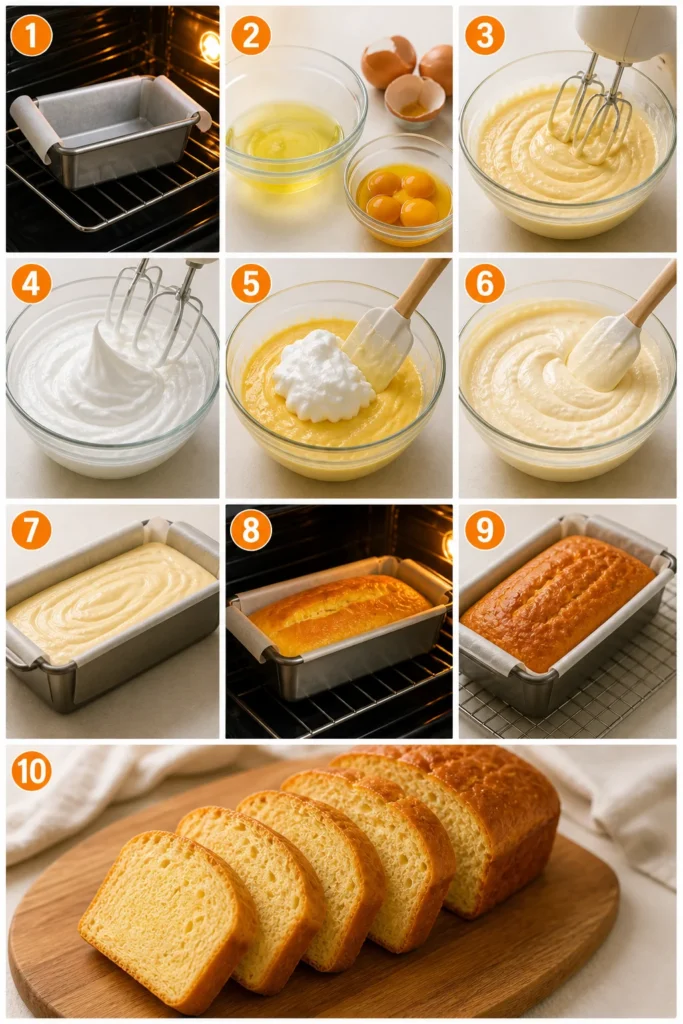
In your clean mixing bowl, whip the egg whites starting on medium speed, then increasing to high. Beat until stiff peaks form — this takes three to five minutes. You know you are done when the foam holds its shape completely, does not slide when you tilt the bowl, and feels firm when you drag a spatula through it.
Fold one-third of the whipped whites into the yolk base using a wide silicone spatula. Move slowly, scooping from the bottom up and turning the bowl as you go. This first addition lightens the dense base and makes it easier to incorporate the rest without deflating everything.
Add the remaining whites in two more additions. Stop folding the moment the batter looks just combined. Small white streaks are fine — they bake out. Twenty to twenty-five strokes total is usually enough. Every additional stroke costs you air bubbles.
Pour the batter into the prepared pan and bake at 325°F for 25 to 30 minutes. The top should be deep golden and the center fully set with no jiggle when you gently shake the pan. Do not open the oven in the first 20 minutes. Cold air at this stage causes the foam structure to contract before the proteins have set.
Cool in the pan for 10 minutes, then transfer to a wire rack. Do not slice until the loaf has cooled completely. The interior is still steaming and soft when it first comes out, and cutting into it early compresses the crumb permanently.
If you want to master the full process step by step, check our complete carnivore bread recipe for more detailed guidance.
Most carnivore bread failures happen long before the loaf enters the oven.
Common Mistakes
Yolk contamination. The most common failure. Fat destroys foam. If yolk gets into the whites, the whites cannot be whipped. Start over.
Under-whipped whites. Soft peaks hold almost no air compared to stiff peaks. If the foam drops off the whisk or slides around the bowl, keep beating. You need genuine stiff peaks — firm, upright, and stable.
Over-folding. Every fold pops bubbles. Stop at just combined, even if the batter looks slightly streaky. More mixing does not mean better results here.
Opening the oven early. The rapid drop in temperature collapses the foam before the proteins can set around it. Set a timer and stay out of the oven for at least 20 minutes.
Slicing while hot. The crumb is fragile while warm. Wait for full cooling or the texture will be dense and gummy rather than light and sliceable.
Cold cream cheese. Lumps from cold cream cheese never fully incorporate into the yolk base. They leave dense pockets in the final loaf. Room temperature is not optional.
Wrong pan size. Too wide and the loaf spreads thin. Too narrow and the center stays raw while the exterior burns. The 8×4 inch standard pan works best for this volume of batter.
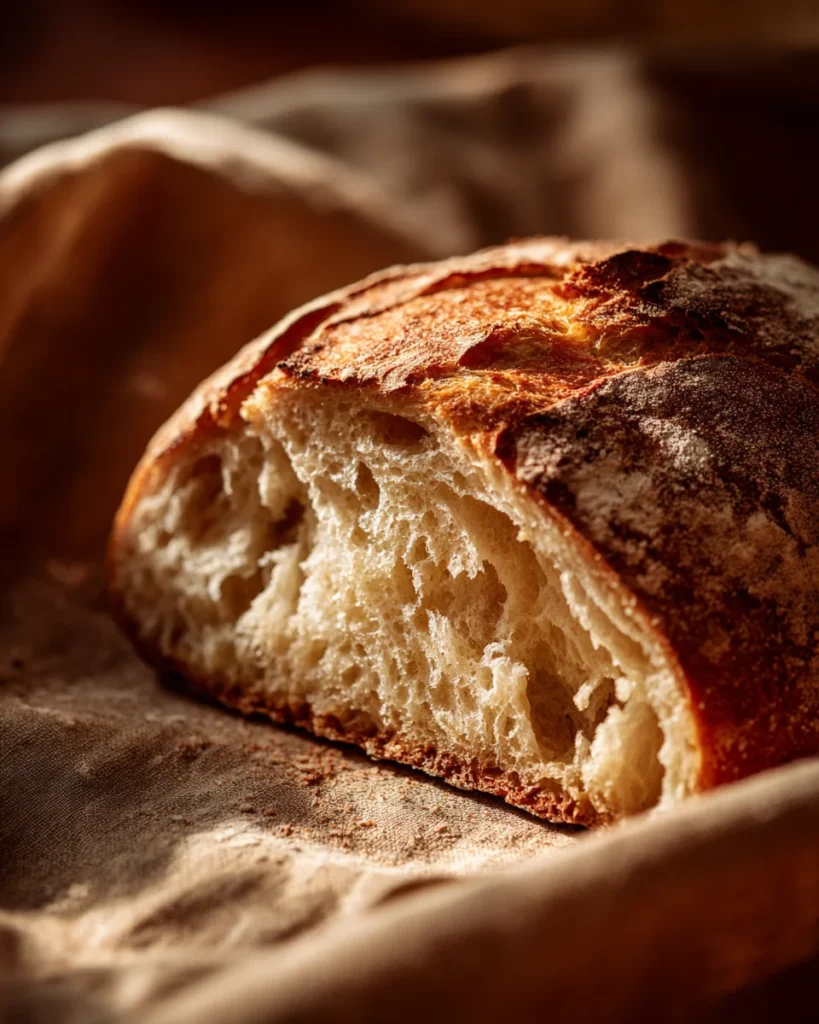
Expert Tips
Chill your mixing bowl and whisk in the freezer for 10 minutes before whipping the whites. Cold surfaces help the proteins form a tighter, more stable foam faster.
Eggs that are a few days old whip more easily than very fresh eggs. Fresh eggs have a stronger protein structure that resists denaturation. If your whites are struggling to reach stiff peaks, your eggs may be too fresh — this is one of the few cases where older is better.
Add one teaspoon of apple cider vinegar to the yolk base before folding in the whites. The acid firms the overall protein structure and gives the finished bread a subtle tang that reads as genuine bread flavor without adding any carbohydrates.
For the densest, most sandwich-worthy result, slightly under-fold the final batter and use a smaller 7×3 inch pan. Bake at 300°F for 35 minutes. The extra structure gives you clean, firm slices that hold fillings without falling apart — the kind of dense bread you can actually build a meal around.
For a lighter, fluffier result, spread the batter in a wider 9×13 inch baking dish and reduce the bake time to 18 to 22 minutes. The larger surface area distributes heat more evenly and produces a more open, airy crumb.
This technique is ideal if you’re aiming for a more structured and firm result, similar to a dense carnivore bread that can hold fillings without falling apart.
Variations
Dense sandwich loaf. Add 2 tablespoons of collagen peptides to the yolk base. Use a 7×3 inch pan and bake at 300°F for 35 minutes. The collagen adds structure and a mild elasticity to the crumb that makes the slices hold together even when loaded with fillings.
Fluffy rounds. Skip the cream cheese entirely. Use 3 eggs, ½ tsp salt, and a small pinch of cream of tartar. Whip, fold, and spread into 4 to 6 rounds on a parchment-lined baking sheet. Bake at 300°F for 25 minutes. These are lighter and more delicate — closer to a bun than a loaf, and the right choice when fluffy bread texture is the goal rather than structural density.
Dairy-free version. Replace the cream cheese with 3 tablespoons of rendered beef tallow, cooled to just below its solidifying point so it is soft but not liquid. It emulsifies into the yolks and provides fat and richness without any dairy. The result is slightly denser with a deeper savory flavor from the tallow.
If you prefer a softer and lighter texture, you can also explore how to make fluffy carnivore bread with a more airy crumb.
Nutritional Profile
Per slice, based on 10 slices from the base recipe:
| Nutrient | Per Slice |
|---|---|
| Calories | ~90 kcal |
| Protein | ~6g |
| Fat | ~7g |
| Net Carbohydrates | ~0.5g |
| Glycemic Index | 0 |
| Sugar | 0g |
There is no flour, starch, or added sugar in this recipe. Because it relies primarily on eggs and dairy, the carbohydrate content remains extremely low compared to traditional bread. The combination of protein and fat also makes the bread more filling and satisfying than many grain-based alternatives.
Frequently Asked Questions
Can carnivore bread actually rise without baking powder?
Yes, and it rises well when the technique is executed correctly. Stiff egg white foam contains enough trapped air to lift the entire loaf during baking. The proteins set around those air pockets as the heat rises, locking the structure permanently. The method requires precision, not chemicals.
Why does my loaf collapse after baking?
Almost always one of three causes: whites not whipped to true stiff peaks, batter over-mixed and air lost during folding, or the oven opened before the proteins had time to set. Revisit each of those steps first before adjusting anything else.
Can I freeze this bread?
Yes. Slice the fully cooled loaf, separate each slice with parchment paper, and freeze in an airtight container for up to three months. Toast directly from frozen at 350°F for five to seven minutes. The texture after toasting is often better than fresh.
What is the difference between natural rise bread and baking powder bread?
Natural rise bread uses mechanically aerated egg white foam as its leavening mechanism. Baking powder bread uses CO2 produced by a chemical reaction. Natural rise tends to produce a more stable, slightly chewier crumb. Baking powder produces a faster but less controlled rise that is more prone to post-bake collapse.
Does carnivore bread without baking powder contain carbohydrates?
This bread contains very few digestible carbohydrates because it relies on eggs and animal-based ingredients instead of flour or starches.
To keep your bread fresh longer, make sure to follow proper carnivore bread storage methods. You can also use this base to create variations like carnivore buns for quick meals.
If your bread has been turning out dense or flat, focus on your egg whipping technique and folding process. Small adjustments can completely transform your results.
Conclusion
Carnivore bread without baking powder comes down to one skill: learning to treat the egg as your leavening agent. Separate carefully. Whip to genuine stiff peaks. Fold with restraint. Everything else follows from those three steps.
The result is a clean, additive-free loaf with extremely low-carb profile, real flavor, and enough structural versatility to go dense and sandwich-worthy or light and fluffy depending on how you adjust the pan and the fold. No chemicals. No plant ingredients. No compromise.
Start with the base recipe. Make it twice. By the third bake you will not need the instructions.