If your carnivore bread keeps failing, it’s not your recipe — it’s the science behind it.
Why does carnivore baking work differently from regular baking?
Carnivore baking science is built on three mechanisms — egg protein coagulation for structure, fat for moisture and tenderness, and chemical leavening for rise. Without flour or starch, heat transforms egg proteins into a solid matrix that holds the bake together. Understanding these reactions is what separates consistently good results from constant trial and error.
Most people think carnivore baking is about following the right recipe. In reality, the problem isn’t the recipe — it’s the science behind it.
Every failure — flat buns, rubbery bread, or collapsed loaves — happens because a specific reaction didn’t occur properly. Once you understand what heat, protein, and fat are doing inside the batter, you stop guessing and start baking with precision.
If you apply these principles correctly, you’ll notice clear improvements in results like fluffy carnivore buns or more stable bread structure.
This is the science behind it, explained clearly and practically. If you’ve already worked through a fluffy buns guide or a general bread guide, this article gives you the underlying reasons why those techniques work — and why they fail when you skip steps.
Table of Contents
Table of Contents
What Carnivore Baking Science Actually Means
Conventional baking science centers on three processes: gluten network formation (from wheat protein), starch gelatinization (from flour carbohydrates), and yeast fermentation (from sugar). Remove all three and you’re left with an entirely different set of reactions.
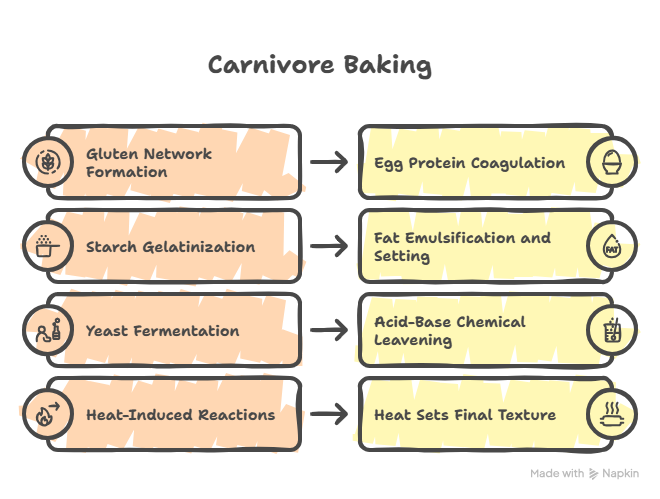
Carnivore baking science replaces all of them with animal-derived chemistry:
- Gluten → replaced by egg protein coagulation
- Starch gelatinization → replaced by fat emulsification and setting
- Yeast fermentation → replaced by acid-base chemical leavening
Each of these works differently, responds to heat differently, and fails differently. Understanding all three is the foundation of baking well without any plant ingredients.
What makes carnivore baking work?
- Egg protein creates structure
- Fat adds moisture and tenderness
- Heat sets the final texture
These three elements replace flour, starch, and yeast.
The Central Role of Egg Protein
Eggs are doing almost everything in a carnivore bake. They are simultaneously the structure, the binder, the moisture source, and — when whipped — the leavening agent. No other ingredient comes close to this level of functional complexity.
Egg white protein: albumin and coagulation
Egg whites contain roughly a dozen different proteins, the most important of which are ovalbumin, ovotransferrin, and ovomucin. In their raw state, these proteins are folded into compact shapes suspended in water.
When heat is applied — starting at around 60°C (140°F) — these proteins begin to unfold, a process called denaturation. As they unfold, they form bonds with neighboring proteins, creating a three-dimensional mesh. This mesh is what gives cooked egg white its solid structure.
This process is known as protein denaturation (explore here).
In a carnivore bake, this coagulation is your gluten. The mesh of denatured egg proteins is what holds the bread together, gives it crumb structure, and prevents it from collapsing when you take it out of the oven.
The critical detail: egg white proteins fully coagulate between 60°C and 80°C (140°F–176°F). Above 85°C (185°F), over-coagulation occurs — the proteins tighten and squeeze out moisture, producing a rubbery, tough crumb. This is the science behind why carnivore bakes need lower oven temperatures than conventional bread.
Egg yolk: lecithin and emulsification
Egg yolk contributes something different and equally important. Yolk contains lecithin, a phospholipid molecule with a water-attracting end and a fat-attracting end. This makes it a natural emulsifier — it holds fat and water together in a stable mixture.
In a carnivore batter, lecithin prevents fat from separating out of the batter during mixing and during baking. Without adequate yolk, fat pools on the surface of the batter, creates an oily crust, and leaves the interior dry. With adequate yolk, fat is distributed evenly through the entire crumb, producing moisture and tenderness throughout.
This is why recipes that use only egg whites — removing the yolk entirely — produce drier, less tender results even when fat is added separately. The lecithin isn’t there to keep the fat in suspension.
The fat-to-protein ratio explained by science
The ratio of fat to egg protein determines the balance between tenderness and structure. Protein creates rigidity; fat disrupts the protein mesh and creates tenderness by physically spacing the protein strands apart.
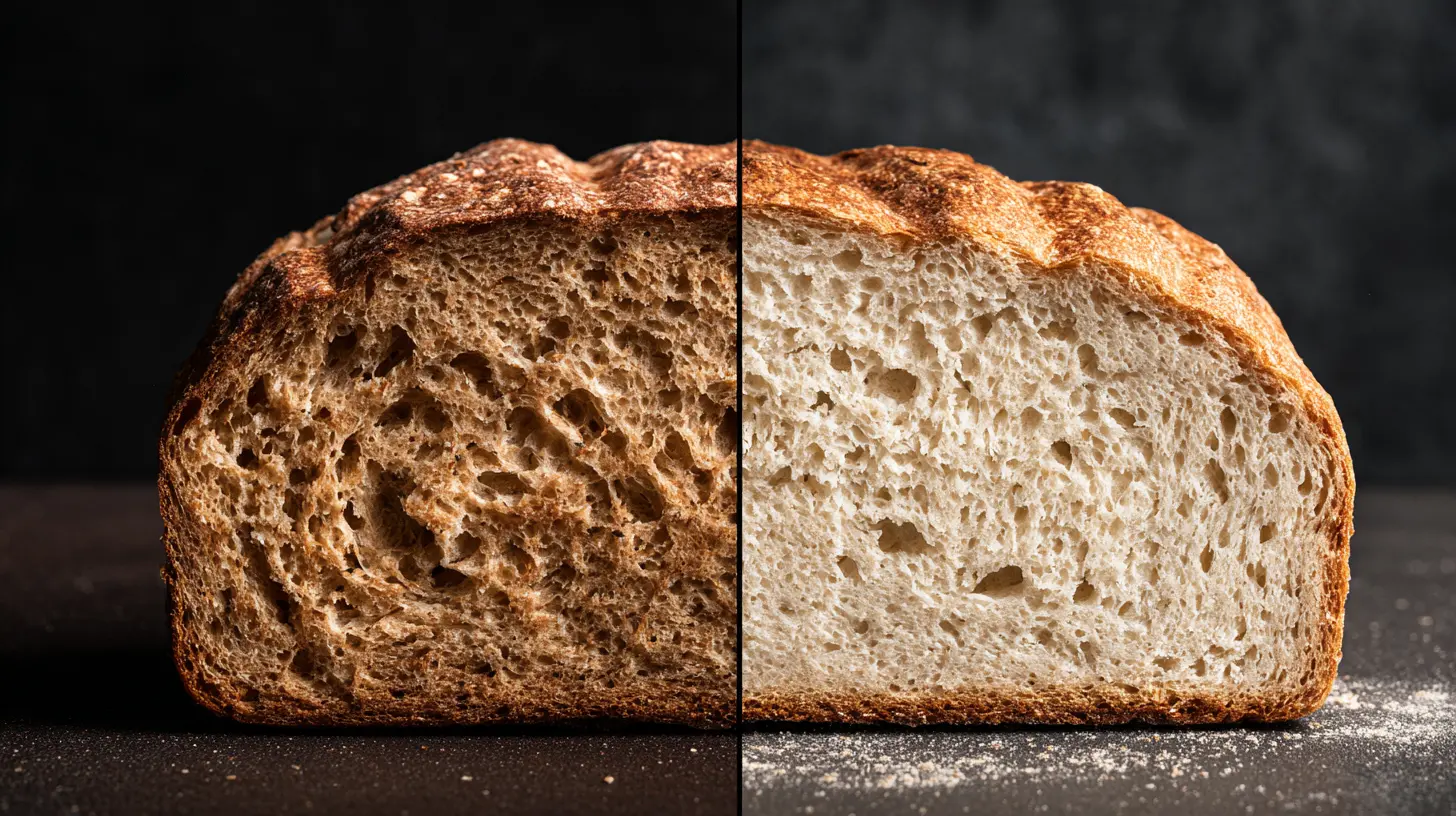
A batter with too much protein relative to fat produces a tight, rubbery crumb — the protein mesh forms densely with nothing to interrupt it. A batter with too much fat relative to protein produces a crumb that can’t hold together — the mesh never forms properly because fat molecules keep interfering with protein bonding.
The empirically reliable ratio is approximately 3 parts fat to 1 part protein by weight. This produces a crumb with enough protein mesh for structure and enough fat for tenderness and moisture.
The Chemistry of Leavening Without Yeast
Conventional bread rises because yeast consumes sugars and produces carbon dioxide gas. Carnivore baking has no sugars for yeast to consume. Rise must come from elsewhere.
Acid-base reaction: cream of tartar and baking soda
The standard carnivore leavening system uses cream of tartar (potassium bitartrate, an acid) and baking soda (sodium bicarbonate, a base). When combined in the presence of moisture, they react to produce carbon dioxide gas:
Potassium bitartrate + Sodium bicarbonate → Carbon dioxide + Water + Potassium sodium tartrate
The carbon dioxide gas is what creates rise. Bubbles form in the batter, expand under heat, and are then trapped by the coagulating egg protein mesh as the bake sets.
The ratio matters precisely. Too much baking soda relative to cream of tartar leaves unreacted base in the batter, which produces a metallic or soapy taste. Too much cream of tartar relative to baking soda leaves unreacted acid, which can interfere with protein coagulation. The reliable ratio is 4 parts cream of tartar to 1 part baking soda.
This reaction begins as soon as the ingredients are moistened, which is why resting your batter longer than 15 minutes wastes leavening power. The gas has already been produced and escaped before the batter reaches the oven.
Mechanical leavening: whipped egg whites
Whipping egg whites introduces a different leavening mechanism — purely mechanical rather than chemical. Whipping denatures the surface proteins of the egg white, which then wrap around air bubbles and stabilize them. The result is a foam where protein films hold millions of tiny air pockets.
When this foam is folded into batter and placed in a hot oven, two things happen. First, the air inside each bubble expands under heat, creating lift. Second, the egg proteins surrounding each bubble coagulate and set, locking the expanded structure in place.
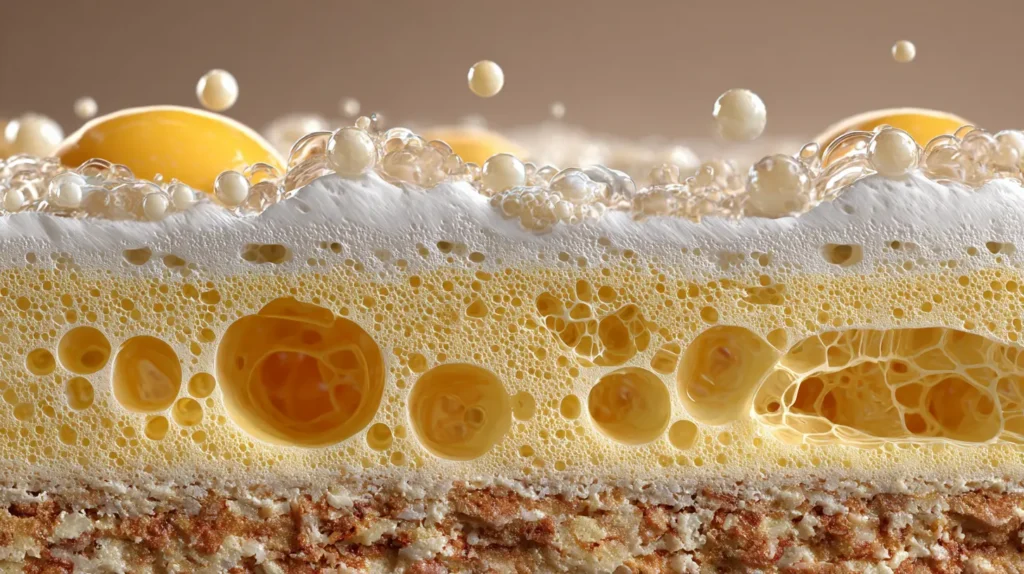
This is a more delicate leavening mechanism than chemical leavening because the air bubbles can be destroyed by overmixing, by fat contamination of the whites before whipping, or by folding too aggressively. A single drop of egg yolk in the whites prevents proper foam formation — lecithin in the yolk interferes with the surface protein films.
Why carnivore bakes don’t rise as high as wheat bread
Even with perfect leavening, carnivore bakes rise less than wheat bread. The reason is structural. In wheat bread, the gluten network stretches as gas bubbles expand — it has elasticity. Egg protein coagulation produces a more rigid matrix. It can expand somewhat, but it doesn’t stretch. This limits how much the bake can rise before the structure sets.
This is a fundamental property of the chemistry, not a technique failure. Expecting carnivore bread to double in size like a yeast-leavened wheat loaf is expecting a different chemical reaction to occur.
How Heat Transforms the Batter
Heat is the final stage and the point at which all the preceding chemistry either succeeds or fails. Understanding what happens at different temperatures explains most baking failures.
Temperature timeline inside a carnivore bake
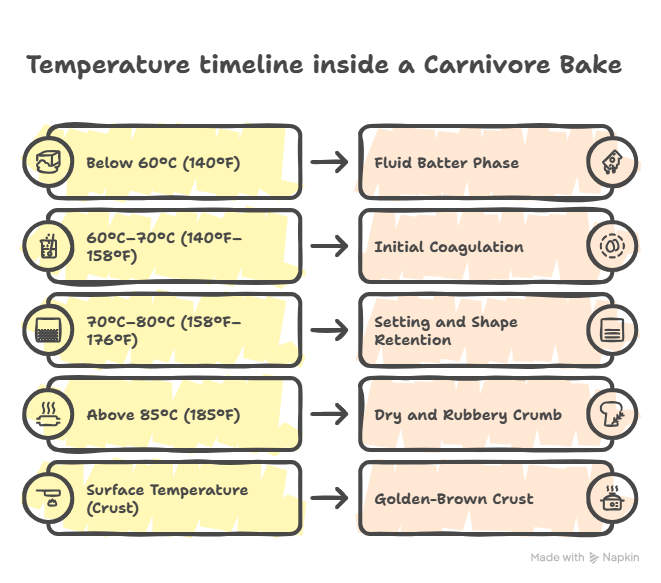
Below 60°C (140°F): Fat melts if it hasn’t already. The batter becomes more fluid before it sets. This is why carnivore bakes sometimes look worse at the 10-minute mark than they did going in — they’re liquid before they’re solid.
60°C–70°C (140°F–158°F): Egg white proteins begin denaturing. The first coagulation occurs. The batter starts to lose its liquid character. Ovotransferrin sets first in this range.
70°C–80°C (158°F–176°F): Ovalbumin, the dominant egg white protein, fully coagulates. This is the critical window. The structural mesh forms completely. The bake sets and holds its shape.
Above 85°C (185°F): Over-coagulation begins. Proteins tighten, expelling moisture. The crumb becomes dry and rubbery. This is the temperature range produced by oven settings above 175°C (350°F) in a carnivore bake, because the small mass of the bake heats through quickly.
Surface temperature (crust): The surface reaches much higher temperatures than the interior — often 150°C–180°C (300°F–356°F). At these temperatures, the Maillard reaction occurs between amino acids in the egg proteins and any remaining traces of reducing sugars (even the tiny amounts naturally present in cream cheese or butter). This produces the golden-brown color on the crust. It’s a much less dramatic Maillard reaction than in wheat bread, which is why carnivore crusts brown more lightly.
What temperature is best for carnivore baking?
- 150–165°C for even cooking
- Above 175°C = rubbery texture risk
- Internal temp: 75–80°C
Lower heat creates better structure.
Why oven temperature matters more in carnivore baking
In conventional baking, the mass of flour and starch in the dough acts as a heat buffer — it absorbs heat and distributes it relatively slowly. Carnivore batter has no such buffer. The egg-and-fat batter heats through quickly, which means the interior reaches critical temperatures faster than you’d expect.
This is the scientific basis for the consistent recommendation to bake carnivore products at 150°C–165°C (300°F–325°F). At these temperatures, the interior reaches the 70°C–80°C coagulation zone while the surface Maillard browning stays controlled. At higher temperatures, the surface over-browns and may burn before the interior has fully set.
The steam factor
As the batter heats, water trapped in the egg whites and cream cheese converts to steam. This steam expands and contributes to rise alongside the carbon dioxide from leavening. In an oven that’s too hot, this steam escapes too quickly before the protein mesh can set around the expanded bubbles — the bake rises briefly and then collapses.
In a correctly tempered oven, steam expansion is gradual, matching the rate at which the protein mesh is coagulating and setting. The bake rises slowly and stays risen.
The Science of Common Failures
At its core, carnivore baking is not about memorizing recipes. It is about understanding how protein, fat, air, and heat behave together inside the oven.
Rubbery texture: Over-coagulation from excessive heat or too much egg white protein relative to fat. The protein mesh formed too densely and expelled moisture. Fix: lower oven temperature; increase fat ratio.
Flat, dense result: Leavening failed — either the chemical reaction exhausted before baking, the whipped whites were deflated, or the oven was too cold to fully expand the gas bubbles before setting. Fix: bake immediately after resting; fold whites more carefully; verify oven temperature.
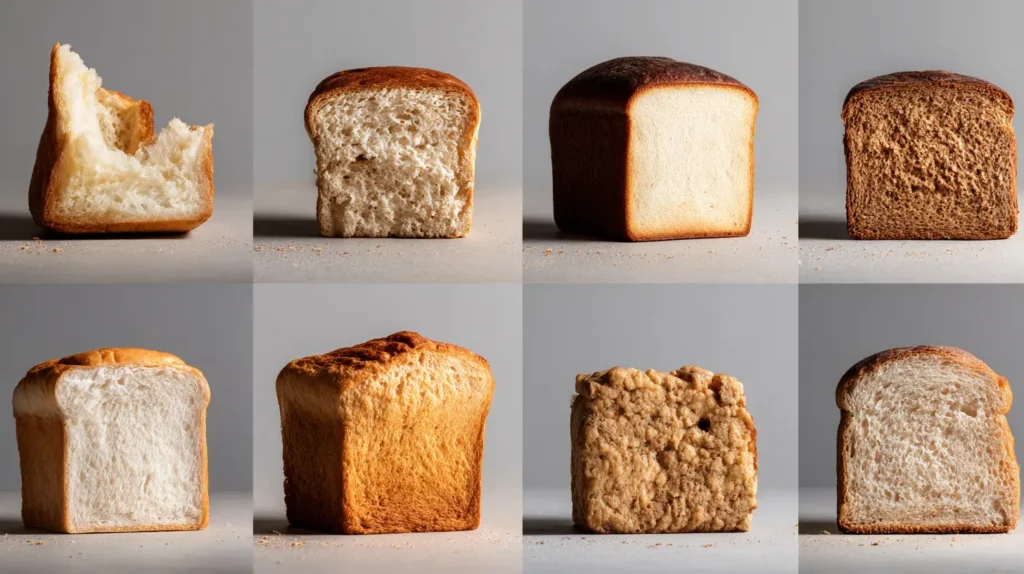
Wet, gummy center: The internal temperature never reached 75°C–80°C. The protein mesh didn’t fully coagulate. The bake looks done on the outside but is raw inside. Fix: use smaller pan; extend bake time; use an instant-read thermometer — internal temperature should reach 75°C before removing.
Collapsed after cooling: The protein mesh set correctly but wasn’t strong enough to support the structure as steam escaped during cooling. Usually caused by insufficient egg protein relative to the volume of the bake. Fix: reduce pan size; increase egg protein slightly; cool slowly in a slightly open oven.
Crumbly, no cohesion: The protein mesh formed but is too widely spaced to hold together — typically caused by too much fat relative to protein. The fat molecules separated the protein strands too far apart to bond. Fix: reduce fat ratio slightly; ensure adequate whole eggs.
Many of these problems are explained further in our complete bread guide, especially when dealing with dense or collapsed results.
Expert Tips Grounded in the Science
- Use an instant-read thermometer. The interior of a carnivore bake is done when it reaches 75°C–80°C (167°F–176°F). Visual cues from the surface are unreliable because the surface temperature is always much higher than the interior.
- Never open the oven before the protein sets. The coagulation window between 60°C and 80°C is when the structure is most fragile. Opening the oven drops temperature suddenly, steam escapes, and the partially set mesh collapses. Wait until at least 75% of the bake time has passed.
- Whip whites in a completely clean, dry bowl. A single trace of fat — including residue from previous use — prevents the surface proteins from forming stable films around air bubbles. The science is unforgiving here.
- Let melted fat cool before adding to batter. Hot fat above 60°C begins to denature egg proteins on contact during mixing, before the batter reaches the oven. You lose structure before baking even starts.
- Rest batter for 5–10 minutes, not longer. The acid-base leavening reaction begins immediately on mixing. Five to ten minutes allows full hydration of proteins and partial gas formation. Beyond 15 minutes, significant leavening is lost.
- Cool on a wire rack, not in the pan. Steam escaping from the bottom of the bake needs somewhere to go. Cooling in the pan traps steam and softens the base, producing a wet, gummy bottom crust.
How This Science Applies Across Carnivore Bake Types
The same principles apply differently depending on what you’re making. Understanding this explains the technique differences across a complete buns guide versus a bread guide versus pancakes.
Buns require the highest protein-to-volume ratio because they need to hold a dome shape unsupported. The protein mesh must be strong enough to resist the pull of gravity on the dome without a pan wall to lean on. More whole eggs, higher fat for tenderness, and whipped whites for mechanical lift.
For more practical techniques, you can also follow a detailed buns guide to understand how structure and shape behave in smaller bakes.
Bread loaves have pan support, so the protein mesh doesn’t need to be as strong laterally. The challenge is even heat distribution through a larger mass. Lower temperature and longer bake time allow the interior to reach coagulation temperature without the surface over-browning.
Pancakes require the least structural protein because they’re thin and supported by the pan throughout cooking. The protein mesh only needs to set enough to allow flipping without tearing. Low heat and a short cook time are sufficient — over-cooking a pancake means over-coagulation and rubbery texture within seconds.
Crackers require complete moisture evaporation in addition to protein coagulation. The goal is a dry, rigid matrix. This requires longer baking at lower temperature — essentially desiccating the protein mesh after it has set.
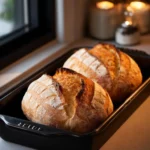
Why Carnivore Baking Fails (Egg, Fat & Heat Secrets Explained)
- Prep Time: 15 minutes
- Cook Time: 30 minutes
- Total Time: 45 minutes
- Yield: 6 slices 1x
- Category: Bread
- Method: Baking
- Cuisine: Carnivore / Keto
- Diet: Low Calorie
Description
Carnivore bread recipe focused on achieving the perfect dough consistency using eggs and fat for a stable, fluffy texture.
Ingredients
4 eggs
100g cream cheese
50g butter
1/4 tsp salt
Instructions
Preheat oven to 165°C
Separate eggs and whip whites
Mix yolks with fat ingredients
Fold gently
Adjust consistency (not too runny or thick)
Bake 25–30 minutes
Cool before slicing
Notes
Texture is key.
Avoid overmixing.
Adjust fat ratio if needed.
Nutrition
- Serving Size: 1 slice
- Calories: 100
- Sugar: 0g
- Sodium: 150mg
- Fat: 8g
- Saturated Fat: 4g
- Unsaturated Fat: 3g
- Trans Fat: 0g
- Carbohydrates: <1g
- Fiber: 0g
- Protein: 7g
- Cholesterol: 140mg
FAQ
What is the science behind carnivore baking?
Carnivore baking replaces gluten with egg protein coagulation, starch gelatinization with fat emulsification, and yeast fermentation with acid-base chemical leavening. Heat denatures egg proteins between 60°C and 80°C, forming a structural mesh that holds the bake together. Understanding these three mechanisms explains every success and failure in animal-based baking.
Why do eggs provide structure in carnivore baking?
Egg white proteins unfold and bond together when heated, creating a three-dimensional mesh that functions like gluten. This mesh is the structural skeleton of the bake. Egg yolk adds lecithin, an emulsifier that keeps fat distributed evenly through the crumb, preventing dryness and separation.
Why do carnivore bakes become rubbery at high temperatures?
Egg proteins tighten and expel moisture when overheated. Once the internal temperature rises too high, the protein mesh becomes dense and rubbery instead of light and tender.
Why must carnivore bakes be cooked at lower temperatures?
Egg proteins over-coagulate above 85°C, squeezing out moisture and producing rubbery texture. Without the heat-buffering mass of starch, carnivore batter heats through quickly. Lower temperatures (150°C–165°C) allow the interior to reach the correct coagulation zone (70°C–80°C) without the surface burning or the proteins tightening into a rubbery mass.
Why do carnivore bakes collapse after coming out of the oven?
Collapse usually means the protein mesh set correctly but lacks the strength to support the structure as steam escapes during cooling. This happens when the egg protein content is too low relative to the volume of the bake, or when the bake is removed before the interior fully reaches coagulation temperature. Use a thermometer to confirm 75°C internally before removing from the oven.
If your baking keeps failing, stop changing recipes and start controlling these three variables: protein, fat, and heat. That’s where real results come from.
Most carnivore baking failures are chemistry problems disguised as recipe problems.
Conclusion
Carnivore baking science comes down to understanding three things: egg proteins build structure through coagulation, fat creates tenderness and moisture through emulsification, and leavening creates rise through carbon dioxide production. Heat orchestrates all three — and getting the temperature right is what determines whether the reactions produce a good result or a failed one.
Once you understand why each step matters at the molecular level, the techniques stop feeling arbitrary. You rest the batter because the leavening reaction needs time. You bake at lower temperatures because egg proteins over-coagulate above 85°C. You cool on a wire rack because trapped steam softens the structure.
The science doesn’t change between recipes. Master it once and it applies everywhere — whether you’re refining your buns guide approach, troubleshooting a dense loaf, or experimenting with a new format entirely.