
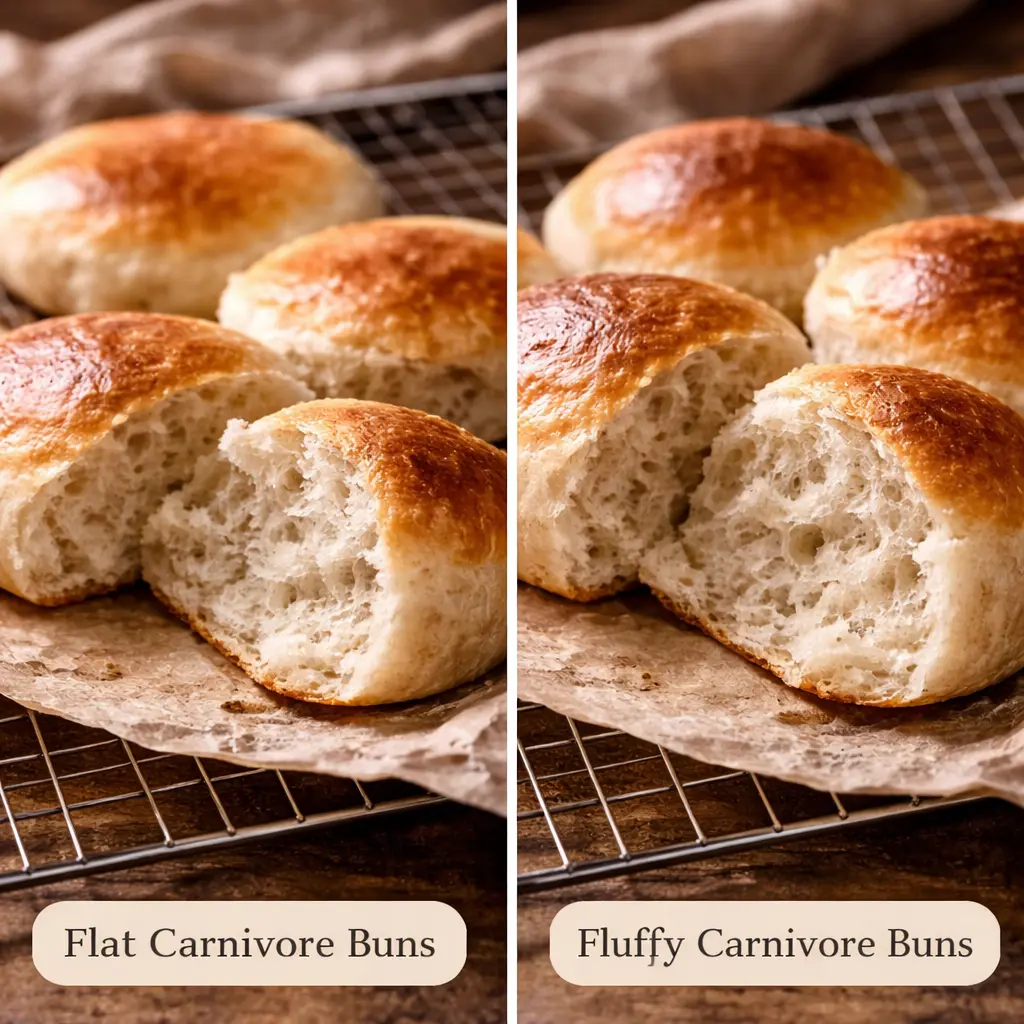
Carnivore buns turn flat when egg whites lose their structure before baking sets the shape. The most common causes include overmixing, incorrect ratios, and unstable oven temperature. The good news: none of these are random — every cause has a direct, repeatable fix.
Table of Contents
Table of Contents
Why Carnivore Buns Are Flat (Quick Answer)
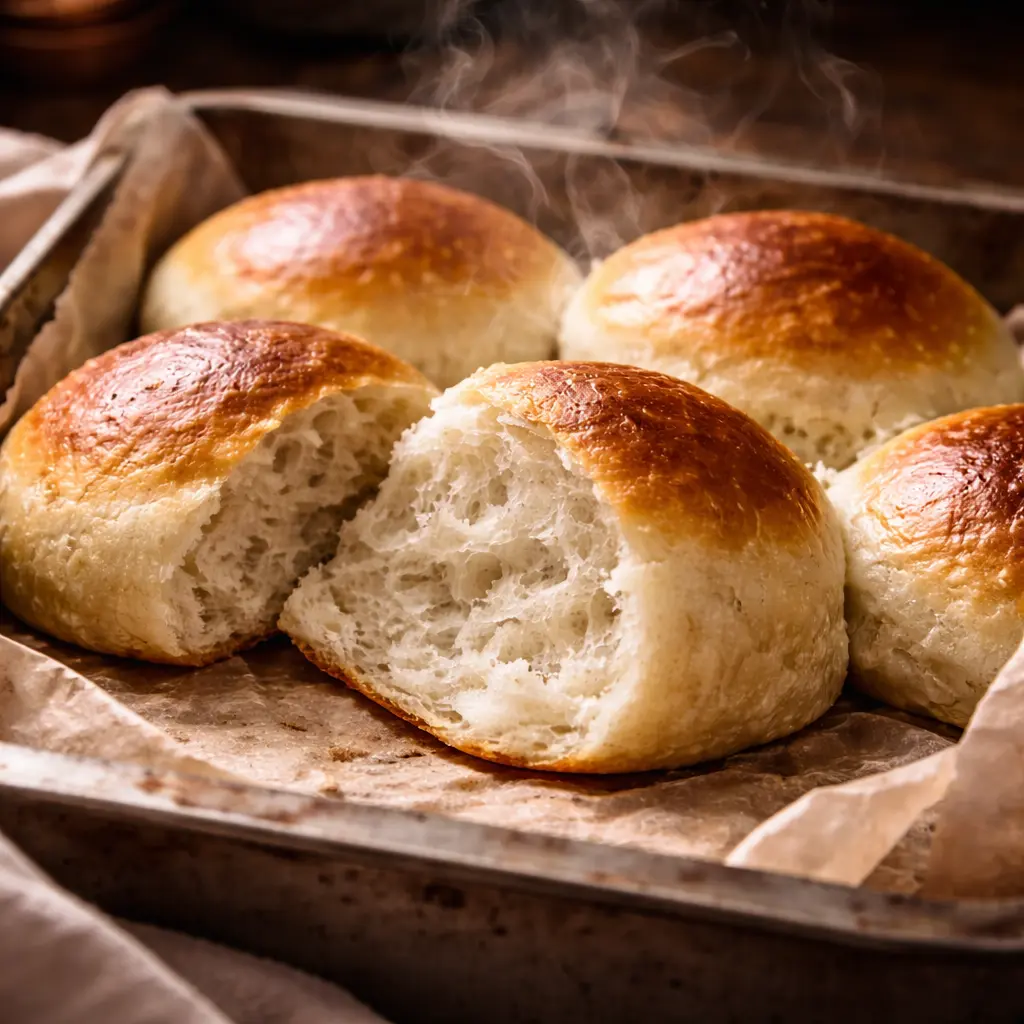
Flat carnivore buns always come back to one core problem: the egg foam collapsed before the baking heat could lock the structure in place.
Without gluten or yeast, egg whites are doing every bit of the lifting. When that foam is weak, destroyed, or overwhelmed by a heavy batter, the buns spread outward instead of rising upward — and no amount of extra baking time will fix what was already lost before the pan went in.
The five most common causes at a glance:
- Weak egg white foam — whites not whipped to true stiff peaks
- Overmixing the batter — air destroyed during folding
- Incorrect ingredient ratios — batter too heavy to rise
- Low or unstable oven temperature — structure never sets properly
- Opening the oven too early — instant deflation from cold air
The #1 Reason Buns Collapse
Carnivore buns collapse mainly because egg whites lose their air structure due to improper whipping or overmixing. This is the root cause behind almost every flat bun complaint — and it happens at one of two moments: before the batter goes in the oven, or in the first few minutes of baking.
| Issue | Result |
|---|---|
| Under-whipped whites | No lift — buns spread flat immediately |
| Over-whipped whites | Dry, grainy, unstable foam that breaks down |
| Broken foam during folding | Flat buns with dense, compact crumb |
Under-whipped is the most common. Soft peaks look deceptively ready — the batter seems light and airy. But soft peak foam can’t hold the weight of cream cheese through folding, shaping, and the first minutes in the oven. By the time the heat reaches the center, the structure is already gone.
Over-whipped whites are less common but just as damaging. When whites go past stiff peaks into a dry, clumpy foam, the protein bonds are over-tightened and the bubbles become brittle — they shatter during folding instead of stretching.
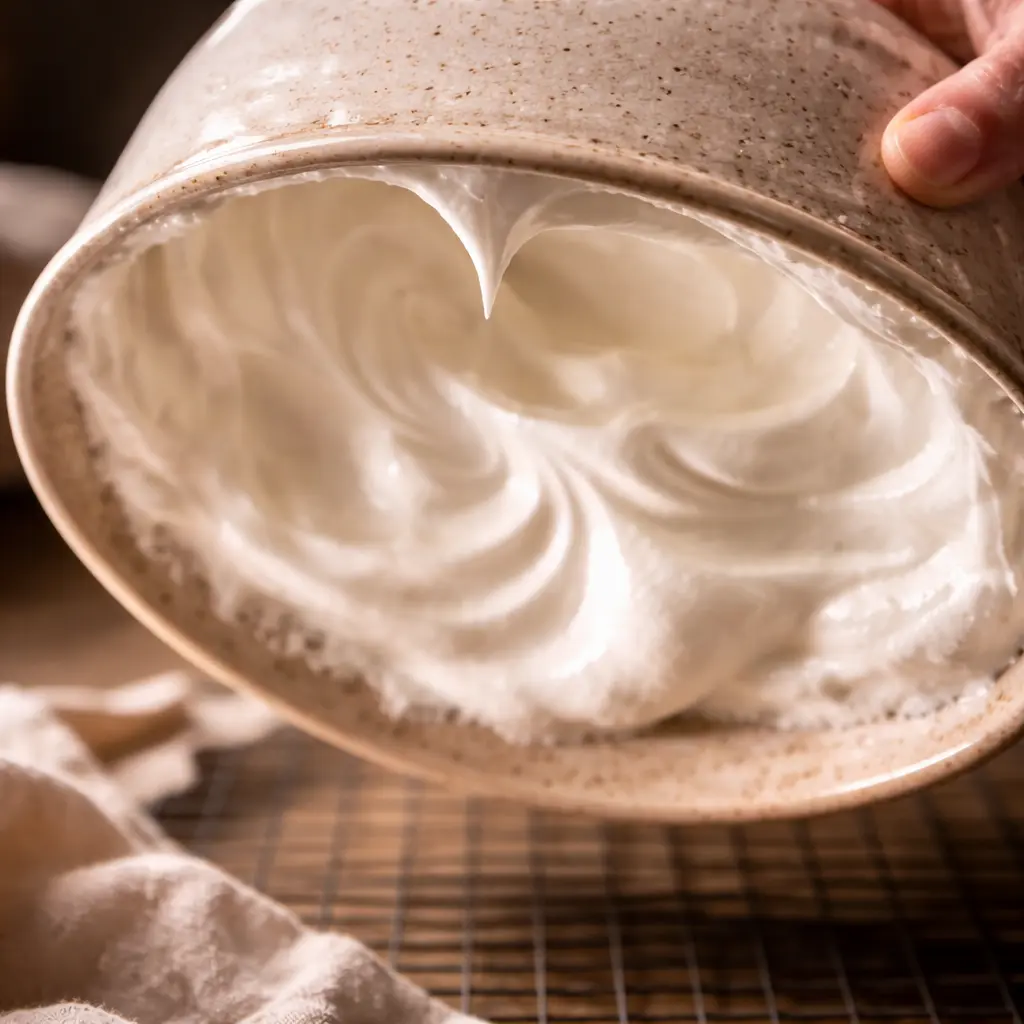
The target is glossy, smooth stiff peaks that stand straight up when you lift the beater. That’s the only stage where the foam is strong enough and flexible enough to survive the rest of the process.
Overmixing vs. Undermixing
Both overmixing and undermixing destroy the structure needed for fluffy buns — they just do it in different ways, and both produce the same flat, disappointing result.
| Mixing Problem | Effect |
|---|---|
| Overmixing | Pops air bubbles → dense, flat buns |
| Undermixing | Uneven pockets of white → uneven rise, then collapse |
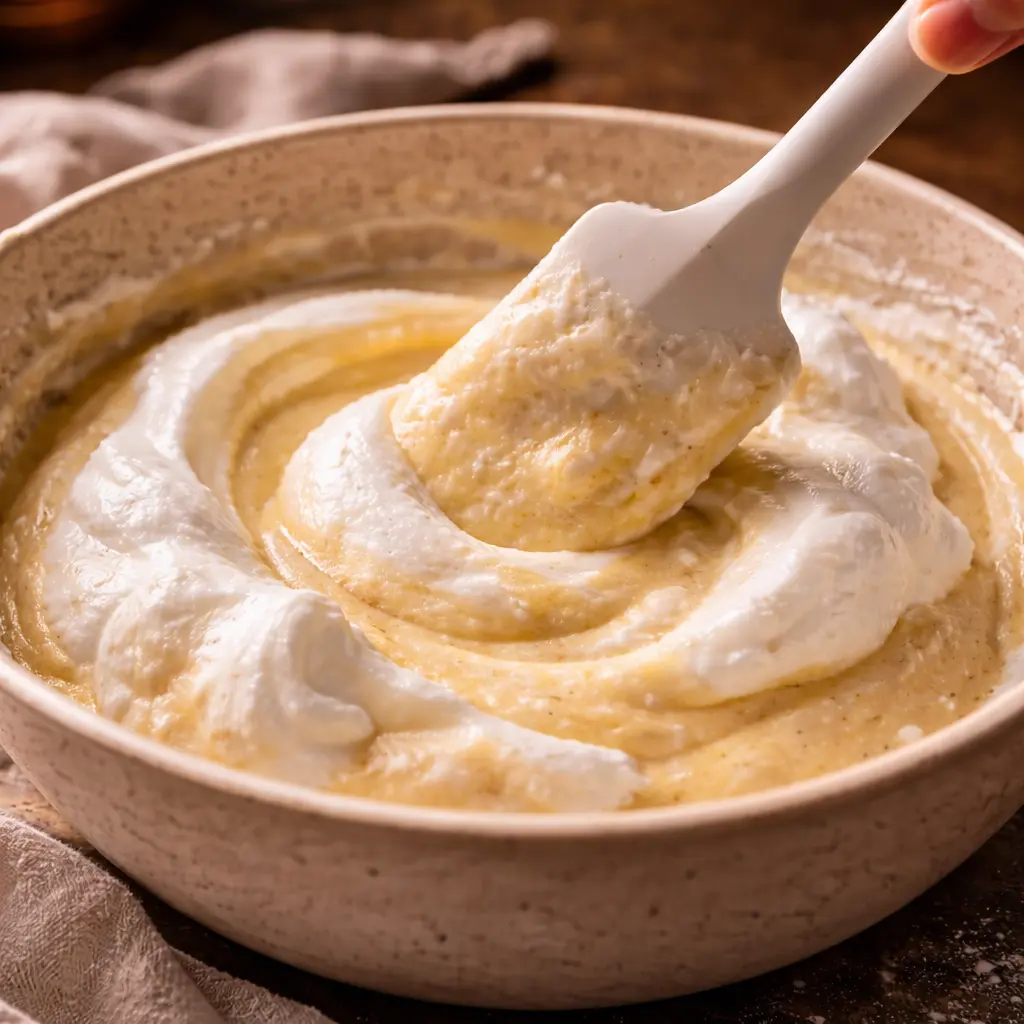
Overmixing is by far the more common mistake. Once whites are added to the yolk-cream cheese base, every extra fold pops bubbles that took minutes of whipping to create. The batter might still look airy — but the structural air is already gone. The buns go into the oven looking promising and come out flat.
Undermixing creates a different problem. Pockets of pure egg white cook at a different rate than the rest of the batter. The bun rises unevenly, develops weak spots, and those spots collapse as the bun cools — resulting in a sunken top or lopsided shape.
The correct approach: fold in thirds using a wide silicone spatula, cutting down the center and sweeping under. Stop the moment no large white streaks remain — a few faint streaks are perfectly fine. Aim for 12–15 total folds across all three additions.
Wrong Ingredient Ratios
Too much fat or too few eggs makes the batter too heavy to rise. The egg foam has a finite lift capacity — push it past that limit with extra cream cheese or add-ins, and the buns will spread wide instead of rising tall.
| Ratio Problem | Outcome |
|---|---|
| Too much cream cheese | Batter spreads outward, no upward rise |
| Too few eggs | Weak structure that can’t hold shape |
| Extra add-ins without adjusting | Heavy batter the foam can’t support |
The reliable base ratio: 3 large eggs to 2–3 oz (60–85g) of full-fat cream cheese. This is the calibrated balance point where the egg foam has just enough strength to lift the batter and hold it through baking.
Go beyond 3 oz of cream cheese and the batter becomes too dense. The whites are working harder than they’re capable of — and the buns pay for it by going flat.
Every extra ingredient — seeds, shredded cheese, spices, protein powder — adds weight to that batter. If you want to experiment with add-ins, add one extra egg white per significant addition to compensate for the increased load.
Oven Temperature Mistakes
Incorrect temperature prevents the egg structure from setting at the right time — either too early (trapping density inside) or too late (allowing the foam to collapse before it solidifies).
| Temperature Issue | Result |
|---|---|
| Too low (under 290°F / 143°C) | Foam collapses before protein sets |
| Too high (over 375°F / 190°C) | Outside sets and browns while inside sinks |
| Opening oven early | Instant deflation from cold air rush |
The sweet spot is 300–320°F (150–165°C). At this range, the heat penetrates evenly — the inside rises and sets at roughly the same rate as the outside. The bun has time to reach its full height before the crust locks it in place.
Too low and the foam runs out of strength before the proteins cook enough to hold the shape. The bun rises slightly, then slowly sinks back down as the unbaked center collapses under its own weight.
Too high and the opposite happens: the outside bakes and browns within the first 10 minutes while the inside is still raw foam. When you pull the buns out, the uncooked center contracts as it cools — and the bun caves in from the middle.
Opening the oven in the first 20 minutes is one of the fastest ways to ruin a batch. Even a brief drop in temperature causes immediate deflation. Set a timer, trust the process, and don’t open the door until at least the 22-minute mark.
How to Fix Flat Carnivore Buns (Step-by-Step)
To fix flat carnivore buns, stabilize egg whites, control mixing, and bake at a consistent temperature. Follow these steps in order — each one protects the air structure that the previous step built.
Step 1 — Clean your tools completely Wipe the mixing bowl and beaters with white vinegar on a paper towel. Fat residue — even invisible amounts — prevents egg whites from whipping. This takes 20 seconds and eliminates one of the most common hidden causes of flat buns.
Step 2 — Use room temperature egg whites Separate eggs cold (less yolk breakage), then let whites sit at room temperature for 20–30 minutes. Room temperature whites whip to nearly triple the volume of cold whites — this single step can transform your results.
Step 3 — Whip to true stiff peaks Add ⅛ tsp cream of tartar before whipping. Start on medium for 60 seconds, then increase to high. Stop when peaks stand straight up, the foam is glossy and smooth, and the bowl can be turned upside down without anything moving.
Step 4 — Fold gently — never stir Use a wide silicone spatula. Add whites in three additions. Cut down the center, sweep under, fold over, rotate the bowl. 12–15 total folds. Stop with faint white streaks still visible — they’ll incorporate during shaping.
Step 5 — Use the correct ratio 3 large eggs to 2–3 oz cream cheese. No exceptions until you’ve mastered the base. Every deviation adds risk.
Step 6 — Bake at 300–320°F (150–165°C) Fully preheat for at least 15 minutes before the buns go in. Use an oven thermometer if possible — most ovens run 15–25°F hotter or cooler than the dial shows.
Step 7 — Don’t open the oven early Set your timer and walk away. No peeking until at least 22 minutes in. The buns need uninterrupted, stable heat to rise and set completely.
| Problem | Fix |
|---|---|
| Flat buns | Improve whipping — reach true stiff peaks |
| Dense buns | Fold more gently, reduce fold count |
| Spreading batter | Adjust ratio — less cream cheese |
| Collapse after baking | Stabilize oven heat, don’t open early |
Quick Checklist Before Baking
Run through this before every batch:
- Bowl and beaters wiped with white vinegar — grease-free
- Egg whites at room temperature for 20+ minutes
- Cream of tartar added to whites before whipping
- Whites whipped to stiff, glossy peaks — not soft, not grainy
- Batter folded in thirds with a wide spatula
- Stopped folding while slightly streaky
- Oven fully preheated to 300–320°F (150–165°C)
- Oven door staying closed for first 22 minutes minimum
- Buns portioned with a scoop — not a spoon
Top 5 Causes of Flat Carnivore Buns
For a quick reference, these are the five causes that account for the vast majority of flat bun problems:
- Weak egg white foam — the most common and most impactful cause
- Overmixing — destroying air that was already built
- Wrong ratios — too much fat for the foam to support
- Temperature instability — heat too low, too high, or interrupted
- Early oven opening — cold air causes immediate, irreversible collapse
FAQ
Why are my carnivore buns flat?
Egg whites lost their structure — either from under-whipping, over-whipping, or overmixing during folding. The foam collapsed before the oven heat could set the shape permanently.
Why didn’t my buns rise?
Most likely a combination of weak foam and incorrect baking temperature. If the whites weren’t at stiff peaks and the oven wasn’t fully preheated, the buns never had a chance to rise before the structure gave out.
Can I fix flat buns after baking?
No. Once baked, the structure is permanent. Flat buns stay flat. The fix has to happen before the batter goes into the oven — specifically at the whipping and folding stages. Use a flat batch as breadcrumbs and start fresh with better technique.
Keep Going with Carnivore Buns
Once you’ve fixed the flat bun problem, the next step is expanding into variations. For a richer, more indulgent result with a brioche-style crumb, the carnivore brioche bun recipe uses extra yolks and a slightly different folding method to build an even more luxurious texture.
If you’re building buns specifically for burgers and need something that holds up under heavy fillings without collapsing, burger-ready carnivore buns are shaped and baked differently to give you a sturdier base without sacrificing the soft interior.
Conclusion
Flat carnivore buns are not a recipe failure — they’re a technique failure. The recipe is almost never the problem. Egg white handling, mixing discipline, and oven management are where flat buns are made or prevented.
Get the foam right. Fold it gently. Bake it at the right temperature without interruption.
Do those three things and flat buns become a problem you only had once. Your buns will rise tall, hold their shape after cooling, and have the light, airy texture that makes carnivore baking genuinely worth doing.